
Chinese leader Xi Jinping’s latest claim of selflessly trying to save the world has taken the form of a planetary defense system that, not surprisingly, can also be used to target the United States and its allies, posing a threat to national security.
In recent weeks, China has announced a series of steps related to planetary defense, including plans for an asteroid early-warning network and further details on a kinetic-impact asteroid deflection mission currently scheduled for 2027.
These build on a longer track record: China joined the United Nations’s International Asteroid Warning Network in 2018, named planetary defense an official policy priority in its 2021 Space White Paper, and established the Deep Space Exploration Laboratory in 2022 under Wu Weiren, chief designer of China’s Lunar Exploration Program.
Beijing’s motivations extend beyond the low statistical probability of an asteroid strike. The program lets China build its reputation as a comprehensive space power, a goal Xi has described as an “eternal dream.”
It also fits a broader pattern in Xi’s rhetoric: in a 2017 speech at the U.N. Office in Geneva, transcribed by Xinhua, Xi called on the world to join China in building a “community of shared future for mankind,” framing China’s role as a benevolent steward acting on behalf of humanity rather than in pursuit of its own strategic interests. Planetary defense, framed publicly as protection for the entire planet rather than a Chinese national program, fits that same messaging pattern.
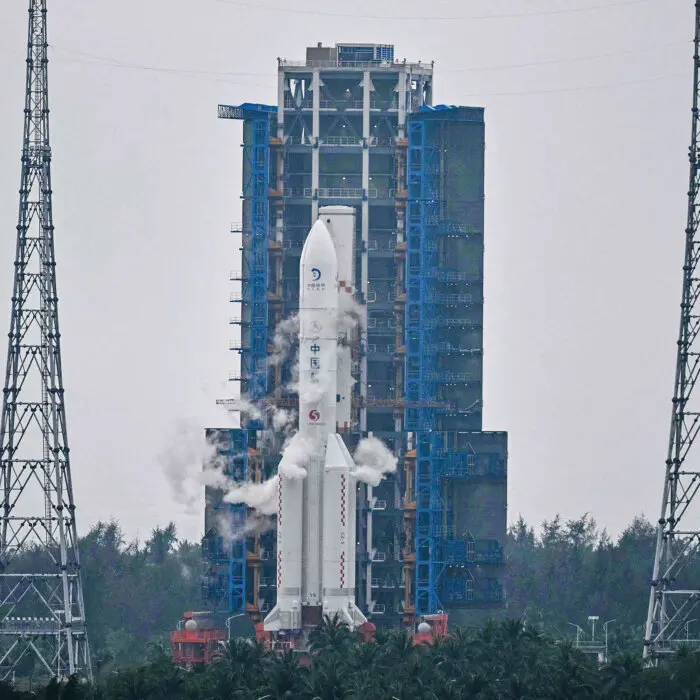
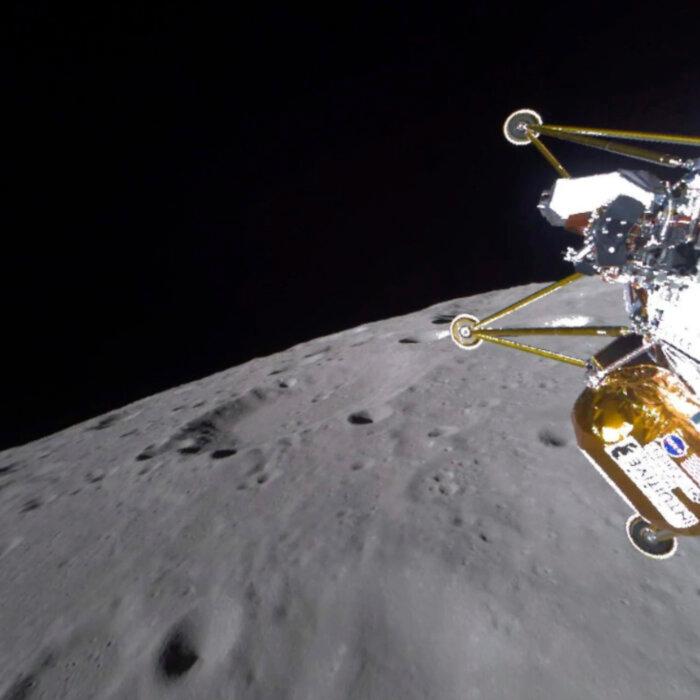
The program is also tied directly to military-civil fusion. In 2017, Xi called for integrated military-civilian development across sea, space, cyberspace, biology, and energy, and in 2020, Beijing identified space infrastructure as a fusion platform.
In April 2024, the People’s Liberation Army (PLA) dissolved its Strategic Support Force and created the Aerospace Force as an independent arm responsible for military space operations. Its BeiDou satellite navigation system, originally military, was later exported commercially, setting a precedent for how planetary-defense technology could similarly be dual-purposed.
This assessment that Beijing views space as a domain of national rivalry is echoed by retired U.S. Air Force Maj. Gen. Thomas “Tav” Taverney, former vice commander of Air Force Space Command, who wrote that China has fused economic development, industrial policy, and military modernization into a single strategy through its doctrine of Military-Civil Fusion, directing commercial research, universities, and state-owned enterprises toward defense objectives.
He argues that space, alongside cyber, artificial intelligence, missile defense, and drone warfare, is now a domain where conflicts could begin long before conventional combat starts.
The dual-use nature of China’s asteroid mission is at the project’s core. China’s plan pairs a kinetic-impactor spacecraft with a second spacecraft that monitors the strike at close range. The kinetic impactor is built to strike a small, fast-moving target with enough precision to alter its trajectory. That precision-strike capability presents the identical engineering challenge as building a weapon that rams into and destroys or disables a satellite.
The second spacecraft’s job is to fly close to the impact and track it in real time. That close-range monitoring technique is the equivalent skill needed to approach, shadow, and monitor another country’s satellite in orbit, including U.S. military and intelligence satellites.
In other words, the mission tests two capabilities at once: a strike system that can double as an anti-satellite weapon, and a tracking system that can serve as a means of surveilling adversary satellites.
The space-ground monitoring network that China has described as its early-warning system compounds the concern. A sensor constellation built to detect, track, and calculate the orbit of small, faint, fast-moving asteroids is functionally the same architecture needed to locate and target adversary satellites.
The 2026 U.S. Annual Threat Assessment states that China has eclipsed Russia as the primary U.S. competitor in space and is building counterspace capabilities specifically to contest U.S. space dominance by targeting the satellites the U.S. military depends on for GPS, missile warning, communications, and precision strike.
U.S. Space Command’s own posture statement to the House Armed Services Committee names China directly as the pacing threat, noting China operates more than 500 intelligence, surveillance, and reconnaissance satellites that enhance the PLA’s ability to find, track, and target adversary forces, and flagging China’s 2025 launch of the dual-use Shijian-25 satellite, which conducted an on-orbit docking with another Chinese satellite, the kind of rendezvous and proximity operation that mirrors the tracking capability at issue in the asteroid mission.
Space Force’s 2040 vision document anticipates that the United States will need to operate alongside tens of thousands of satellites by mid-century, specifically to maintain an edge against Chinese and Russian counterspace advances.
The U.S. response to China’s new space weapons program has centered on accelerating its own counterspace and space-domain-awareness capabilities. Space Force Chief of Space Operations Gen. B. Chance Saltzman reported that the service is deploying electronic satellite jammers and building out a full range of counterspace capabilities.
Saltzman stated that the objective is for the U.S. military to dominate in space and to “deter conflict in space and to win decisively if called upon.” That posture follows direction from Defense Secretary Pete Hegseth, who has set space dominance over China and Russia as an explicit Pentagon goal.