Beijing’s big drive to make China technologically self-sufficient is proving more difficult than the authorities thought or at least admitted publicly.
In this contest for tech supremacy, it has increasingly become apparent that China stands at a distinct disadvantage not only to the United States but also to sophisticated, well-developed global development and supply arrangements.
It has been some time since Beijing first committed itself to technological parity with, indeed supremacy over, the United States and the rest of the world—it committed itself to this goal even before U.S. President Donald Trump’s first term. China’s planners focused on developing semiconductors, especially advanced chips critical to artificial intelligence, industry, and defense applications.
Chinese authorities have spoken of such goals frequently over time. Indicative are the remarks by China’s top leader, Xi Jinping, from more than a decade ago.
“Amid an increasingly heightened global competition of overall national strength,” he told Chinese officials, “we don’t have many options but to take a path of self-dependent innovation.”

Whether Xi knew the difficulties involved when he made these remarks, China has struggled to replicate for itself what the rest of the world has—a complex and integrated multinational effort.
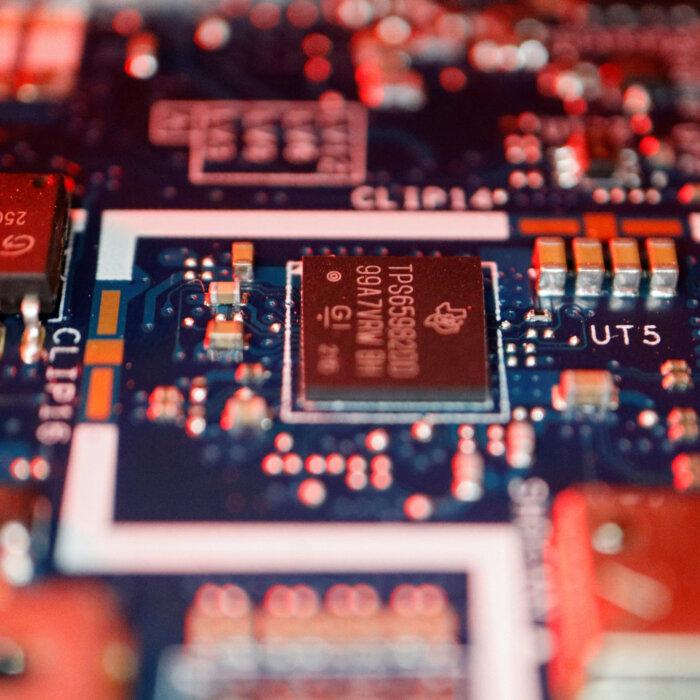
According to reporting by Think China magazine, the production of advanced chips today comes from a combination of highly specialized Taiwanese and South Korean manufacturing from American designs, using Japanese and European production equipment. To do all this on its own, China would have to replicate each of these elements cost-effectively. Indeed, for China to meet Xi’s ambition of supremacy, it would have to surpass the results of this multinational cooperation, which would require a huge commitment of investment spending.
This is not to say that China has failed to make progress toward its goals. Chinese chip production doubled between 2018 and 2023 and rose by a whopping 36 percent in the first four months of 2026.
China also has a booming semiconductor export business, especially to Southeast Asia, India, Taiwan, and South Korea. China now accounts for some 42 percent of global chip production. But these Chinese products—whether used at home or exported—are almost exclusively simpler so-called legacy chips.
The country must still import the advanced semiconductors essential to the rest of Beijing’s technology push. The proof, so to speak, lies in price comparisons. According to Beijing’s General Administration of Customs, the export price of China-made chips has risen smartly, going from $0.38 per chip in 2015 to $0.58 in 2025.
To be sure, chip prices have generally risen, but this increase also speaks to the greater sophistication of the Chinese product. Even so, the fact that China imported chips in 2025 at an average price of $0.72 per chip, a 20 percent premium over the Chinese product, suggests that the economy still relies on foreign production of the most advanced versions.
What makes matters still more challenging is that an advanced chip effort has become harder to serve over time. In 2022, the Biden administration limited the sale of advanced semiconductors and semiconductor manufacturing equipment to China, forcing China to scramble for sources of these sophisticated chips and turn inward to build required production equipment.
It now looks as though Taiwan is considering following Washington’s lead by imposing stricter export controls on advanced chips to China. For obvious reasons, Taipei has little interest in equipping Beijing’s potential invasion force.
No doubt Beijing will continue to push its technology agenda. There is also every reason to expect that it will make progress. At the same time, the clear difficulties facing the Chinese regime’s efforts mean that it will be a long time indeed before China comes even close to the United States and the rest of the developed world, much less gratifies Xi’s ambition to surpass all others.
After all, the Americans, the Taiwanese, the South Koreans, and others have no intention of standing still while China attempts to strive.