In December and June, joint nuclear-capable Chinese and Russian bomber groups passed Japan’s Senkaku Islands and then turned toward Tokyo and Okinawa, respectively. This was harsh strategic signaling against both Japan and the United States, which has a significant military base on Okinawa.
Japan is the only country in the world that has suffered not one, but two nuclear blasts in its cities. That contributed to Japan’s pacifist constitution, one of the world’s only, and Tokyo’s long support for nuclear arms control treaties.
Nevertheless, Beijing is leading its partners and attempting to lead the world in a new fight against what its propagandists call Tokyo’s “new militarism.” As with so much when it comes to communism, this is, of course, a reversal of the truth.
Since the early 1990s, the Chinese Communist Party (CCP) has forced China into its own exponentially increasing defense budgets while Japan’s defense budget remained relatively stable at about $50 billion. This has only recently begun to rise as Japan and its allies digest the rising threat posed by the Chinese regime.
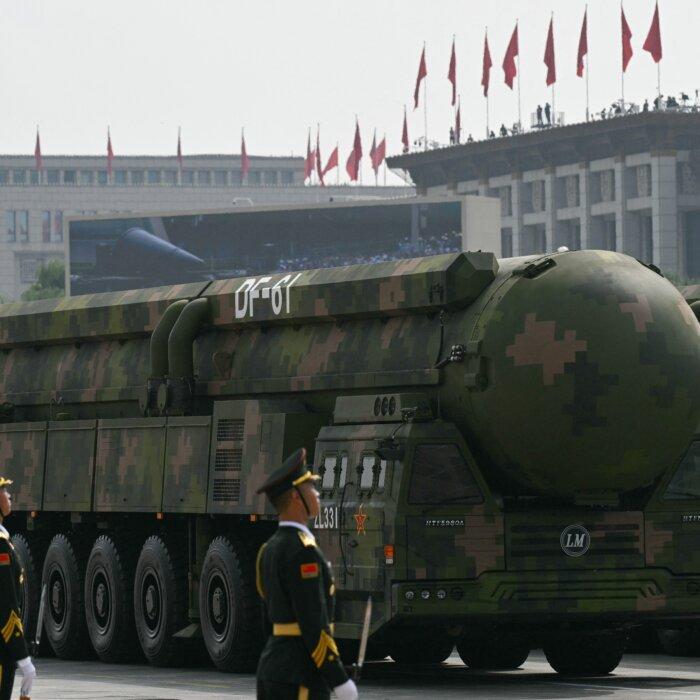
Beijing and Moscow are assisting North Korea’s military forces, which threaten Japan and South Korea as much or more than the United States. North Korea is rapidly developing hypersonic weapons capable of carrying its nuclear weapons and potentially defeating U.S. and Japanese anti-missile defenses, including in Okinawa and Guam.
In partial exchange, North Korea provides Russia with critical military materiel, including ballistic missiles and artillery shells. By taking increasingly threatening actions across the globe, the three nuclear partners are trying to make the United States, Europe, and Japan look weak while destabilizing their defensive alliances.
Simultaneously, the CCP is putting economic pressure on Japan by discouraging tourism, imposing a seafood import ban, and banning exports of dual-use military-civilian materials. This includes CCP limits on China’s rare-earth element (REE) exports, which put immense pressure on Japan’s auto, semiconductor, turbine, and other industrial manufacturing.
China produces approximately 90 percent of refined REEs, which will take years to replace by building new REE refineries and supply chains. This punishes Japan where it hurts and makes an example of Japan that Beijing hopes the rest of the world notices. Japan stood with Taiwan, and so Japan is being economically and militarily punished.
Beijing is attempting to pressure and thereby delink Japan from the U.S. alliance system, and force Tokyo to retract its economic and military support for Taiwan.
The Japanese report emphasized the need for more “comprehensive national power,” stronger alliances, and an improved defense industrial base, including in the production of drones and AI-enabled warfare. Beijing issued a complaint in response, claiming that Tokyo has no right to comment on Taiwan.
While the propagandists in Beijing are working overtime to spin the report as a “new militarism,” Japan’s increasing need to defend itself is entirely of the CCP’s own making. For decades, Beijing has expanded the geographic scope of China’s territorial claims, including claims over Taiwan, Japan’s Senkaku Islands, and, most recently, the Batanes Islands in the Philippines, according to China’s state media.
Tokyo stands firm in support of its fellow democracies. In November, Prime Minister Sanae Takaichi said that Japan could deploy its military in defense of Taiwan if the Chinese regime attacked the island and threatened Japanese survival. She has thus far refused to retract her statement despite the CCP’s pressure.
In trying to break Japan, the CCP is trying to break one of the strongest spokes in America’s hub-and-spoke alliance system in Asia. After breaking all of the spokes, which is doubtless its goal, Beijing could reassemble the spokes with itself at the center as a regional hegemon aspiring to global hegemony.
To take the first step, Beijing must chasten Tokyo into inaction and retake Taiwan, with all that implies for Taiwan’s semiconductor manufacturing and the democracy and sovereignty of Indo-Pacific nations in general.
As with Canada in 2018 and Australia in 2020, the best strategy when the CCP singles out a democracy like Japan or Taiwan is for the other democracies to step in with their moral and material support.
We are all stronger when we act as one. If the CCP is allowed to pursue its divide-and-conquer strategy, our time will eventually come.