Lately, I’ve been hearing more and more from farmers who are testing their soil and finding elevated levels of aluminum and cadmium. They’re seeing crops struggle in ways they haven’t seen before. Some are connecting it to what they believe is being sprayed in the skies above them.
And I understand why.
The sky looks different from the way it did when I was a child. Contrails used to disappear quickly. Now they linger, spread, and turn into a haze that hangs overhead. Whether that’s increased air traffic, changing atmospheric conditions, or something else entirely, I can’t say with certainty. I’m not here to make claims I cannot prove.
But I am here to say this: Before we place all the blame above us, we have to take a hard look at what’s happening beneath our feet.
Aluminum is one of the most abundant elements in the Earth’s crust. It has always been there. The issue is not necessarily that there is more aluminum in the soil, but that more of it is becoming available.
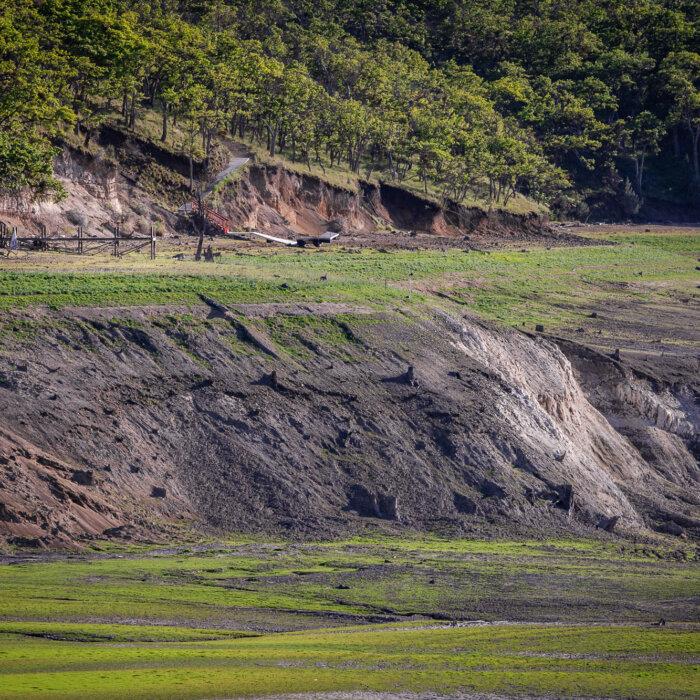
As soil pH drops, aluminum is released from stable mineral forms into soluble aluminum ions, particularly Al³⁺. In that form, it becomes toxic to plant roots. It restricts root development, interferes with nutrient uptake, and ultimately reduces plant health and yield.
I’ve also heard from farmers who say their aluminum levels didn’t just creep up, they jumped to five times higher in a single year. That kind of spike can feel like something new is being added, but soil doesn’t usually work that way.
Aluminum is already present in most soils, bound up in stable forms. When pH drops, organic matter declines, or the biology that holds minerals in place begins to break down, then aluminum can be released into a soluble form that shows up on a test and becomes toxic to plants. In other words, the number can change quickly, not because the aluminum suddenly arrived, but because the soil crossed a threshold, making what was already there more available.
What causes that shift is not a mystery.
Years of nitrogen-based fertilizers, especially ammonium forms, drive soil acidification. Tillage breaks apart soil structure and accelerates mineral weathering. The loss of organic matter removes one of the soil’s primary buffering systems. As microbial life and fungal networks decline, we lose the biology that binds minerals into stable, plant-safe forms.
So when farmers test their soil and find higher aluminum levels, it may not be that aluminum has suddenly appeared. It may be that we have created the conditions that make it soluble, reactive, and harmful.
Cadmium is different, but it also points back to our practices.
Cadmium typically does not occur at high levels in healthy soils without an external source. One of the most common ways it enters farmland is through phosphate fertilizers. The rock used to produce phosphorus inputs often contains cadmium as a natural contaminant. With each application, small amounts are added to the soil, and over time, they accumulate.
So when farmers ask about the cadmium, the answer is uncomfortable but clear. We are at least partially responsible.
I would be interested to see more side-by-side data comparing conventional farms with regenerative systems. Do we see the same spikes in aluminum on land that is building organic matter, maintaining ground cover, and supporting active microbial life? Because the science we do have tells us something important.
Aluminum toxicity is strongly tied to soil acidity and biology, not just total aluminum levels. When soil pH drops below roughly 5.5, aluminum shifts into a soluble form that damages plant roots and limits nutrient uptake. That suggests management matters.
If regenerative systems are keeping soils buffered, biologically active, and structurally intact, it is reasonable to ask whether those systems experience the same kind of spikes or whether they are more resilient to them.
There are other factors that make people suspicious. We now have seeds that have been genetically modified to withstand aluminum toxicity. On one hand, it can look like the same companies or institutions that are investing in weather modification technologies are also investing in seeds designed to survive the very conditions that people fear are being created. It is not unreasonable for people to connect those dots.
But there is another explanation. We have been degrading our soils for decades, with little meaningful course correction since the 1970s. As soil acidification increases and more aluminum becomes available, it creates a real and growing problem for farmers. Where there is a problem, there is a market. Companies step in to fill that gap, developing seeds that can tolerate those conditions.
I unequivocally believe we have God-given rights, as well as rights afforded to us by the Constitution of the United States of America, including property rights, that entitle us to say: I do not consent to unknown chemicals being sprayed over our land and our families.
At the same time, I believe we have the right to food that is truly nourishing and water that is not contaminated.
I do not have definitive data on what may or may not be happening above us. But we do have extensive soil testing, scientific literature, and soil scientists raising concerns about the trajectory we are on. Some estimates suggest that we are rapidly depleting the productive capacity of our soils. Whether that timeline is exact or not, the direction is clear.
But even if every concern about the skies were proven true tomorrow, the solution on the ground would not change.
The way forward is the same.
We need more organic matter in our soil. We need more biodiversity. We need living roots in the ground for more days of the year. We need to rebuild microbial life and fungal networks that cycle nutrients and stabilize minerals.
We need to move away from systems that rely on soluble nitrogen poured onto the soil and toward systems that allow biology to make nutrients available in the form and timing that plants actually need.
There is no soil on Earth that lacks nitrogen. There are only soils that lack the biology required to cycle it.
Plants do not create minerals. Every mineral in a plant comes from the soil. Without a functioning soil food web, those minerals remain locked away or shift into forms that are harmful rather than helpful.
So we end up with food that looks healthy but is grown in a system that is fundamentally broken. Big, green, beautiful vegetables grown on inputs rather than biology.
And then we wonder why our bodies feel the way they do.
The cycle continues. Depleted soil produces depleted food, and depleted food contributes to depleted people.
It’s almost funny that I’m writing this at all. I come from a family in which my mother has a standing joke that anytime she feels off, tired, forgetful, she says, blame it on the chemtrails. And maybe that’s part of what’s happening culturally.
We’re looking for something to point to, something to explain why things feel like they’re breaking down. The truth is, I don’t know exactly what to blame. But I do know this. We have been degrading our soils for decades. We have been stripping away biology, organic matter, and resilience. And regardless of what is happening above us, the solution remains the same.
Just as we can create the conditions that make abundant aluminum available, a form that is harmful to plant and human health, we can also create the conditions that make nitrogen, phosphorus, potassium, and hundreds of other minerals available in forms that nourish life. The choice is ours.
We rebuild the soil.