This copy is for your personal, non-commercial use only. Distribution and use of this material are governed by our Subscriber Agreement and by copyright law. For non-personal use or to order multiple copies, please contact The Epoch Times Reprints.
Filip Agren of Gallery AFK in Braddock, Pa. uses a grinder on the sculpture for Raccoon Rainbow Park in the Pittsburgh area. Courtesy of Michael Schwarz
A giant space raccoon is coming to town. The 12.5 foot sculpture, being built in Pittsburgh, will reportedly be the world’s biggest steel raccoon ever. Kids in the neighborhood of Millvale needed a park, and so high school volunteers have since 2021 worked on turning what used to be a vacant junkyard into a conservation playground. The park is one of only two good ones in the borough of Millvale, just eight minutes drive up the Allegheny River from Pittsburgh.
Thanks in part to the volunteers and leadership of Millvale Community Development Corporation board president Brian Wolovich and a local science teacher, Abbey Nilson, trash from the lot was cleared into three 30-yard dumpsters, and the space now sports a basketball court, bicycle pump track, and two park benches made of 400 pounds of recycled plastic. The park has solar panels, rain barrels, painted bricks made by the youngest volunteers, and a shed made of shipping pallets.
Playground equipment, including swings, are planned. There’s a mural by Max Gonzales and Shane Pilster with student-inspired elements like a friendly dragon and owl reading a book. The playground, called Rainbow Raccoon Park, got its name from the sculpture that neighborhood kids want built there.
The Henry L. Hillman Foundation donated $20,000 to make the sculpture a reality. Artists Michael Schwarz and Filip Agren’s design won the contract, and they set about getting material donations. Triad Metals donated eight tons of Cor-ten steel plate. Cor-ten stands for corrosion resistance and tensile strength. The steel was made in Pittsburgh. The Grable Foundation, Triboro Ecodistrict, Frank Bryan Concrete, and West Penn Laco also obtained or provided donations.
I visited Mr. Agren’s Gallery AFK in Braddock, PA. He is making rapid progress with the welding. The head, feet, tail, and much of the mid-section are now done.
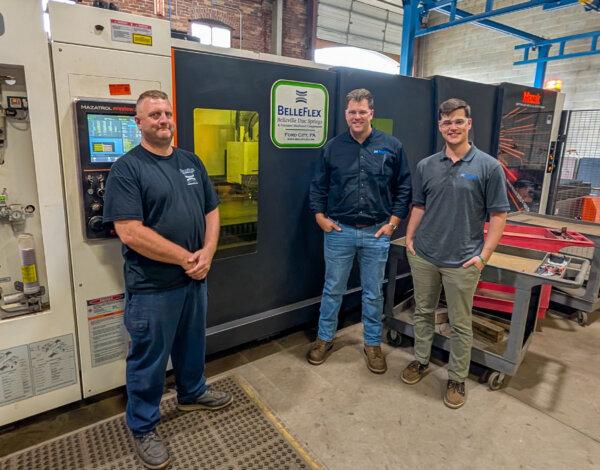
BelleFlex Technologies, about an hour’s drive up the Allegheny River, volunteered to use its laser cutting machine to cut out the 695 pieces of steel plate needed for the sculpture. BelleFlex supplies material to the International Space Station. The sculptors are approximating the raccoon’s soft profile through welding the plates together, which gives the raccoon an origami, cubist, or spaceship look. If raccoons were to build a space ship to leave those earthly trash bins behind forever, it might look something like the sculpture, whose construction also has a passing similarity to the F-117, the first U.S. Air Force stealth jet. Since BelleFlex supplies to the space station, we shouldn’t be surprised that the giant raccoon looks a bit like it is headed for the stars.
The Mazak fiber laser cutting machine at BelleFlex Technologies, LLC, that cut 695 panels for the raccoon sculpture. Pictured are, from left to right, Operator Jake Reesman, General Manager John Bach, and Engineer Chris Hess, all of whom worked on the project. Courtesy of Anders Corr
I had the privilege of visiting the team at BelleFlex. They cut the panels from about 20 large sheets of steel, then deburred, cleaned, and packaged the pieces so it would be easier for the welders. The BelleFlex plant is in Ford City, northeast of Pittsburgh. I saw the fast fiber laser in a precision cutting operation on other steel. It looked a bit like the movies when an action hero uses a hand-held laser to cut through steel doors. Only, the real laser cutter at BelleFlex is the size of a large bedroom. BelleFlex also operates a water jet that cuts through even thicker steel.
The laser is housed in the same huge brick building where Pittsburgh Plate Glass (PPG) got its start in the 19th century. PPG now has a market capitalization of over $26 billion.
BelleFlex got permission from its parent company, Blair Strip Steel Co., in New Castle, Pennsylvania, to donate its time to the park sculpture. Blair is America’s oldest operating strip company, with roots as an iron smelter in the mid-1800s. In 1923, Blair started operating a heavy gauge strip steel mill to supply the auto industry. It progressed with the times and now supplies precision strip steel to the aerospace industry, and operates the world’s heaviest-gauge strip mill.
BelleFlex makes massive spring flange washers that flex as they take weight, and then spring back, acting as shock absorbers. For example, BelleFlex disk springs are installed on the docking system of the International Space Station, and on undersea tsunami detectors used by the National Oceanic and Atmospheric Administration. BelleFlex also engineers ultra-strong and lightweight composite material, including through pultrusion. One BelleFlex material is twice as strong as oak, but half as heavy. The company has a long list of aerospace, defense, energy, mining, and medical clients that are business confidential. But, you would most likely recognize some of their names if you heard them.
Excellence in manufacturing matters in space, as the Challenger shuttle disaster in 1986 made clear. A single rubber “o-ring” failed and the entire ship blew up, killing seven astronauts onboard. O-rings are basically big washers, which is exactly what BelleFlex does. So, the smallest probability of failure is unacceptable. BelleFlex’s competitors overseas may make cheaper products that will probably work. But for BelleFlex, probably isn’t good enough. “We’re not in the business of probably,” said John Bach, the company’s general manager of sales and engineering.
So, it’s important to keep quality companies like BelleFlex around. In an emergency when America needs a better o-ring, or spring flange washer, we have the engineers and machinery at BelleFlex, on American soil, who are ready to earn the order and engineer the solution on short notice. That goes for other top U.S. manufacturers as well. The stronger America’s industrial ecosystem is, the stronger is America.
Not to mention, we might someday want to help our raccoons escape their trash-strewn life for something better on another planet. When their ship does finally take off from Rainbow Raccoon Park, I hope some of those cute furry creatures decide to stay.
Views expressed in this article are opinions of the author and do not necessarily reflect the views of The Epoch Times.
Anders Corr has a bachelor’s/master’s in political science from Yale University (2001) and a doctorate in government from Harvard University (2008). He is a principal at Corr Analytics Inc. and publisher of the Journal of Political Risk, and has conducted extensive research in North America, Europe, and Asia. His latest books are “The Concentration of Power: Institutionalization, Hierarchy, and Hegemony” (2021) and “Great Powers, Grand Strategies: the New Game in the South China Sea” (2018).