Taiwan deliberately throttled mobile data service across seven central counties and cities on Aug. 10, testing whether emergency services and civilian institutions could continue operating under communications constraints caused by war or a major disaster.
Taiwan’s three major wireless carriers restricted mobile-data speeds from 2:30 p.m. to 3 p.m. in Taichung, Miaoli, Nantou, Changhua, Yunlin, Chiayi City, and Chiayi County.
The carriers capped mobile data speeds at 256 Kbps through their core networks, according to the Executive Yuan. The government said the measure simulated communications resources becoming constrained by war or a major disaster.
Voice calls, text messages, emergency lines, fixed networks, and Wi-Fi were not restricted.
“This year is relatively unusual because it is the first time we have conducted an exercise involving disruption to mobile communications,” Changhua Magistrate Wang Hui-mei told NTD, a sister media outlet of The Epoch Times.
Wang said the throttled speed was about 1 percent of ordinary 4G or 5G speeds, while calls and text messages remained available.
One Changhua resident told NTD that the exercise allowed people to experience degraded service before encountering it during a war. Another said advance exposure could help residents respond without panicking.
Rather than imposing a complete blackout, authorities reduced the capacity of a functioning commercial network to test which services could continue.
Finding the Minimum Needed to Operate
Huang Sheng-hsiung, chairman of the Taiwan Network Information Center, said in a statement posted on Facebook before the exercise that the mobile data service drill represented a shift from seeking complete restoration after a communications disruption to determining the minimum level at which essential systems could keep operating.
Huang, who also uses the English name Kenny Huang, is a member of the Presidential Office’s Whole-of-Society Defense Resilience Committee advising on information, communications, transportation, and financial network security.
Huang described the challenge as maintaining a “minimum operating level” when communications bandwidth becomes scarce.
A live test can expose operational needs and weaknesses that remain hidden in written contingency plans, he said. It also allows critical infrastructure operators to determine whether their systems can function with limited bandwidth.
Those requirements vary by sector. Emergency medicine, financial clearing, and traffic control systems differ in the amount, timing, and type of data they require, making a single resilience threshold impractical, Huang said.
The exercise could help agencies and operators determine the minimum requirements for their own systems and use limited communications resources more effectively, he said.
Civilian and Military Communications
Taiwan’s military separately tested how commanders could maintain communications and make decisions under disrupted battlefield conditions.
On Aug. 10, Defense Minister Wellington Koo inspected the Taipei garrison area’s command system and defensive deployments, discussing intelligence transmission, command and control, backup communications, and air defense operations with officers, according to the Ministry of National Defense.
Koo said rapid intelligence transmission and a complete operational picture were essential for commanders to understand threats and act quickly. He also called for distributed command and backup mechanisms to strengthen battlefield command resilience.
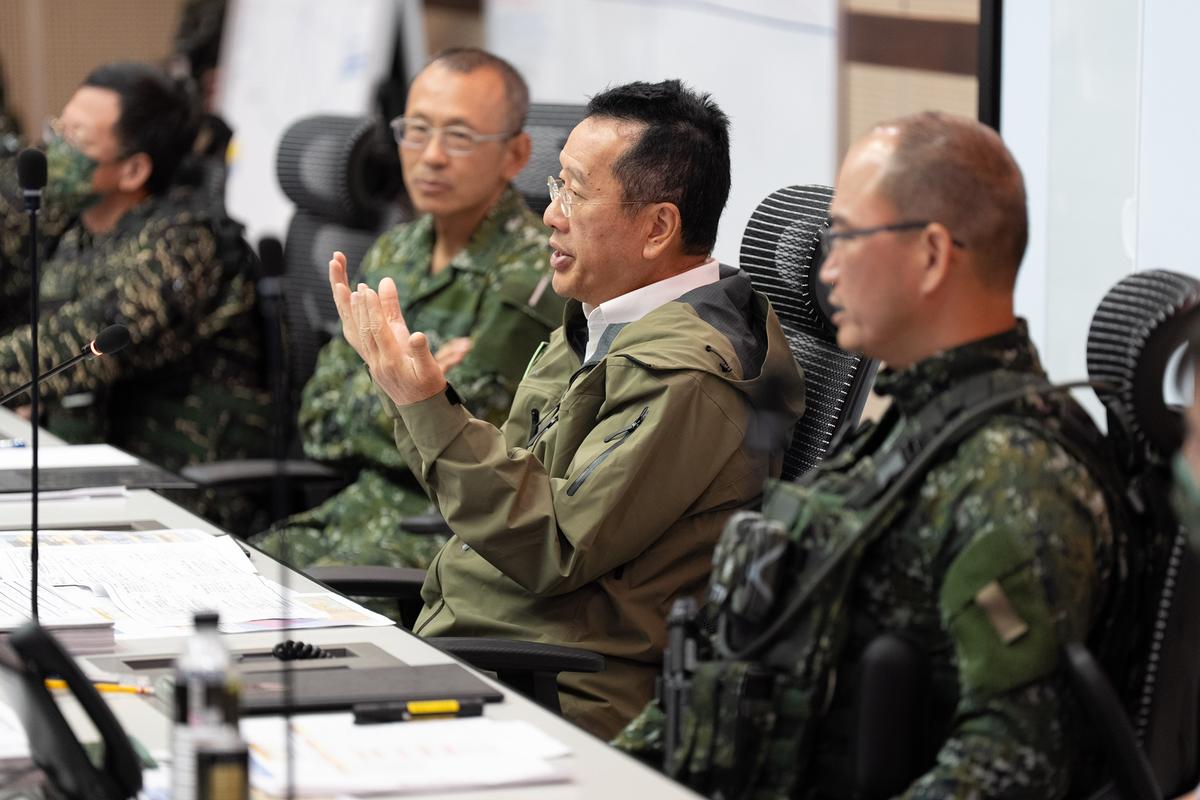
The civilian and military activities involved separate communications systems but addressed parallel needs: sustaining essential public services and keeping military commanders connected during disruption.
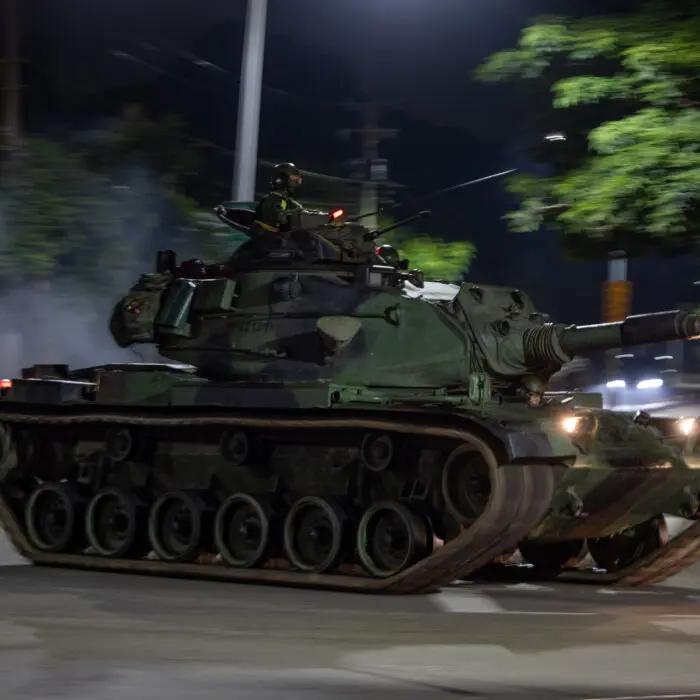
Han Kuang 42 began on Aug. 5 and is scheduled to continue through Aug. 14. The exercise uses a continuous scenario progressing from preparations for a People’s Liberation Army attack through force preservation, a blockade, missile strikes, attempted landings, and prolonged fighting, according to the Defense Ministry’s exercise plan.
The synchronized Urban Resilience exercise involves local governments and civilian agencies in evacuation, disaster response, medical services, communications, infrastructure protection, firefighting, and public security.
Maj. Gen. Lu Wenyuan, director of joint operations planning at the ministry, said the civilian exercise would follow the Han Kuang timeline and test “the capacity of our whole-of-society defense mobilization to face war,” according to a July 28 NTD report.
Emergency Services Remained Available
An interagency response center at Taipei Main Station monitored telecommunications, policing, firefighting, medical care, transportation, financial services, and other civilian operations during the mobile-data restriction.
Officials maintained video contact with the seven participating local governments.
Police received 243 calls through the 110 emergency number during the exercise, according to the Executive Yuan, which is equivalent to a national Cabinet. Six reports were submitted through a police video reporting application and five by text message.
The 119 emergency line also remained available. Fire and ambulance activity was slightly higher than the average for comparable 30-minute periods in 2025 but remained within the normal range, officials said.
Medical institutions used fixed networks, Wi-Fi, and existing backup systems, while emergency medical services continued operating.
Authorities also tested low-earth-orbit satellite, microwave, and radio communications. The Executive Yuan said those systems operated normally.
Putting Backup Plans to a Live Test
Lawmaker Wang Ting-yu compared the exercise to a fire drill.
“No one hopes for a fire, and no one hopes to encounter an accident,” he wrote on Facebook Aug. 10.
Knowing where fire hydrants and exits are—and how to respond—allows people to prepare for the worst, Wang said.
He said the communications exercise similarly tested how Taiwan could maintain government and social operations if a natural disaster or military conflict damaged mobile infrastructure.
Huang said repeated live exercises could help Taiwan develop a more structured approach to preserving communications. Critical services could use dedicated or physically isolated connections, while other essential systems would retain enough bandwidth to maintain minimum operations.
He also advocated a localized PACE framework—primary, alternate, contingency, and emergency communications—so agencies would not depend on a single network or backup.
Under that approach, agencies could move from ordinary mobile networks to fixed lines, Wi-Fi, local telephones, offline resources, or emergency communications as conditions deteriorated.
A second 30-minute mobile data exercise is scheduled for Aug. 13 in Taipei, New Taipei, Taoyuan, Keelung, Hsinchu City, Hsinchu County, and Yilan County. The Executive Yuan said findings from the central Taiwan exercise would be used to adjust the northern phase.