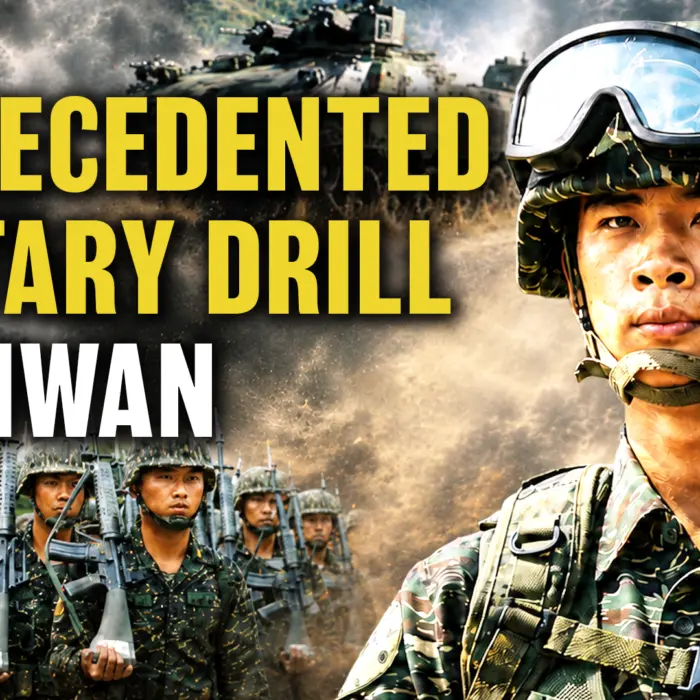
Taiwan launched its largest annual Han Kuang military exercises on Aug. 5, with this year’s drills placing unprecedented emphasis on countering Chinese Communist Party (CCP) gray-zone pressure and preparing for a potential transition from harassment to armed conflict.
The 10-day, nine-night exercise, known as Han Kuang 42, involves about 20,000 active-duty and reserve personnel and is designed to test Taiwan’s ability to respond to the CCP’s ongoing harassment and rapidly transition from peacetime operations to combat.
Military experts say the exercise differs significantly from previous years, with several elements being conducted on a scale not previously seen.
“The Han Kuang exercise this year is different from the past. There are at least five characteristics that are unprecedented,” Yu Tsung-chi, former dean at Taiwan’s National Defense University, told The Epoch Times.
The first is the military’s use of drone swarms and the development of a “kill chain,” which Yu described as an emerging form of combat capability.
The second is a greater focus on countering gray-zone operations, including joint efforts by Taiwan’s navy and coast guard to respond to potential Chinese maritime blockade tactics.
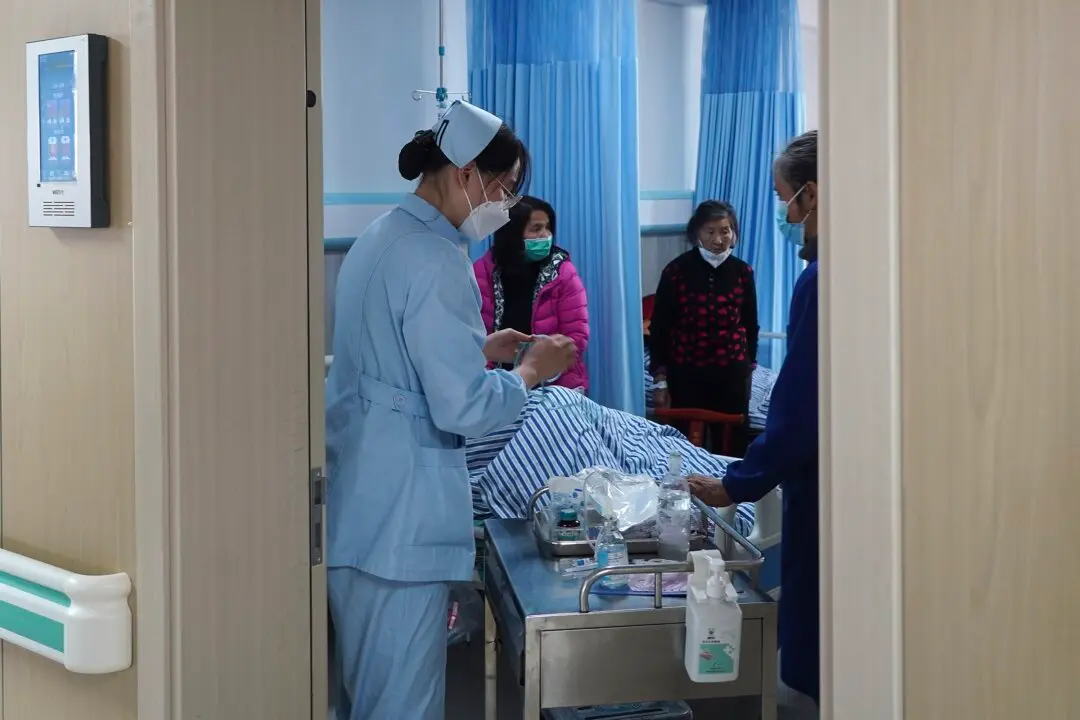
The third is the scale of exercises designed to strengthen civilian medical resilience. While medical preparedness has been included in previous drills, Yu said this year’s exercise requires substantially larger-scale, on-the-ground participation.
The fourth is reserve mobilization. Taiwan is mobilizing one reserve brigade each in the north and south, involving about 5,000 personnel in total—a first for the exercise, according to Yu.
The fifth is communications resilience. Taiwan is conducting network-slowdown exercises in 14 counties and cities to simulate the effects of a major disaster or war in which communications infrastructure is attacked or disrupted.
The exercises are intended to test how businesses, communications networks and logistics systems could continue operating under such conditions, Yu said.
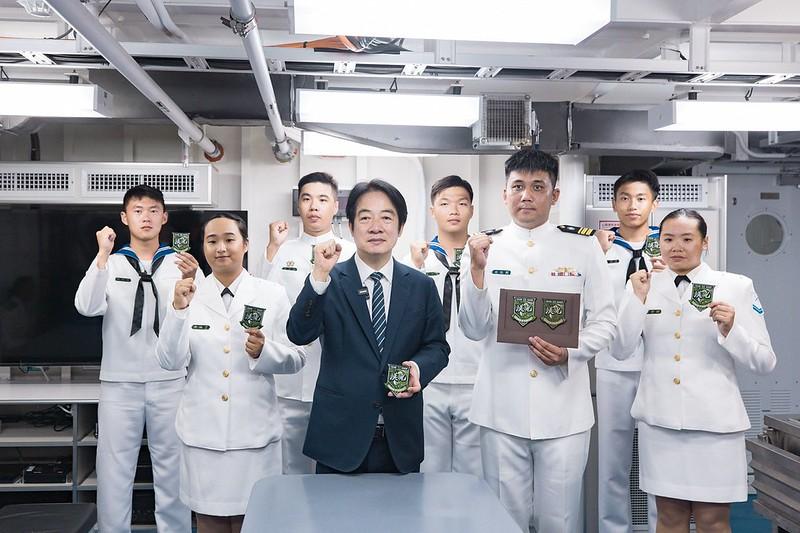
Taiwanese President Lai Ching-te visited a military garrison in Bali District in New Taipei City on Aug. 6, the second day of the exercise. He reviewed preparations involving missile deployment, mine loading, and efforts to establish defensive barriers at Taipei Port, while receiving briefings on force protection, preservation of military strength and battlefield responses.
Preparing for Possible Blockade
Yu said the exercises reflect growing concern over China’s increasingly aggressive maritime gray-zone tactics, which could shift rapidly into military conflict.
“The CCP’s increasingly escalating maritime gray-zone harassment tactics can at any time transition from exercises into war,” he said, referring to China’s strategy aimed at gradually squeezing Taiwan’s room for survival.
The drills indicate that Taiwan is preparing for the possibility that Beijing could use maritime blockade operations next year in an attempt to force Taiwan to capitulate without launching a full-scale invasion, Yu said.
“Whether it is drones or countering gray-zone harassment, [Taiwan is seeking] to quickly open safe maritime corridors so that maritime transportation can enter and leave quickly,” he said. “This is to ensure that Taiwan will not be suffocated by China’s isolation and blockade tactics.”
Yu said the preparations also reflect a broader effort among countries along the first island chain to coordinate against Chinese gray-zone pressure.
“Any single country may not be able to compete with the CCP in terms of numbers,” he said. “To successfully resolve the CCP’s continuously increasing gray-zone harassment, democratic countries must become more united and take countermeasures together.”
US-Taiwan Defense Cooperation
The Han Kuang exercises are also drawing attention to increasingly open U.S.-Taiwan security cooperation.
The exercises date back to 1984 and were originally joint U.S.-Taiwan military exercises before Taiwan began conducting them independently. For years, U.S. military personnel training Taiwanese forces largely kept a low profile. In recent years, however, U.S. military personnel and observers have appeared more frequently around Taiwan’s military exercises.
Taiwanese Defense Minister Wellington Koo acknowledged in front of the press on July 31 that the U.S. Indo-Pacific Command has assisted Taiwan at multiple levels in improving its defense capabilities, saying U.S.-Taiwan military cooperation is “closer than everyone imagines.”
“This represents that the United States has already begun actively taking action in confronting the CCP’s military or paramilitary operations,” Yu said regarding the images.
He said U.S.-Taiwan cooperation involving coast guard operations and joint reconnaissance patrols is likely to expand. He noted increased U.S. Coast Guard activity in the Indo-Pacific, including a recent deployment to Singapore and expanded presence in the Philippines, and said the United States could eventually establish additional coast guard deployments involving Taiwan and Japan.
Chen Pokong, a U.S.-based China analyst and author, told The Epoch Times Taiwan’s increasingly specific and geographically focused military preparations reflect a shift in the perceived nature of the CCP threat.
The possibility of Chinese military action against Taiwan, he said, has evolved from a distant threat into a risk for which Taiwan must be prepared at any time.
Taiwan’s increasingly localized exercises and greater emphasis on defense in depth, Chen said, are likely based in part on intelligence shared by the United States.
Potential Political Warfare Inside Taiwan
Yu said preparations by Taiwan also reflect concerns about the possibility of worsening internal instability within the CCP and the potential for Xi to take greater military risks.
Chen, meanwhile, argued that internal turmoil within China could make a full-scale invasion less likely, but could also create incentives for Beijing to use external confrontation for political purposes.
He said that after Xi’s purge of senior military figures, including Zhang Youxia and Liu Zhenli, the Chinese military may not have the capability or cohesion needed to invade Taiwan successfully. However, Beijing could still use military threats to project strength and conceal internal divisions.
Furthermore, Chen said the CCP could seek to divide Taiwan politically, offer incentives to pro-Beijing forces and exploit Taiwan’s democratic system to weaken resistance from within.
Taiwanese society, he said, increasingly contains both strongly anti-communist groups and those who are sympathetic to or willing to accommodate Beijing.
“Through infiltration and subversion methods, the CCP seeks to divide and dismantle Taiwan, using Taiwan’s democracy to infiltrate Taiwan,” Chen said.