Taiwan’s top military research institute demonstrated three robot dog variants built on a U.S.-made platform, turning into public view a capability area that the defense ministry had already identified to lawmakers as part of its push to apply emerging technologies to asymmetric warfare.
The National Chung-Shan Institute of Science and Technology, or NCSIST, displayed the systems at the Ministry of National Defense in Taipei on June 2. The ministry said the demonstration featured LiDAR, reconnaissance, and firepower variants.
The robots use Ghost Robotics’ Vision 60 quadrupedal unmanned ground vehicle as the base platform, according to the defense ministry. NCSIST integrated Taiwan-developed mission payloads, including electro-optical reconnaissance, a remote-controlled turret system, and LiDAR combined with thermal-imaging recognition.
An official video posted by the Military News Agency, an organization under Taiwan’s defense ministry, showed three olive-drab quadruped robots moving in formation and operating outdoors. The video also showed variants labeled for reconnaissance, LiDAR, and firepower functions, including one model carrying a rear-mounted weapon station.
NCSIST Deputy Director Jen Kuo-kuang said the project is intended to help build a “non-red” supply chain and local production capacity, referring to supply chains that avoid dependence on Chinese components, according to the defense ministry.
Policy Trail
The demonstration followed an April 27 defense ministry report to the Legislative Yuan’s Foreign and National Defense Committee on the Defense Innovation Office’s use of emerging technology for asymmetric warfare.
In that report, the ministry said recent wars have moved from traditional force-on-force battles toward asymmetric warfare built around large numbers, lower costs, high efficiency, unmanned systems, and artificial intelligence.
The ministry said it created the Defense Innovation Office to bring mature civilian technologies into military use, promote smart innovation, and accelerate defense applications.
The report said Taiwan’s armed forces planned to introduce highly mobile, multifunctional, and modular quadruped robots, unmanned transport vehicles, and tactical vehicles for reconnaissance, strike, and resupply missions in depth and urban operations.
Three Variants
The LiDAR model carries 3D LiDAR and thermal-imaging sensors, the defense ministry said. NCSIST said it can conduct autonomous patrols and inspections, avoid obstacles in real time, detect heat sources, and build three-dimensional spatial models.
The ministry said that the variant could be used for base security patrols, facility monitoring, and nighttime sentry missions.
The reconnaissance model uses an NCSIST-developed electro-optical reconnaissance system. The ministry said it can search for targets, analyze and identify them, track them, and return information in real time to a smart decision-making command-and-control system.
NCSIST said the reconnaissance model could help commanders understand battlefield information and assign robot dog missions.
The firepower model carries an NCSIST-designed, remote-controlled turret system combined with a visible-light camera, thermal-imaging sensor, and laser rangefinder, according to the defense ministry.
Taiwan’s Central News Agency (CNA) reported that the version displayed at the event was fitted with a riot-control gun.
NCSIST said the firepower variant could support reconnaissance and fire-support tasks, depending on operational needs, including coastal patrols, airfield security, police riot-control operations, and urban environments.
The available public materials do not establish that the system was shown with lethal ammunition, autonomous firing capability, an operating unit, or a deployment timeline.
US Platform, Taiwan Specs
For the Taiwan-modified versions, CNA reported that NCSIST listed each robot at about 52.4 kilograms, with a payload capacity of 10 kilograms, speeds above 2.5 meters per second, an 8-to-10-hour operating period, and IP67 resistance to dust and water.
NCSIST also said the systems can support dog-to-dog networking, according to CNA.
Those figures describe NCSIST’s stated specifications for the models shown in Taipei, not independently tested performance.
Jen said future robot-dog systems could be integrated with unmanned ground vehicles, drones, and unmanned surface vessels to build a broader unmanned combat system, according to the defense ministry.
Coastal and Island Missions
Jen said Taiwan’s military had expressed a need for the equipment, though no formal order had been placed.
“In fact, the marines believe that on beaches and the coastline, including for the coast guard in Nansha and Dongsha for patrols and inspection, there is a pressing need,” Jen said, referring to Taiwan-controlled features in the South China Sea.
Taiwan controls Taiping Island, also known as Itu Aba, in the Spratly Islands, and Dongsha Island, also known as Pratas Island, near the northern end of the South China Sea. Taiwan’s Coast Guard Administration lists Dongsha as 444 kilometers from Taiwan’s main island and Taiping as 1,591 kilometers from Taiwan.
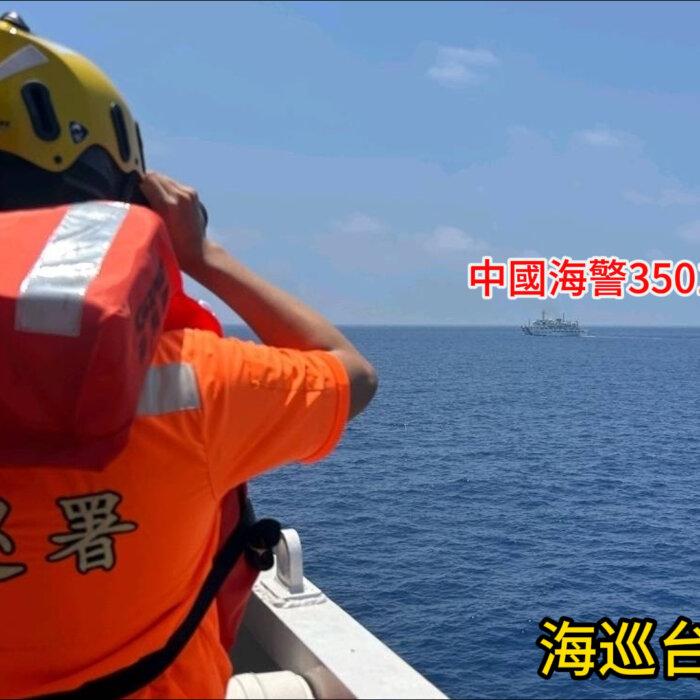
Taiwan’s Coast Guard Administration has reported Chinese coast guard and fishing-vessel activity near Pratas over the past year. In May, the agency accused China of showing “blatant disregard for international law” after a Chinese coast guard vessel approached waters near Pratas.
The Chinese communist regime claims Taiwan as part of China and has not ruled out the use of force to bring it under its control. Taiwan rejects Beijing’s sovereignty claims.