Small businesses across several Chinese provinces have temporarily closed rather than risk inspections as Chinese authorities pursue parallel enforcement drives involving compulsory product certification and workplace safety.
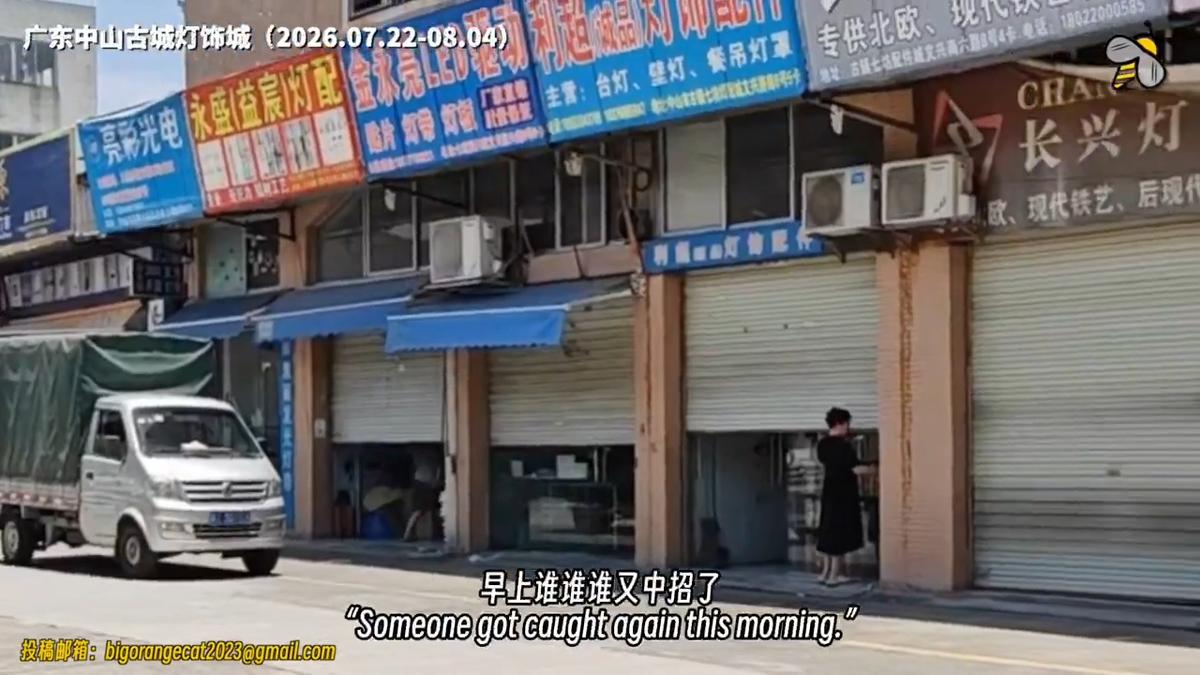
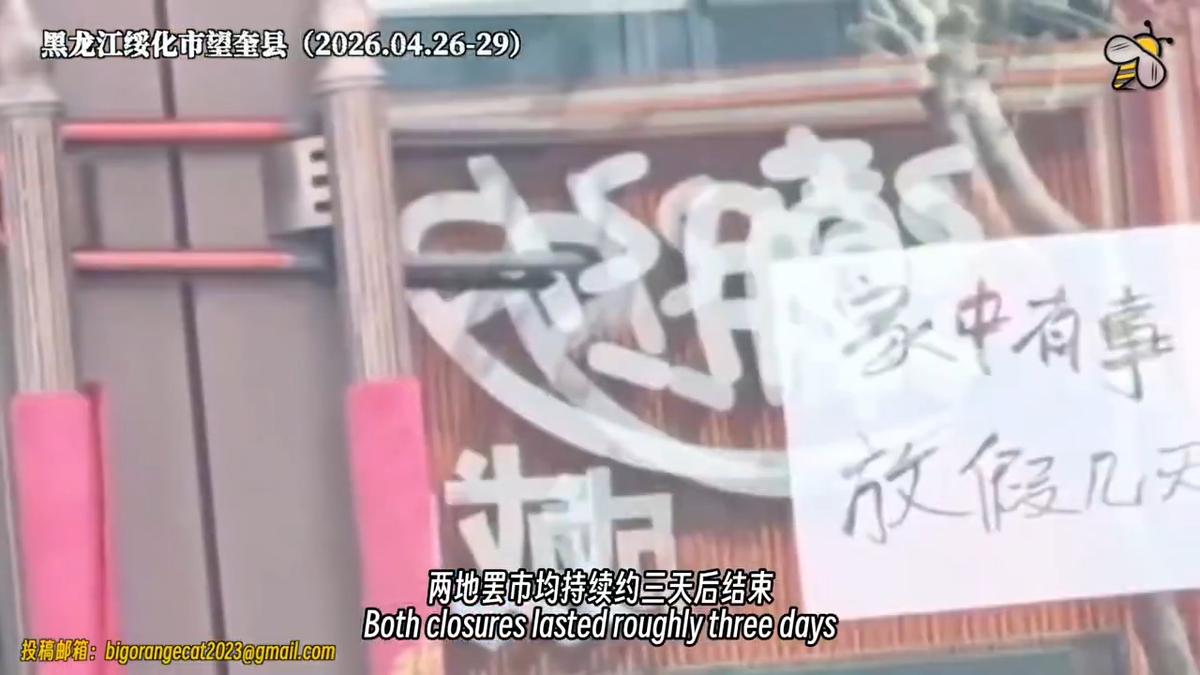
Some stores posted notices saying they were closed because of family matters. Others kept their doors partly open while their owners watched the street for inspectors.
YesterdayBigcat grew out of “Not News,” a project Lu and Li Tingyu started in 2012 to document collective incidents frequently censored in China. Chinese authorities detained them in 2016; Lu was sentenced to four years in prison and Li to two years.
Lu fled China in 2023, later received asylum in Canada, and continues documenting collective incidents through YesterdayBigcat, according to The Reporter.

One merchant confirmed receiving a fine. Others said products had been taken for laboratory testing or that nearby stores had closed until inspectors left.
A kitchenware and household goods merchant surnamed Lin in Guangdong told The Epoch Times that inspectors found a gas stove without China Compulsory Certification (CCC), and several gas hoses in her store. She was fined 495 yuan (about $73).
Lin said officials told her the relatively small penalty reflected several factors, including that it was her first violation and that the certification requirement had become mandatory only in October 2025.
She said merchants had not received clear notice explaining the requirements or what to do with older inventory.
“Before carrying out inspections, you should tell merchants like us and give us a standardized list,” Lin recalled telling officials.
When an official suggested that merchants could find the requirements online, Lin said she responded: “What about people who never went to school or cannot read? How are they supposed to learn?”
Lin said she had operated her business for more than a decade and described this year—particularly the past two months—as the worst period she had experienced.
In Hunan Province, a hardware store owner surnamed Wu told The Epoch Times that inspectors examined polyethylene water pipes in her store in June. One product was found to be slightly thinner than required, she said.
Regulators contacted the manufacturer, and Wu was not penalized.
“If the product itself has a problem, they should investigate it at the source,” she said.
Wu questioned why retailers should face enforcement over suspected defects originating with manufacturers. Small merchants can hold valid business licenses but still encounter problems involving a supplier’s certification, product specifications, labeling, or purchasing records.
A phone and computer repair shop owner surnamed Zhou in Shibing County, Guizhou Province, said local authorities had conducted CCC inspections for years but enforcement had become stricter this year.
Inspectors recently took chargers and portable power banks from his store for laboratory testing, he said. Zhou was told that the results would take about a month, but he did not know what penalty could follow if a product failed.
“Anything electrical is inspected—lightbulbs, power strips, and electric heaters,” he said. “They take a sample to a professional testing organization. If it fails, there will be a fine, but I don’t know how much.”
Zhou said he had obtained a distributor’s business license and requested CCC certificates from manufacturers to reduce his exposure.
“We are a small roadside shop in the countryside,” he said. “What business is there? It is already good enough if we don’t go under.”
Fear of Fines Empties Commercial Streets
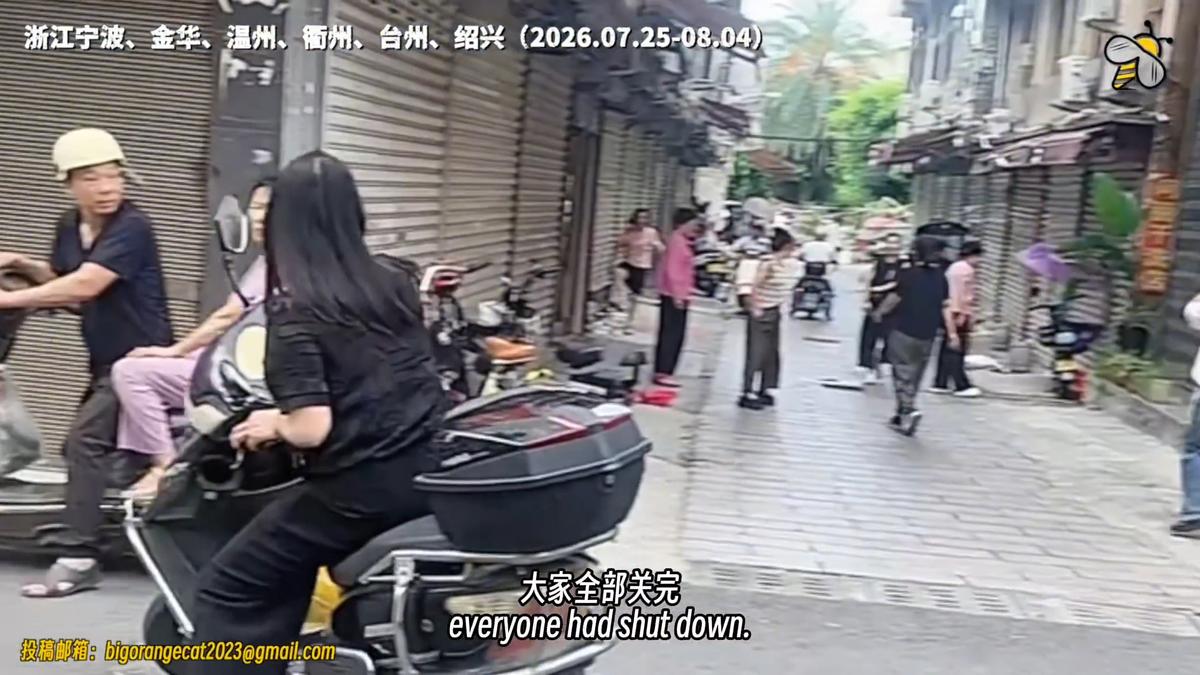
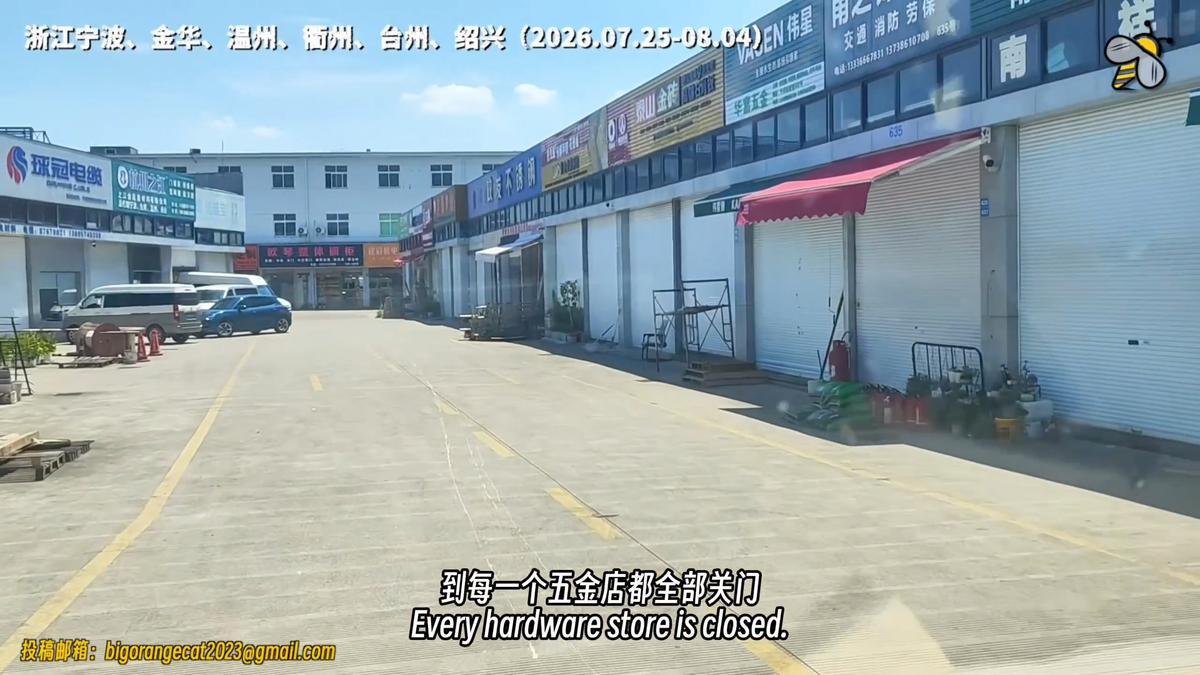
In its compilation of the recent closures, YesterdayBigcat identified incidents in nine cities across Zhejiang, Jilin, Jiangsu, and Guangdong provinces between July 22 and Aug. 4. They included Ningbo, Wenzhou, Jinhua, Quzhou, Taizhou, and Shaoxing in Zhejiang.
A building materials merchant surnamed Sun in Ningbo’s Jiangdong district separately told The Epoch Times that CCC-related inspections had continued for several days.
Sun said stores selling building materials, hardware, adhesives, paint, accessories, and logistics services had closed temporarily to avoid inspection risks.
Merchants recorded in the videos said they often did not know which agency would arrive, what inspectors would examine, or what would be considered a violation.
“We don’t know what they’re inspecting, or whether we’ll pass,” one merchant said. “Everyone is afraid. What we earn is less than what we might be fined, so we close. We might as well close.”
Their uncertainty was compounded by stories of fines running into tens of thousands of yuan—more than many small stores could absorb.
One shop owner said merchants had heard that fire-safety violations could bring a minimum fine of 20,000 yuan (about $2,964).
“You haven’t been a business owner, so you don’t know,” she said. “Who has a passageway that meets every requirement? They say it starts at 20,000. Who can afford that?”
Another resident described the fear that inspectors could seize on almost anything.
“Is it the fire-safety requirement that doesn’t pass, or the sanitation requirement?” he said. “A piece of plaster falls off the wall—10,000 yuan (about $1,482).”
Videos compiled by YesterdayBigcat also carried local accounts of merchants being fined over three spoiled potatoes or a single ashtray. As stories circulated of fines ranging from tens of thousands to more than 100,000 yuan (about $14,820), shop owners feared they could neither anticipate what inspectors would cite nor afford the consequences.
“People are panicking—just panicking,” a man filming in Hailun, Heilongjiang said. He described owners standing outside their shops watching the street, some keeping their doors only partly open.
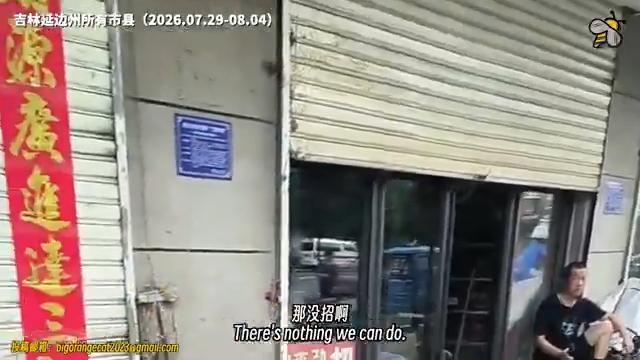
“At the first sign of trouble, the shutters come straight down,” he said. “Every day, your ears and eyes are straining, and your heart is pounding.”
The man said that when he saw someone walking along the street with a serious expression, he immediately wondered whether the person belonged to an inspection team.
“Everyone looks like one,” he said. “Who wouldn’t be afraid? Once they catch something, it is tens of thousands.”
Warnings Race Ahead of Inspection Teams
News traveled through merchants’ chat groups, telephone calls, and tips from people familiar with an inspection team’s movements.
When someone reported inspectors at a nearby market or commercial street, merchants called others farther along the route and urged them to close. A warning about one inspection could empty rows of stores before the team arrived.
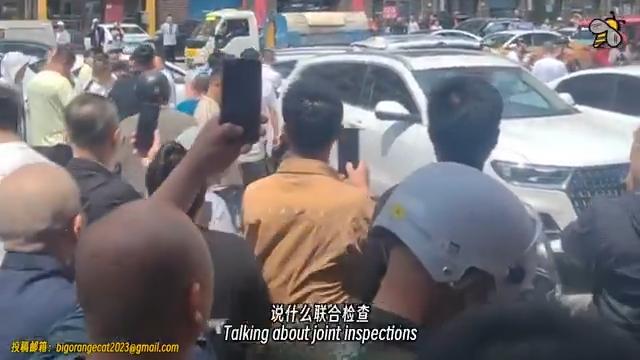
In one scene, uniformed personnel were shown exiting Dayong Tobacco and Liquor Store as residents and neighboring merchants crowded outside. Many held up their phones to record the inspectors.
Dayong had reopened after a local state broadcast urged merchants not to believe rumors about large fines. Inspectors subsequently entered the store and imposed a fine, according to YesterdayBigcat.
Most of the surrounding storefronts were closed. As the officials exited, residents and merchants recorded them for circulation online and in social-media groups.
YesterdayBigcat estimated that hundreds of thousands of businesses had closed, although the overall number could not be independently confirmed.
The platform described the closures as “nonviolent noncooperation.” Its compilation depicted merchants initially shutting their doors to protect themselves from unpredictable penalties, with the same response spreading from one store and commercial district to another as warnings and inspection footage circulated.
Separate Inspection Programs Underway
China’s State Administration for Market Regulation launched a nationwide CCC enforcement initiative in April.
CCC certification is required before products in designated categories can be manufactured, sold, imported, or used commercially in China.
The regulator said the campaign would focus on products including portable chargers, electric bicycles, and gas-burning appliances. Inspectors were directed to look for uncertified products, false certification marks, and other violations and to trace responsibility through the supply chain.
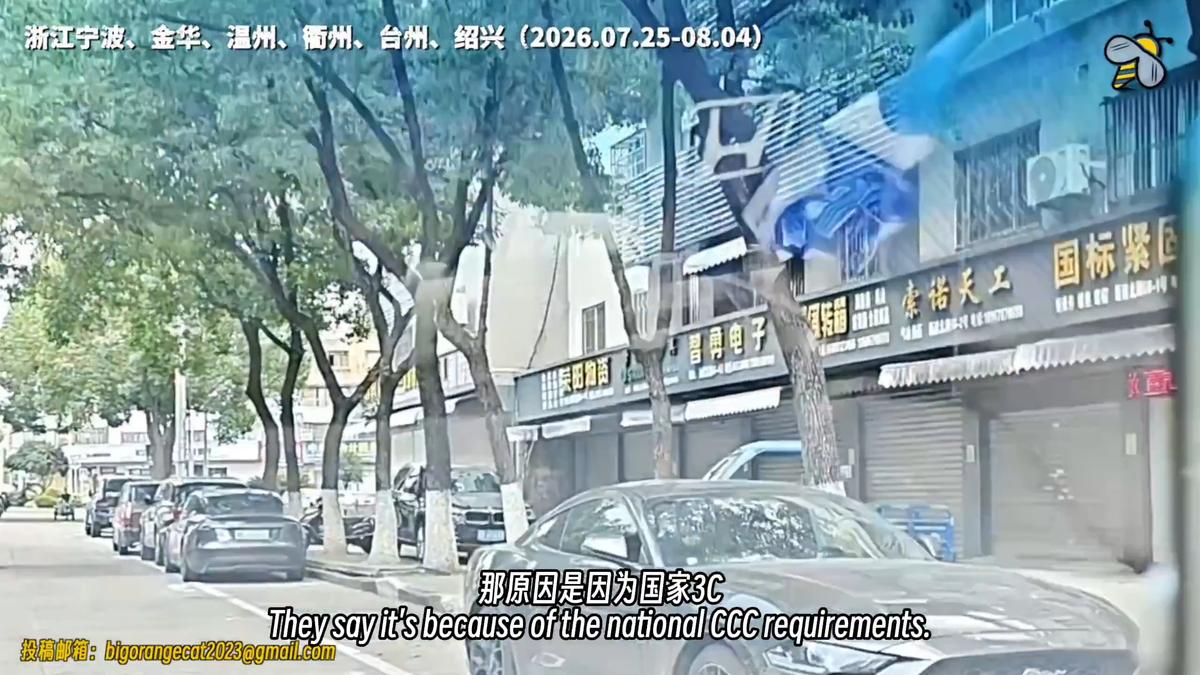
Those categories overlap with some of the hardware, lighting, appliance, kitchenware, and phone-accessory stores described in the interviews and shown closed in the videos.
The CCC initiative does not account for all the businesses shown closed. They also included restaurants, pharmacies, salons, supermarkets, repair shops, and delivery outlets, while merchants frequently referred only to an unspecified “inspection team.”
The Ministry of Emergency Management’s workplace-safety inspections are administered separately. The ministry dispatched 24 central inspection teams across all 31 provincial-level jurisdictions and the Xinjiang Production and Construction Corps for announced and unannounced inspections during the second and third quarters.
Merchants may also face checks involving food handling, fire safety, gas equipment, business records, pricing, scales, and product labeling. Businesses outside the product categories named in the CCC campaign sometimes closed as well.
Thousands of Improper Fines Documented
The closures come after Chinese authorities themselves documented enforcement abuses on a large scale.
A State Council directive on inspections involving businesses identified profit-driven, arbitrary, repetitive, and campaign-style inspections. It also identified agencies disrupting business operations, ordering businesses to close without sufficient grounds, setting inspection quotas, and evaluating officials based on inspection frequency or the amount collected in fines.
A separate administrative enforcement regulation, effective Feb. 1, covered inspections, penalties, seizures, compulsory measures, and other administrative enforcement.
At a May press conference, China’s Ministry of Justice said a yearlong review had generated more than 66,000 leads involving potentially improper enforcement.
Authorities handled more than 5,500 cases involving improper fines totaling 790 million yuan (about $117 million), according to the ministry.
The cases included imposing different penalties for similar conduct, routinely applying maximum fines, using fines in place of regulation, conducting repetitive inspections, and improperly sealing businesses or seizing property.
The ministry also said jurisdictions where fine and confiscation revenue increased by more than 20 percent had been placed under monitoring for possible fine-collection targets or links between penalties and officials’ performance assessments.
Fiscal Pressure Raises Questions
Some merchants and residents speaking in the videos attributed the inspections to local governments’ need for revenue.
Tian Xie, a business professor at the University of South Carolina Aiken, said the tax reviews of listed companies and the inspections affecting small merchants involve different targets and enforcement mechanisms but are unfolding against the same backdrop of falling land-sale revenue, weaker private investment, and mounting pressure on local government finances.
“Under these conditions, authorities have incentives to maximize collections through every available channel, including intensified tax reviews, administrative fines, and multi-domain inspections,” Xie told The Epoch Times.
A 2024 study by Li Yu, Zhuoyang Lyu, and Hao Duan, “Plugging the Gap: Debt Pressure and the Rise of Forfeiture Revenues in Local Governments,” published in Finance Research Letters, found that increased local-government debt pressure was associated with higher fine and confiscation revenue.
Another study by Yukun Wang and Min Dai, “Regulatory Bias Under Fiscal Stress: Evidence From Non-Local Firms in Maritime Transport Enforcement,” published in China Economic Review, found that local governments facing greater fiscal pressure were more likely to penalize businesses based outside their jurisdictions.
Xie said signs of revenue-driven enforcement could include inspection activity or fine collections rising alongside local fiscal shortfalls, penalties disproportionate to the violations, unusually high violation rates, or enforcement spreading across numerous business categories.
The tax reviews involve different agencies and enforcement mechanisms from the storefront inspections.
Xie said unpredictable or overlapping inspections can hurt small businesses even when no fine is imposed. Brief closures interrupt revenue while rent, wages, utilities, and other expenses continue, and uncertainty over what inspectors might cite can discourage owners from hiring, expanding, or investing.
Stores Remain Closed After Official Denial
A video compiled by YesterdayBigcat in Heilongjiang included a broadcast from the Zhaozhou County media center.
A government publicity vehicle traveled along local streets announcing that online reports of merchants receiving enormous fines were false. The broadcast urged businesses not to believe or spread rumors and told them to reopen.
In a separate video, a female resident stood on a street where supermarkets, restaurants, and other stores remained closed.
“They say the rumors have been refuted and that it’s all fake, so why is everything still closed?” she said. “I just want to know—why are the supermarkets closed, the restaurants closed, every kind of store closed?”
Another Heilongjiang resident filmed a row of businesses displaying notices that said, “Family matter, temporarily closed.” He said the last time he had seen closures on such a scale was during the COVID-19 pandemic.
“Business was already difficult,” another resident said while filming a nearly empty street. “Even when stores open, customers may not come in.”
“They’ve frightened everyone,” he said. “Are you officials going to let ordinary people live or not?”