A recent wave of successful lawsuits for foreign companies could be part of China’s continued attempt to portray itself as a country that respects intellectual property (IP) rights.
The propaganda is important to China because of the growing international furor over Beijing’s flagrant disregard for IP, whether through its mass manufacturing of knockoffs (China is where most of the world’s counterfeits originate); state-sponsored economic espionage through hacking Western companies; systematically acquiring Western tech firms to obtain technology critical to the Chinese regime; and the multiple court indictments in the United States alleging that Chinese nationals have conspired to steal data, files, and documents from U.S. companies.
On Nov. 5, Danish toymaker Lego announced that it won a major case against Chinese imitators. A Chinese court ruled that the knockoff companies would have to stop producing the counterfeit toys and pay Lego 4.5 million yuan (about $643,000) in damages.
A month earlier, British luxury brand Alfred Dunhill announced it won its court battle against Chinese menswear brand Danhouli for infringing on its iconic logo, which features elongated lettering. Alfred Dunhill was awarded 10 million yuan ($1.45 million) by the Foshan Intermediate People’s Court, an unusually large sum compared to past Chinese court litigation.
As with much of what happens in China, court rulings have political ramifications.
But the Chinese regime likely has an ulterior motive for its sudden embrace of intellectual property rights: amid increasing scrutiny of China’s IP theft practices, it wants to create an international perception of China as a country that is cracking down on IP infringement.
This is evident in Chinese leader Xi Jinping’s most recent public comments made in the lead-up to his upcoming trade negotiations with U.S. President Donald Trump at the G-20 summit. China’s IP theft is the chief reason the U.S. administration has cited for enacting punitive tariffs on Chinese imports worth $250 billion.
While visiting Spain to secure trade deals on Nov. 28, Xi Jinping said, “We will make efforts to streamline access to markets in the areas of investment and protect intellectual property.”
Earlier in November, Xi also talked up the need to enforce punitive laws for IP infringement, during a speech at the Shanghai import expo, an event that itself was seen as a propaganda stunt to quell growing international concern over China’s predatory trade practices.
Can Foreign Companies Win?
Many legal experts on Chinese IP who have crunched the numbers on Chinese court cases say the win rate for foreign plaintiffs is actually quite high for trademark, copyright, and patent infringement lawsuits. But the data is actually incomplete, owing to the opacity of the Chinese court system.
China did not provide public information on litigation until 2014, when the Chinese court system unveiled a public online docket to search pending cases. Little is known about how Chinese courts ruled in IP-related cases prior to 2014.
Law firm Rouse told The Wall Street Journal in a July 2016 article that the high win rate is likely due to the fact that foreign firms only sue in China if they are confident they can win.
In an annual assessment of global IP practices released this February, the U.S. Chamber of Commerce pointed to continued widespread trademark infringement and barriers in China’s legal system that make it difficult for foreign companies to protect their designs.
“The system tends to favor local entities at the expense of multinational rights holders,” the report said. “Incidences of bad faith trademark filing appear to be worsening and a backlog still exists of decades of abusive filings,” despite some recent lawsuit wins for foreign multinationals, according to the report.
Plenty of Lawsuit Losses
Many prominent examples abound of multinationals that have lost copyright lawsuits to Chinese copycat companies that have clearly copied their designs or concepts.
In 2016, Muji, a Japan-based retailer, sued a Chinese company named Natural Mill in English with a similar concept of selling minimalist-design household goods. The Chinese firm used the same Chinese characters that Muji adopted for its logo (Chinese characters, known as kanji, are used in the Japanese writing system). The Beijing Intellectual Property Court ruled against the Japanese company, citing the fact that Natural Mill filed a Chinese trademark license for its name in 2001. Muji was founded in Japan in 1980, but only entered the Chinese market in 2005.
Former basketball star Michael Jordan also faced a years-long battle for the rights to his name in China.
Air Jordan is a brand under Nike, originally created exclusively for Jordan in 1984.
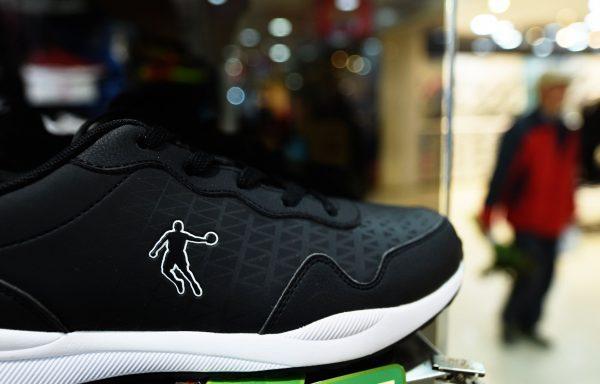
Qiaodan Sports Company based in Fujian Province used a similar-looking logo: a silhouette of a basketball player jumping with a ball in hand. Qiaodan is also the Mandarin Chinese transliteration of Jordan.
And recently, an IP infringement lawsuit involving Chinese, Taiwanese, and U.S. chipmakers have exemplified how Western companies can be ensnared in Beijing’s political fights.
In July, amid boiling tensions between China and the United States over trade tariffs, a Chinese court ordered a sales injunction for U.S. chipmaker Micron, banning it from selling its semiconductor products in China, claiming that the company violated patents held by Taiwanese chip manufacturer, United Microelectronics (UMC).
UMC had filed patent infringement lawsuits against Micron with mainland China courts in January. Observers saw the sales injunction as a retaliatory move by Beijing against an American company for the U.S. administration’s imposition of tariffs on Chinese goods.
The latest development is that a U.S. federal court has indicted UMC, Chinese chipmaker Fujian Jinhua, and three individuals for allegedly conspiring to steal DRAM chip-manufacturing technology from Micron through a cooperation agreement UMC signed with Fujian Jinhua. The U.S. administration has also imposed an export ban against the Chinese company preventing it from buying American tech components.
Dominating Patents on Technical Standards
Beijing is now pushing for Chinese firms to aggressively file patents in cutting-edge technology, as part of its agenda to grab greater global market share in artificial intelligence, 5G, and other key innovations.
Known as China Standards 2035, the plan calls for Chinese companies to develop technical standards and make them the international default, so China will no longer need to rely on foreign technology.
Chinese state media have in turn used China’s high number of international patent applications —48,882 filed with the World Intellectual Property Organization in 2017, making it the second highest-ranking country behind the United States—as propaganda to demonstrate that China respects IP rights.
“China encourages technological exchanges and cooperation between Chinese and foreign enterprises, and protects the lawful IPR [intellectual property rights] owned by foreign enterprises in China,” read one Xinhua article published on June 28.