A farmer in northeastern China said floodwaters left more than 800 of her pigs dead or missing—and that after government departments ignored her requests for assistance, officials repeatedly called and ordered her to delete videos appealing for help.
“They called today telling me to delete it, and they called again the next day telling me to delete it,” the farmer, identified by the pseudonym Han Chunmei, told the Chinese edition of The Epoch Times.
Han said she asked what help officials would provide if she removed the posts.
“We suffered a disaster, and you did not even say anything comforting,” she said. “I posted asking outsiders for help, but you demanded that I shut up.”
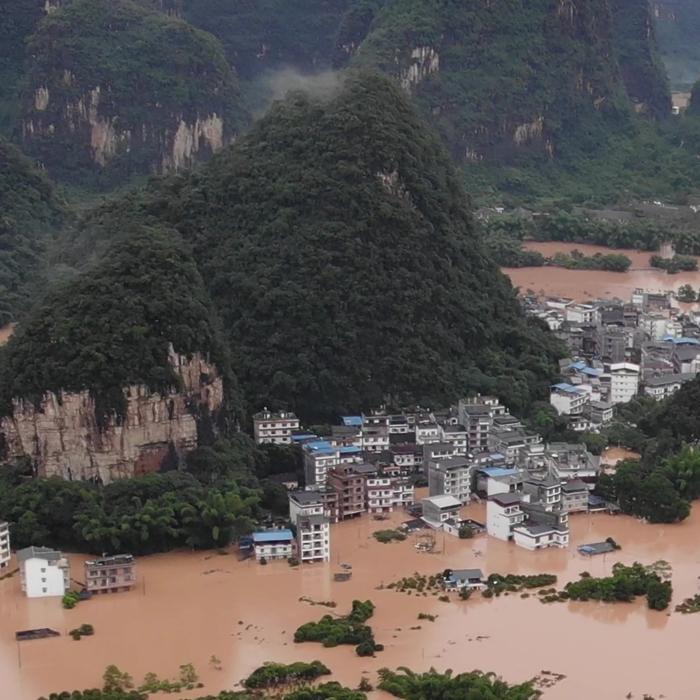
Han was one of two residents interviewed after severe flooding struck Dunhua, a largely rural city in China’s northeastern Jilin Province, on the night of July 14. Both women were identified by pseudonyms because of fear of reprisal.
Their accounts described vague evacuation warnings, blocked roads, improvised shelters, food shortages, and residents largely relying on themselves and their neighbors.

More Than 800 Pigs Dead or Missing
Han said water overwhelmed her hog farm, where she raised more than 800 adult pigs and another 100 to 200 piglets.
About 100 dead adult pigs remained on the property after the flood. The rest were dead or missing, while many piglets also drowned, she said.
She described claw marks on walls where the animals had struggled to escape.
Han estimated that losses to her livestock, feed, vehicles, equipment, buildings, furniture, and other property totaled hundreds of thousands of dollars.
Among the destroyed supplies were about 15 truckloads of corn costing more than 70,000 yuan (about $9,750) per load, she said.
Han said animal disease prevention workers removed carcasses, but no other government personnel came to the property and no one helped disinfect the farm.
She questioned reports by Chinese Communist Party-controlled outlets about government disaster-relief funding and visits to flood victims.
“The news said the government allocated more than 30 million yuan in disaster-relief funds and government personnel were visiting disaster victims,” she said. “I haven’t even seen a government worker or received a bottle of water from them.”
Han said government departments ignored her requests for assistance. She said she had nowhere else to turn, so she began posting videos on Douyin, the Chinese version of TikTok, and other platforms seeking help.
She said calls demanding that she delete the posts soon followed.
A search of Douyin using the Chinese terms for “Dunhua” and “pigs” found no matching videos.
Residents Escaped on Their Own
Zhou Huijuan, the other resident interviewed under a pseudonym, said water began rising rapidly on the evening of July 14 as power and water service failed.
Residents in low-lying homes and near the river moved to higher ground, she said.
“In places where the water was shallower, you could still see a roof ridge,” Zhou said. “In deeper places, the entire house disappeared.”
Zhou and her husband tried to drive toward central Dunhua but found the road underwater. They changed direction and became trapped for another day and night before escaping over a damaged mountain road she remembered from her school years.
She later saw dead pigs, cattle, sheep, cats, and dogs along roads, as well as displaced vehicles and badly damaged homes.
Blocked roads left some residents short of drinking water and food, Zhou said.
Families with remaining supplies shared steamed buns and pickled vegetables. Some displaced residents slept beneath plastic sheets stretched over farm vehicles.
The flooding also inundated fields of corn, soybeans, and rice. Farmers in the region generally have one growing season each year, leaving little opportunity to recover lost crops before winter.
Warnings Did Not Convey the Danger
One week before the disaster, the provincial government published an article titled “Dunhua Builds a Flood-Control Safety Barrier for Its Urban Area.”
It claimed that flood-control equipment was fully operational, officials were on duty on an around-the-clock basis, and a digital platform was monitoring river levels in real time.
Zhou and Han said the warnings that reached them did not convey how rapidly the water would rise or how severe the flooding would become.
Han said the evacuation notice was so vague that her family did not understand that they needed to remove vehicles, livestock feed, clothing, valuables, and other property.
Official Reports Omit the Damage
The Dunhua County website published four articles in total before and after the flood.
The reports promoted claimed emergency mobilization, rescue and recovery work, and officials directing restoration efforts.
None gave a single or countywide count of damaged homes, destroyed crops, livestock losses, injured or missing residents, or total economic losses.
The reports also did not address Han’s account that she received no government assistance before officials allegedly pressured her to remove her appeals.
Residents Question Reservoir Releases
Both women attributed the speed of the flooding to upstream reservoir releases.
On July 14, provincial authorities discussed reservoir discharges and “pre-discharge” measures intended to create storage capacity before the heaviest rainfall.
Han also said a downstream hydropower station held back water, causing levels to rise further before the structure collapsed.
“It had to be a release,” she said. “Without the upstream reservoir releasing water, it could not have risen that quickly.”
Han called for an investigation into the station, compensation for affected farmers, and loan extensions or new credit to help them rebuild.
Despite losing most of her animals and property, she said she planned to raise livestock again.
“It is the only thing we know how to do,” she said.