National Rent Growth Slows for 3rd Month, but Surges in Some Cities: Report

Annual rents fell the most in the West.
National Rent Growth Slows for 3rd Month, but Surges in Some Cities: Report
A 'For Rent' sign in front of a home in Arlington, Va. Will Dunham/File Photo/Reuters
|Updated:
0:00

Residential rental rates continue to cool—except for in New York and San Francisco, where rates remain among the highest in the nation.

Median rental rates dipped slightly in September, the third straight month of price declines, online real estate marketplace Zumper said in its monthly national rent index. Nationwide, rents for one-bedroom residences were $1,517, while rents on two-bedroom properties fell slightly, to $1,894. One-bedroom rents softened in 71 of 100 cities, Zumper said.

Anthemos Georgiades, Zumper’s CEO, said national rental prices have cooled as the rental market continues to recalibrate.

“A combination of cautious renter demand amid economic headwinds, ample inventory on the market, and a labor market that’s losing momentum have eased the pressure on rents we saw earlier this year,” Georgiades said.

Annual rent costs fell the most in the West. Salt Lake City, Utah, saw a decline of 11.1 percent; Denver, Colorado, followed at 7.3 percent; Boise, Idaho, at 5.8 percent; and Phoenix, Arizona, at 3.8 percent, Zumper reported. Much of the declines in the Mountain Region states can be attributed to a flood of new construction that increased vacancy and stalled rental growth.

There were more than 77,000 new rental units delivered across the mountain states in the first quarter, an increase of more than 5 percent. Salt Lake City and Phoenix are slated to deliver numerous additional multifamily properties through the next quarter, Zumper said, but multifamily construction is slowing in many markets.

The National Apartment Association (NAA) said new supply continues to trail overall renter demand, and slowdowns in the delivery of new apartment communities will tighten rental rates in saturated markets. With an expected shortfall of more than 250,000 units in the second quarter, many markets will begin realizing upward pressure on rental rates, the NAA said.
Construction starts in the apartment industry have been on a downward slope for the past two years, real estate analytics company CoStar said. Nationwide, there were 175,655 new units delivered in the second quarter, a year-over-year decline of 11 percent. Vacancies among apartment rental units stood at 8.2 percent in the second quarter, despite absorption of 151,440 units.
In New York City, strong demand for the city’s more than 2.4 million rental units pushed rental rates to the highest in the country. The city saw in September increases of 1–3 percent in one- and two-bedroom rents, to $4,460 and $5,380, respectively.

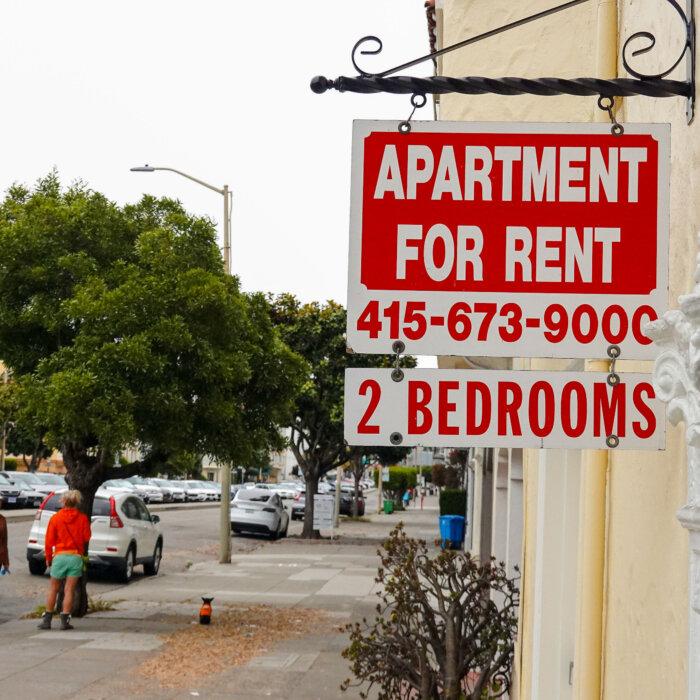
On the West Coast, rental rates in San Francisco topped pre-pandemic benchmarks, rising to $3,510 for single-bedroom units and hitting the $5,000 mark for the first time for two-bedroom properties, Zumper said.

Those figures represent annual increases of approximately 11 percent and 17 percent, respectively, driven by return-to-office policies and increases in AI tech hiring in the city. OpenAI, for example, is headquartered on Market Street, while Anthropic has its headquarters in the city’s Mission Bay district.

Google LogoMark Us Preferred on Google
Rob Sabo
Rob Sabo
Author
Rob Sabo has worked as a business journalist for more than two decades and covers a broad range of business topics for The Epoch Times.