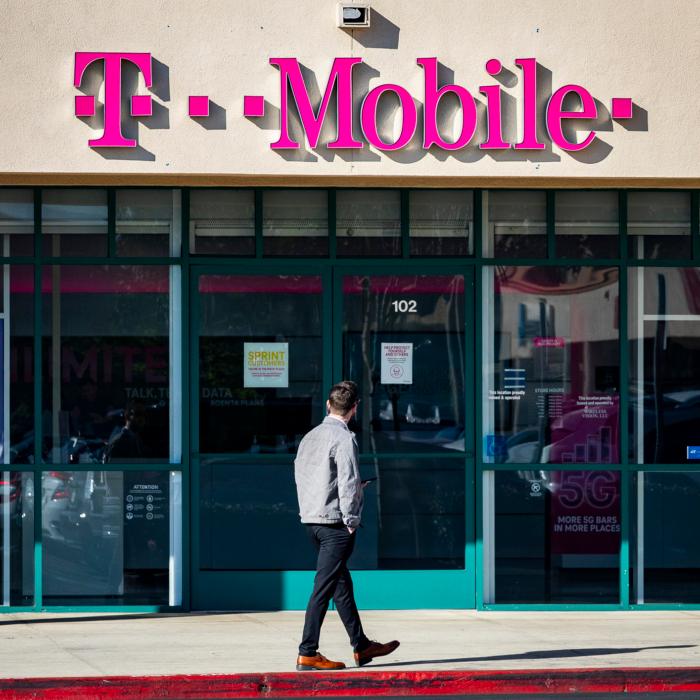
T-Mobile said on July 23 that it expects to see higher customer churn in the third quarter due to its ongoing push to migrate customers on legacy phone plans to newer plans utilizing its 5G and 5G Advanced networks.
The announcement, made during the wireless network operator’s conference call with industry analysts following the release of its second quarter financial results, sent T-Mobile’s shares sharply lower. The stock closed down nearly 15 percent.
T-Mobile ended the second quarter with more than 30 million monthly active users, but it expects temporarily elevated account churn in the third quarter, with postpaid account additions totaling approximately 250,000, well below analyst expectations of nearly 304,000 new accounts for the upcoming quarter.
Postpaid net account additions totaled 277,000 in the second quarter, a year-over-year decrease of 13 percent, and T-Mobile expects its full-year postpaid account additions to be between 950,000 and 1.05 million.
Despite slower postpaid account growth, the company’s Average Revenue Per Account of $152.91 was up 2 percent from the same quarter in 2025.
“The impact to postpaid phone churn is lower as the modernization impact is concentrated more in accounts with fewer lines,” T-Mobile Chief Financial Officer Peter Osvaldik said.
“This modernization creates strong value both for customers and T-Mobile and sets us up to deliver against our 2027 guidance ambitions.”
T-Mobile is shifting customers away from legacy wireless plans to its newer Experience plans, which are designed for its high-speed 5G and 5G Advanced networks. The plans, introduced in April 2025 with a five-year price guarantee, range from $100 to $215 per month for one to four phone lines with AutoPay, depending on the service tier.
T-Mobile reported total second quarter revenues of $22.7 billion, down 1.4 percent from $23.1 billion in the first quarter but up 7.9 percent from $21.1 billion in the comparable quarter a year ago. Diluted earnings per share jumped 5 percent year over year to $2.99 and included cost impacts from its 2025 merger with UScellular. Net cash from operating activities, meanwhile, tallied $7.5 billion, up 7 percent year over year.
T-Mobile raised its adjusted free cash flow for the year to $18.4 billion to $18.8 billion, up from previous guidance of $18.1 billion to $18.7 billion and driven by lower cash income taxes. Full-year service revenues are expected to hit $77 billion, an increase of 8 percent, with third quarter expectations of $19.3 billion climbing 6 percent year over year.
T-Mobile U.S. President and CEO Srini Gopalan highlighted a number of new technology initiatives, including the second quarter roll-out of the company’s first network-native artificial intelligence (AI) application that embeds AI models directly into core operations.
“Longer term, we believe our network will become the connective tissue for physical AI with inferencing at the edge,” Gopalan said.
“We’re continuing to meet the customer where they want while driving digital transformation to further enhance the experience.”
Gopalan also told analysts that T-Mobile would double down on next-generation wireless technologies to build out the company’s network superiority, not only in 5G but in 6G as well. While fixed wireless access constitutes much of the traffic across its networks, its overall capacity remains several times that of current traffic, he noted.
John Saw, T-Mobile U.S. chief technology officer, added that T-Mobile is well positioned to handle any potential capacity due to growth in AI traffic with the rollout of 5G Advanced.
“That is actually in preparation for not just giving our customers with phones a better experience, but also better uplink for future AI traffic that we expect to be seeing soon,” Saw said.