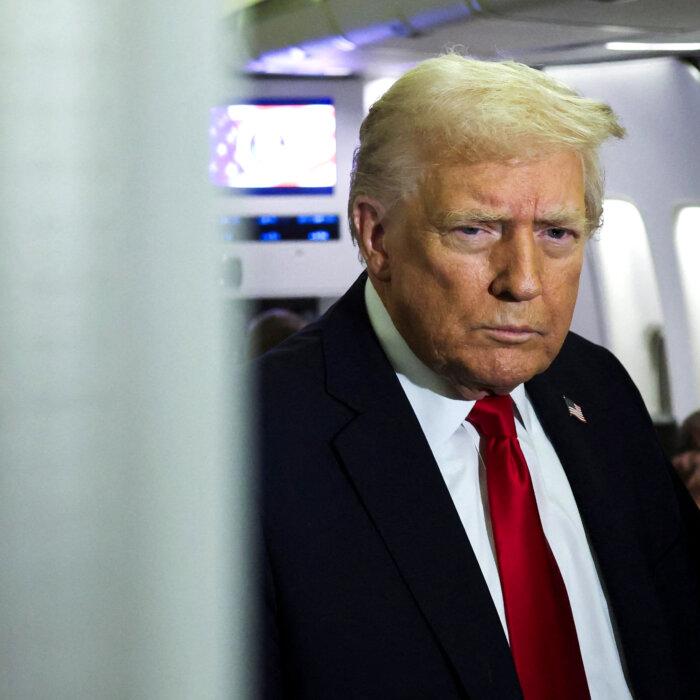
Recently, a growing military buildup in the region and talks of possible U.S. land strikes in Venezuela have raised questions about whether Trump is seeking regime change in the country and whether U.S. action could indirectly trigger a collapse.
“[The Maduro regime has] caused a lot of problems, and ... [has] sent millions of people into our country.”
The Trump administration views the Venezuelan regime as a significant national security threat to the United States, citing its involvement in drug trafficking and mass migration, as well as its ties to Iran, China, and Russia.
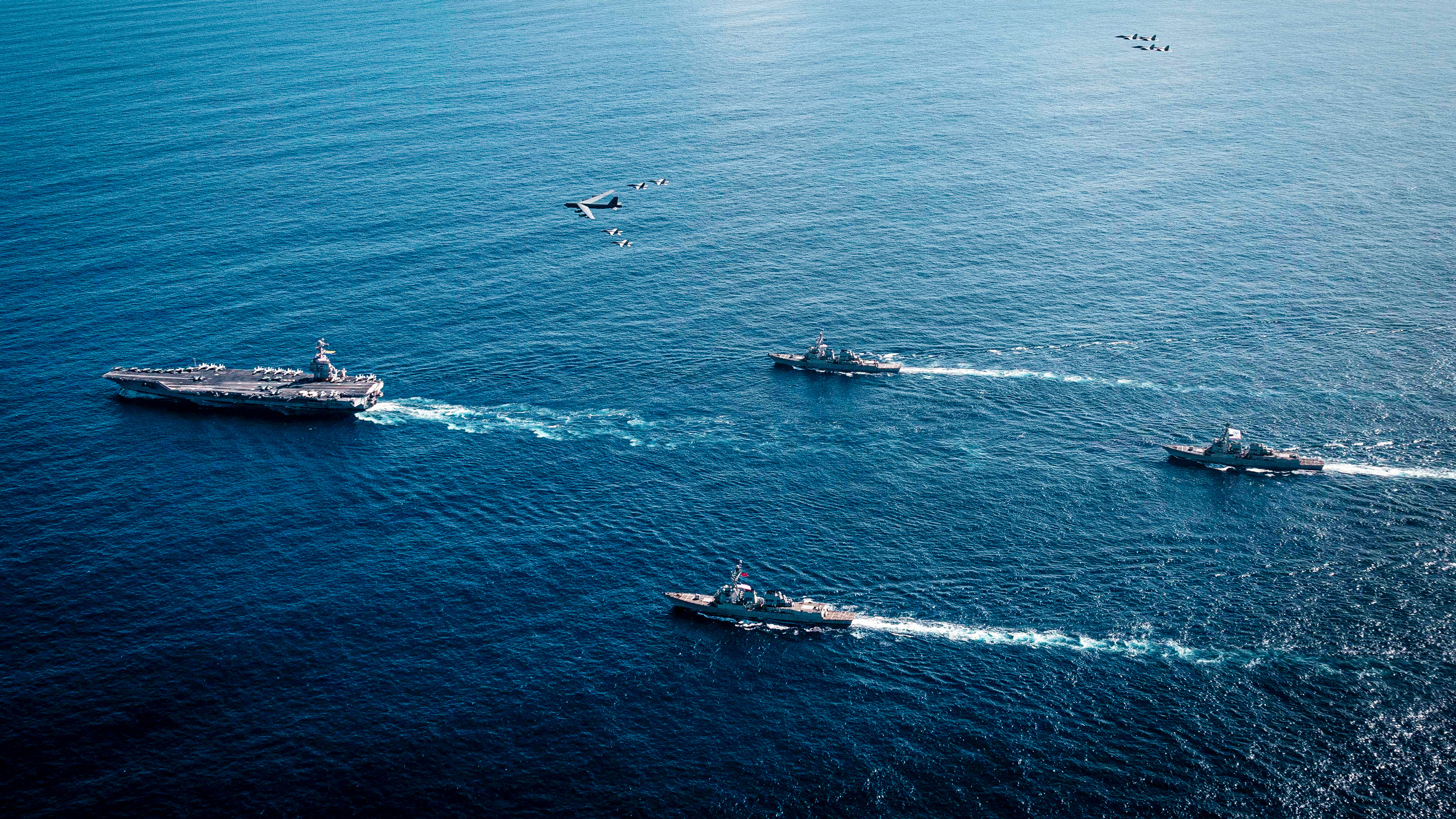
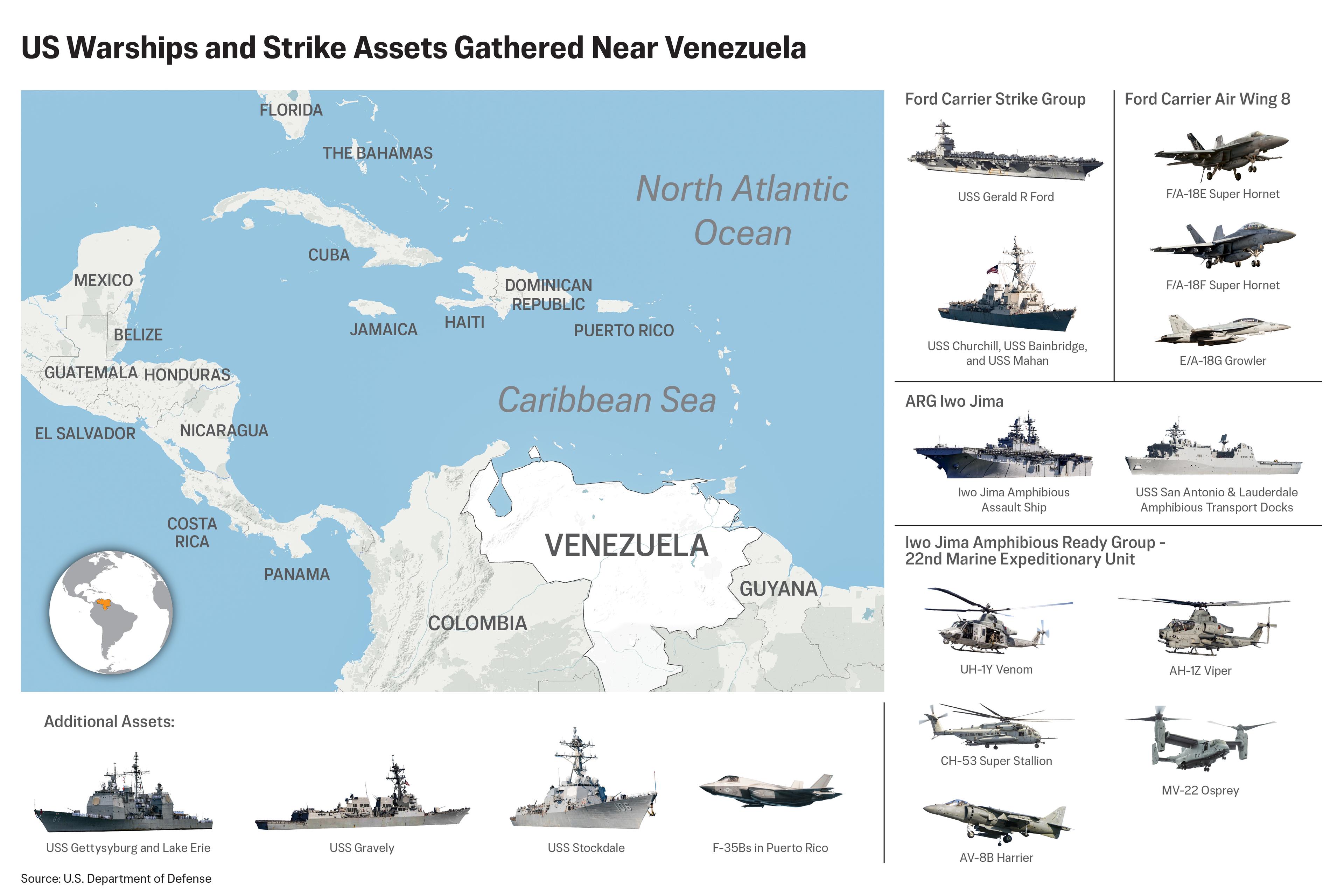
In recent weeks, the U.S. military has deployed one of its largest forces in decades to the Caribbean, including the USS Gerald R. Ford Carrier Strike Group, considered the world’s most advanced aircraft carrier. In total, nearly a dozen warships and about 12,000 troops are stationed in the region as part of what the Pentagon has called Operation Southern Spear.
Evan Ellis, a Latin American studies professor at the U.S. Army War College, said he does not believe that the Trump administration is conducting the military buildup to explicitly seek regime change.
“It’s not about restoring the legitimate government,” he told The Epoch Times. “It’s not about a crusade for democracy per se. It’s about stopping a threat to U.S. interests.”
Although, Ellis said, U.S. land strikes in Venezuela “would likely set into motion a chain of events” that might lead to regime change.
If Maduro departs the country, the legitimate and democratically elected government of Venezuela’s opposition leader, Edmundo González, is expected to come to power. González was recognized by the United States and Europe as Venezuela’s rightful president-elect following the disputed 2024 election.
Trump and members of his administration have repeatedly said Maduro is head of an extensive drug trafficking network, an allegation the Venezuelan leader has denied.

A week later, the United States formally designated Venezuela’s Cartel de Los Soles as a foreign terrorist organization, holding it responsible for violence across the Western Hemisphere and for trafficking drugs into the United States and Europe.
With this action, the administration has formally designated Maduro as a member of a foreign terrorist organization.
The administration said the terrorist designation authorizes the United States to expand military operations in Venezuela.
Cartel de Los Soles has become the 14th Latin America-based criminal enterprise to be designated as a foreign terrorist organization since the beginning of Trump’s second term. Argentina, Peru, Ecuador, Paraguay, and the Dominican Republic have also recognized the group as a terrorist organization.

A Regime on the Brink?
Despite sitting on top of the world’s largest proven oil reserves, Venezuela’s oil production has collapsed because of the socialist regime’s mismanagement and U.S. sanctions, resulting in a severe economic crisis. Many Venezuelans who have suffered from hyperinflation, poverty, and the ongoing humanitarian crisis for years may finally see an opportunity for change.According to Andrés Martínez-Fernández, a senior policy analyst at the Heritage Foundation, the regime is “hanging on to power by a thread,” with limited military support.
“It’s not a regime that maintains any level of substantial public support in Venezuela,” he told The Epoch Times. “Even within the military, adherence to the regime is more limited to some of the higher ranks, those who have benefited from engagement in narco-trafficking.”
Martínez-Fernández said he does not anticipate widespread unrest in the event of regime collapse and Maduro’s departure.
Ellis cautioned that violence and instability in the country could follow regime change. Certain groups in Venezuela, including radicalized members of the National Guard, may attempt to destabilize the country by inciting terrorism, attacking refineries, or sabotaging infrastructure, he said, noting that such violence could hinder the new government’s efforts to restore order.
The Trump administration is unlikely to send its troops into Venezuela to change the regime or restore order, according to Brent Sadler, a retired U.S. Navy captain and a senior research fellow at the Heritage Foundation.
Instead, the goal seems to be to constrain or prevent further escalation, he told The Epoch Times.

“This is not an invasion force,” Sadler said. “It’s more surgical.
“It’s intended to provide the president of the United States the option to surgically go after or to respond, should the Venezuelans or the cartels decide to take a shot at U.S. forces. It’s a hammer waiting to be used.”
Sadler predicts that U.S. forces will stay in the region until Venezuelan drug cartels are put out of business.
He said the primary goal of the military operation is to cut the cartels off from their two big markets: the United States and Europe.
Legal Justification
Since September, the U.S. military has conducted at least 21 lethal strikes on suspected drug trafficking boats in the Caribbean Sea and eastern Pacific Ocean. These strikes killed more than 80 people, whom the Trump administration referred to as “narco-terrorists.”The administration argues that the military’s strikes in the Caribbean are part of a “non-international armed conflict” because it does not recognize Maduro’s government as legitimate.
Ellis said that if the United States attacks a government that it recognizes as legitimate, the attack can be seen as an act of war. But if the group in power is not a legitimate government and is instead an armed group occupying a territory, then the administration can argue that this is not a war between states but a non-international armed conflict.
The administration argues that this is a “non-international armed conflict,” which makes the boat strikes permissible under domestic law, even though they occur in international waters.
“And clearly, the González government has been supportive of U.S. action.”
Oil, Russia, China
Although both China and Russia have interests in the region, it is unlikely that they would take the risk of becoming directly involved in the fight, according to experts.Given Russia’s involvement in Ukraine, experts believe that it is unlikely to provide support for the Maduro regime and risk straining relations with the United States.
The U.S. military presence in the region has been a welcome development for Guyana, one of South America’s smallest countries. Guyana faces a significant threat from Venezuela, which claims the oil-rich Essequibo region, nearly two-thirds of Guyana’s territory. China has also been growing its economic influence in Guyana.
Critical of the Trump administration’s pressure on Venezuela, Colombian President Gustavo Petro has said the U.S. efforts are aimed more at gaining access to the country’s oil than at stopping drug trafficking.
U.S. companies such as Chevron may benefit from increased access to the Venezuelan market. Ellis said that more access to oil would be a positive outcome of regime change but that it is not the primary goal.

Easy Way or Hard Way
There have been growing signs in recent days that a U.S. strike on Venezuela could be imminent.From Nov. 16 to Nov. 21, the United States conducted joint military exercises with Trinidad and Tobago, a country located just seven miles off Venezuela’s northeast coast.
On Nov. 26, Hegseth traveled to Santo Domingo, Dominican Republic, to meet with the country’s top leaders.
Martínez-Fernández said he does not foresee a scenario in which Maduro can remain in power.
He said the Trump administration’s hints in recent days about a possible attack have likely been given with the hope that the threat will encourage Venezuela’s military to topple the regime from within.
The Venezuelan leader may also bend to the pressure to resign and leave the country peacefully, which would simplify matters for the U.S. military.
On Nov. 25, the U.S. president told reporters, “If we can save lives, we can do things the easy way, that’s fine, and if we have to do it the hard way, that’s fine, too.”