The United States has rejected the renewal of the North American free trade agreement, leaving its long-term future uncertain and setting the stage for continued negotiations between the three partners.
The outcome of the July 1 review of the Canada-United States-Mexico Agreement (CUSMA) didn’t come as much of a surprise. U.S. President Donald Trump suggested in recent weeks he would not renew the deal, and the United States and Mexico have a third round of bilateral negotiations on CUSMA planned for later this month.
The United States Trade Representative (USTR), which is leading the negotiations, has yet to announce a first round of formal bilateral talks with Canada.
Though the United States has formally announced it doesn’t want to renew CUSMA, that doesn’t mean the trade deal will unravel. Pending no developments, the agreement remains in place for the next 10 years, with annual reviews like the one that just took place on July 1.
At any time during this period, the parties could decide to extend the agreement for another 16 years, as is the stated wish of Canada and Mexico. The agreement also has a clause that allows one party to withdraw from CUSMA after providing six-months’ notice. The deal would remain in force for the other parties.
In a July 1 statement explaining the U.S. administration’s stance on CUSMA, the USTR said it opposes a renewal “in its current form.”
“The United States will continue to engage with Mexico and Canada to address the Agreement’s shortcomings and our trade deficits with these countries,” the statement said.
Trade talks between Canada and the United States were frozen from November to March. Trump ended negotiations in October after the Ontario government ran an anti-tariff TV ad campaign in the United States.
Canada made two key concessions before talks advanced to that stage. In June 2025, Ottawa pledged to repeal the Digital Services Tax (DST), which the Trudeau government had introduced to target major U.S. technology companies. The tax was formally repealed with the passage of the Budget 2025 Implementation Act in March.
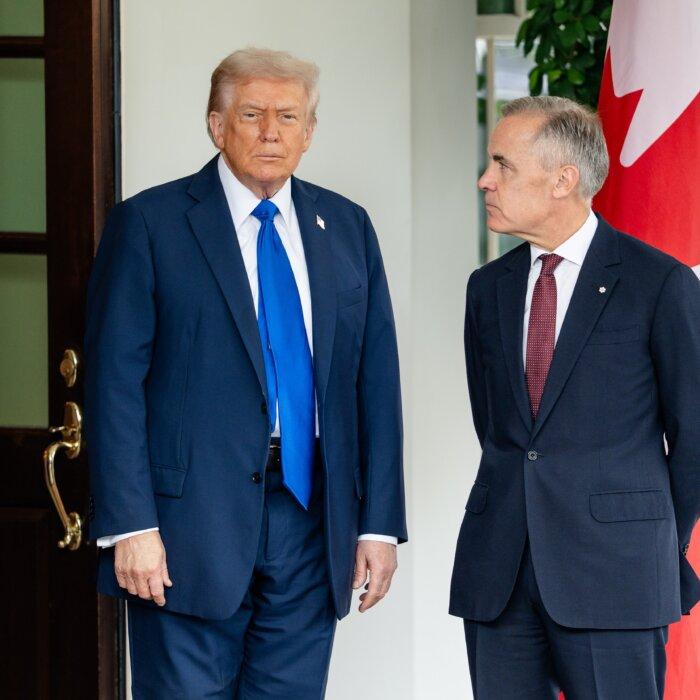
Canada also lifted most of its counter-tariffs on U.S. goods in September 2025, just weeks before Carney’s Oval Office meeting.
Ottawa recently signalled another potential concession when it asked the Canadian Radio-television and Telecommunications Commission (CRTC) to review its decision to triple the levy on major online streaming services, including Netflix and Paramount, to support Canadian and indigenous content.The Liberal cabinet’s directive to the CRTC came one day after LeBlanc met with U.S. Trade Representative Jamieson Greer in Washington.
Hoekstra has called for the Online Streaming Act, which underpins the CRTC’s decision, to be repealed entirely.
The DST and the Online Streaming Act are among the measures Greer’s office has identified as trade barriers. Others include Canada’s supply management system for dairy and poultry, as well as provincial liquor board restrictions on U.S. alcohol.
It remains to be seen whether Canada will have to make further concessions to advance the talks and achieve its primary objective of eliminating U.S. sectoral tariffs. That may prove difficult, as Washington has insisted the tariffs must remain in place to support its efforts to reshore manufacturing.
Conservative MP Shuv Majumdar, recently appointed as his party’s critic on Canada-U.S. trade, said the “wait-and-see” approach of the government lacks urgency amid prolonged uncertainty.
“We’re ready to continue discussions but it will take more time, and that has been obvious for a long time,” he said.