Prime Minister Mark Carney and leaders of the European Union share a similar vision that climate change policies should be integrated in trade between countries.
Carney’s comment came in response to a reporter’s question about a draft agreement of a trade deal between the United States and the EU, which was being circulated by the U.S. Trade Representative’s Office.

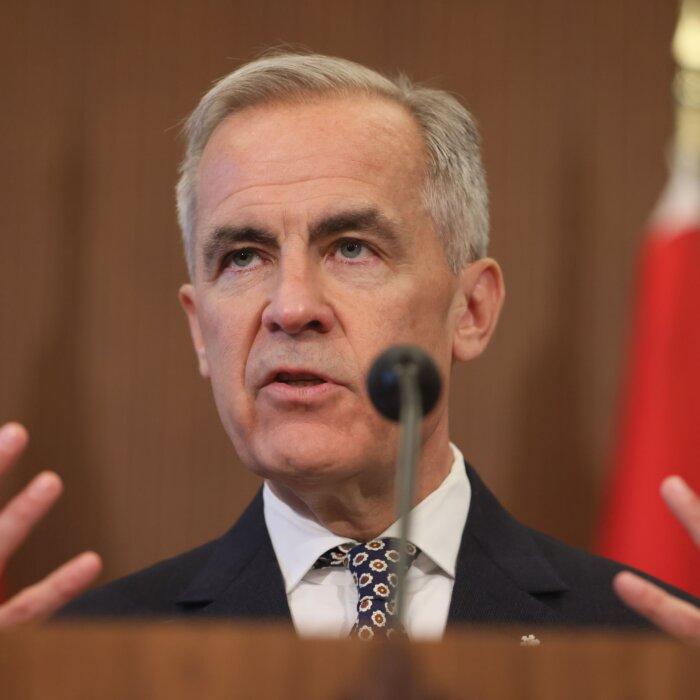
President of the European Commission Ursula von der Leyen did not confirm the media report and said she wouldn’t go into details about the trade negotiations with the United States.
“Negotiations are only closed at the moment. Everything is negotiated,” she said during the press conference alongside Carney.
“Of course we discuss tariff lines, we discuss non-tariff barriers like standards and norms for example, we discuss strategic purchases, we discuss all these topics,” she said. “But where it is the sovereign decision-making process in the European Union and its member states that is affected, this is too far.”
Before becoming prime minister, Carney had been an advocate of climate change policies such as carbon pricing and served as the U.N. special envoy on climate action and finance. He nonetheless eliminated the consumer carbon tax immediately after assuming power in March, saying the tax had become too “divisive” after Conservatives campaigned for years on its removal.
While this topic received more attention during the campaign, Carney has also pledged to adopt a carbon border adjustment mechanism like the EU.
This was not a major talking point during the election campaign, but it appears in the Liberal platform.
The purpose of the mechanism is to help protect Canadian industries that are being domestically penalized by carbon pricing. By raising the price on imported goods high in carbon, it helps keep local companies remain competitive.
The Liberal platform says “companies that take their climate responsibilities seriously should be treated fairly. So we will work with reliable partners to ensure fairness for Canadian industries and better economically integrate Canada with allies in the fight against climate change.”
The Liberal government has not indicated when it intends to propose its carbon border mechanism.
“Guess what one of the requirements is to diversify trade to the European Union?” he said in London, England, on March 17, while saying that carbon pricing will also be necessary for trade with the UK. He added that it would become a necessity for trading with “emerging Asia” as well.
Recent Focus
Amid the trade conflict with the United States, which entails different sets of tariffs and retaliatory measures, Liberals have focused on passing tax relief measures in the House of Commons, along with Bill C-5 to remove federal barriers to interprovincial trade and speed up approval of major projects. Bill C-5 cleared the House of Commons on June 20 and is expected to be studied in the Senate the following week.A deal between Canada and the EU was signed during Carney’s visit, which will allow talks to begin for Canada to join Europe’s rearmament plan. Canada and the EU also agreed to deepen their strategic partnership.
“Carbon pricing, carbon removal and industrial decarbonization are key to reaching net-zero and decarbonization goals, while a high integrity carbon market can contribute to enhancing the global ambition,” it reads.