Making the most of a rare meeting with U.S. President Donald Trump amid tariff disputes may be high on the agenda of some of the leaders attending the G7 Summit in Canada, and Prime Minister Mark Carney used the opportunity to publicly praise the president.
The two leaders held a bilateral meeting on the morning of June 16, prior to the reception of leaders and the initial working session of the summit in Kananaskis, Alberta.
Reporters were allowed in the room after the meeting, where Carney spoke a few words and Trump took all the questions from media.
Carney told Trump it was a “great honour” to welcome him to Canada. He also wished the president a happy birthday and noted the 250th anniversary of the U.S. Army. Trump had marked the anniversary with a grand military parade in Washington over the weekend.
“This marks the 50th birthday of the G7, and the G7 is nothing without U.S. leadership,” Carney added, remarking on Trump’s “personal leadership” on issues such as geopolitics, the economy, and technology. Carney said Canada wants to work “hand in hand” with the United States in these areas.
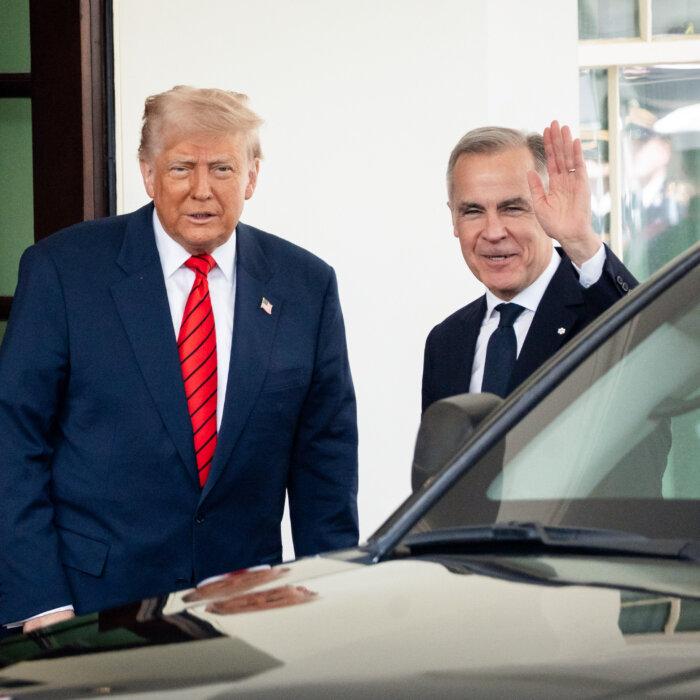
Trump thanked Carney for his words and said the two have developed a “very good relationship.” The two have remained in direct contact since they met in person for the first time at the White House in early May, as they discuss the terms of an economic and security partnership.
“I’m sure we can work something out,” Trump said about the deal, adding that he and Carney have “different concepts” about what it should look like.
Trump then spoke on geopolitical issues such as the composition of the G7, Russia, and the Israel-Iran war, before Carney interjected to put an end to the media availability.
“I’m going to exercise my role, if you will, as a G7 chair, since we have a few more minutes with the president and his team, and then we actually have to start the meeting to address some of these big issues,” he said.
Trump was the centre of media attention, much like during Carney’s visit at the White House when the prime minister scarcely spoke.
“You’re a transformational president,” he said, citing Trump’s “relentless focus on the American worker, securing [U.S] borders, ending the scourge of fentanyl and other opioids, and securing the world.”
“We have to change with the times and to build a better world,” Carney said. “And some of you, such as you, Mr. President, have anticipated these massive changes and are taking bold measures to address them.”
The prime minister said all members of the G7 are reinforcing their militaries and security services for the “new world” where “hostile states and terrorists have expanded their capabilities and their reach.”
In another comment appearing to be directed at Trump, Carney said security is tied to economic prosperity, which he said comes from cooperation.
Trump has upended international trade by implementing a tariffs agenda that has impacted U.S. friends and foes alike, which was also a main campaign target of Carney during the election, saying that Canada’s old relationship with the United States was “over.”
Carney’s tone with Trump in public has since been more diplomatic, and private discussions also appear to be non-confrontational, with Trump expressing he has a good relationship with Carney.
Aside from trade, the two hold differing stances on some geopolitical issues, notably the Israel-Hamas war. On the China file, Trump has reserved his highest tariffs for the Beijing regime, while Carney has noted that China is the highest security risk for Canada.