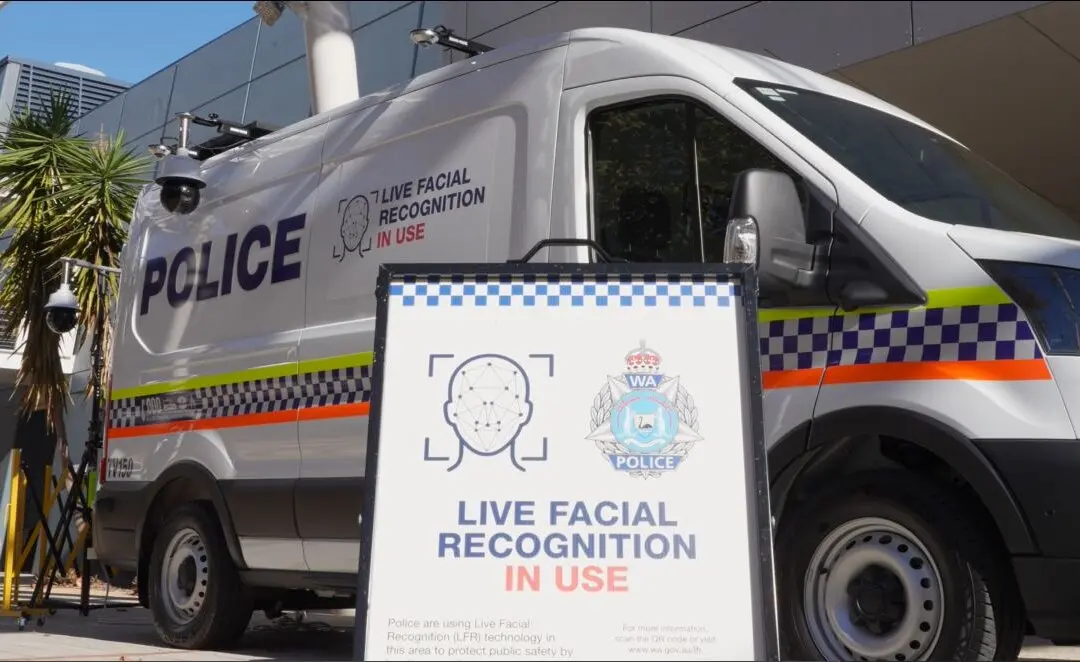
Police in Western Australia are using a purpose-built surveillance van equipped with 360-degree cameras and facial recognition technology, a move that has drawn criticism from civil libertarians.
At this stage the trial involves just one van, and police say the technology will pixelate the face and delete the image of anyone not on their “strictly controlled alert list,” which includes “people with warrants ... people that are non-compliant with lawful restrictions [and] people that are wanted for questioning for serious offences.”
They say it will also assist them in locating missing and vulnerable people.
“Advancements and innovation in technology, including through initiatives such as facial recognition, present significant opportunities for law enforcement agencies, with community safety the number one priority,” WA Police said in a statement released to The Epoch Times.
“This approach has been successfully implemented in other jurisdictions around the world, resulting in improved community safety.”


WA Police Commissioner Col Blanch also said live facial recognition would help police get high-risk offenders off the streets sooner.
“It is about using modern technology responsibly to keep our community safe. It allows police to focus on individuals who present a real risk, while the vast majority of people go about their day without any impact at all.”
Greens Senator Speaks Out
But the move has alarmed civil libertarians and Greens Senator David Shoebridge.“There is no consent here and there is no choice. People going to a concert or a footy match are having their biometric data harvested by police simply for showing up in public.
“This technology gets it wrong, and it gets it wrong most often for women, young people and people with darker skin. That means people will face even higher risks of being wrongly stopped and questioned.”
He pointed out that WA’s new privacy protections for biometric data come into force on the July 1.
“Switching this on now looks like a deliberate rush to build a surveillance system before the law can catch up, and the public deserves a straight answer about that timing.
“The European Union bans real-time facial recognition in public spaces for law enforcement, and Australia is sprinting in the opposite direction.”
Privacy Group Concerned About False Positives
Electronic Frontiers Australia (EFA) calls the police decision to roll out the technology before it falls under the new law “an outrageous act of police overreach and a fundamental breach of our individual and collective human and digital rights.”EFA disputes claims about the accuracy of the technology, especially if is deployed in an area where there are a large number of people in close quarters.
“When an algorithm with a supposed accuracy rate of 99.9 percent is deployed against a massive population baseline (e.g. scanning 100,000 commuters in a transit hub or at a major sporting event or concert), the system’s marginal error rate creates a huge volume of false alerts,” the group says.
“For example, if 100,000 innocent people are scanned, a 0.1 percent false-positive rate will still result in 100 false alarms.”
“What we are talking about is a massive breach of human rights and privacy and one which could increase in scope and scale in the absence of strong laws to limit the use of biometric technologies in public and private spaces,” EFA chair John Pane said.
“The use of real-time biometric image matching in public spaces by WA police really is the cherry sitting on top of the surveillance state cake.”