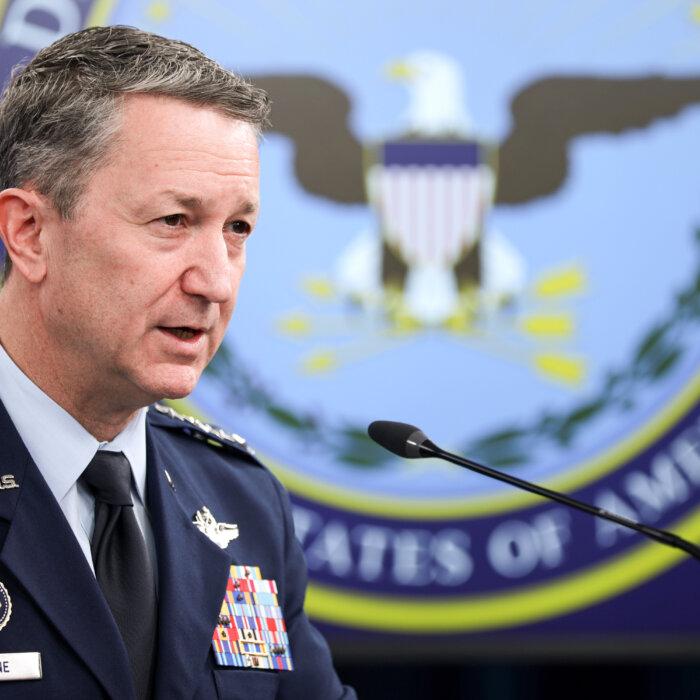
ARLINGTON, Va.—The U.S. military intends to send additional forces to the Middle East amid continuing hostilities against Iran, Chairman of the Joint Chiefs of Staff Gen. Dan Caine announced on March 2.
At a Pentagon press briefing, Caine said thousands of troops from all military branches have already participated alongside Israeli forces in the joint strikes against Iran, called Operation Epic Fury by the United States and Operation Rising Lion by Israel.
U.S. Navy Adm. Brad Cooper, who commands the Central Command (CENTCOM), is managing the force deployment across the Middle East.
“The flow of forces continues today. In fact, Adm. Cooper will receive additional forces,” Caine told reporters.
He declined to say how many U.S. forces are currently involved in the operation and the size of this additional planned troop commitment.
“We have more tactical aviation flowing into the theater, just based on the time it took to get it out there,” Caine said. “I think we’re just about where we want to be in terms of total combat capacity and total combat power for Adm. Cooper.”
Caine said the CENTCOM commander will continue to assess the conflict and make requests of the U.S. joint force.
He said the joint force will also develop options for consideration by President Donald Trump and War Secretary Pete Hegseth.
Hegseth said there are currently no U.S. boots on the ground in Iran, but he also said, “We’re not going to go into the exercise of what we will or will not do.”
Trump began the U.S. force buildup in the Middle East in January in anticipation of hostilities with Iran.
Caine said a salvo of sea-launched Tomahawk cruise missiles formed the first wave of the U.S. attack.
Hundreds of land- and carrier-launched U.S. fighter jets and electronic attack aircraft followed the initial salvo by firing their own stand-off weapons into Iran.
“In the initial phase, CENTCOM’s focus was systematic targeting of Iranians’ command and control infrastructure, naval forces, ballistic missile sites, and intelligence infrastructure designed to daze and confuse them,” Caine said.
Caine said hundreds of additional advanced U.S. fourth-generation and stealthy fifth-generation fighter jets, B-2 Spirit stealth bombers, electronic attack aircraft, unmanned drones, and refueling tankers have since participated in the operations.
“Over the course of the last two days, the Joint Force has launched hundreds of missions from land and sea and delivered tens of thousands of pieces of ordnance. The effort continues to scale,” Caine said.
Iranian forces have responded to the U.S. and Israeli attacks with salvos of drones and ballistic missiles targeting Israel and countries around the region that have hosted U.S. forces.
Four U.S. military personnel have been killed in the operations so far, and others have sustained injuries.
Kuwaiti air defense forces also shot down three U.S. F-15E Strike Eagle fighter jets in an apparent friendly fire incident.
All six crew members operating the aircraft were able to safely eject and are in stable condition.
“The military objectives that CENTCOM and the joint force have been tasked with will take some time to achieve and, in some cases, will be difficult and gritty work,” Caine said. “We expect to take additional losses.”