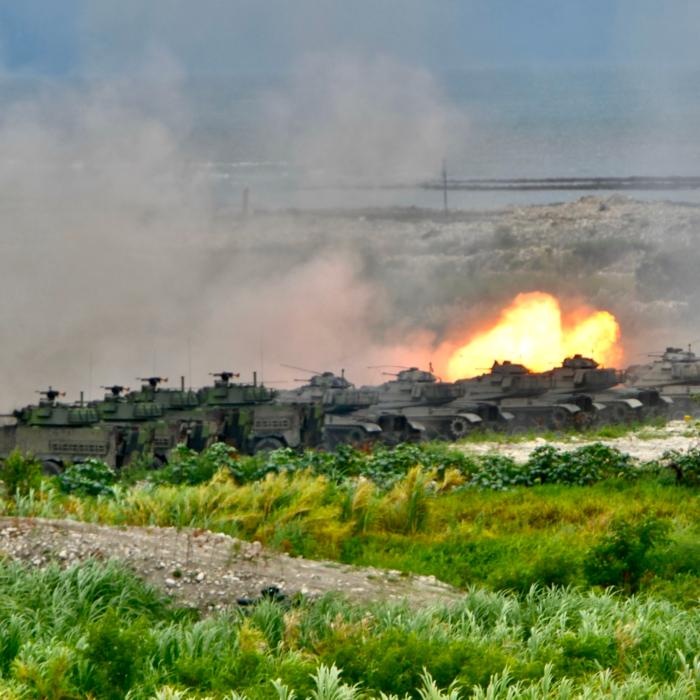
U.S. Marines fired a high-mobility artillery rocket system (HIMARS) near Mount Fuji on May 20, conducting a live-fire drill at a Japanese training area as Japan and Taiwan move to expand mobile missile capabilities with U.S. support.
The Defense Visual Information Distribution Service (DVIDS), a U.S. Defense Department platform that publishes official military news and media, said Marines with the Third Battalion, 12th Marine Regiment, Third Marine Division, conducted the HIMARS live-fire event at the Combined Arms Training Center, Camp Fuji, in Shizuoka Prefecture.
The release said the training was designed to enhance Marine readiness while reinforcing the Marine Corps’s commitment to regional security and Japan’s defense.
Mobile Firepower at Camp Fuji
HIMARS is a truck-mounted launcher designed to fire rockets or missiles and then relocate. U.S. forces have described the system as a “highly mobile, long-range rocket artillery platform” capable of rapid emplacement, engagement, and displacement.According to DVIDS, the East Fuji Maneuver Area offers realistic terrain, ample range capacity, and the infrastructure needed to support HIMARS operations. The May 20 drill was the second HIMARS live-fire exercise at Camp Fuji. The first dry-fire training took place June 11–13, 2025.
Lt. Col. Ryan Anness, commanding officer of the Third Battalion, 12th Marine Regiment, said in the release that integrating HIMARS live-fire training at Camp Fuji enhances readiness and demonstrates U.S. commitment to Japanese allies.
“By expanding our long-range precision fires capability here, we are validating we can project power and respond to any crises in the region at a moment’s notice,” he said.
Japan Deploys Standoff Missiles
The Camp Fuji training took place less than two months after Japan announced its first deployment of domestically produced standoff missiles.Japanese Defense Minister Shinjiro Koizumi said on March 31 that Japan had completed development of the upgraded Type 12 surface-to-ship missile (SSM) and the hyper-velocity gliding projectile (HVGP), and renamed them the Type 25 SSM and Type 25 HVGP. He said the Type 25 missile was deployed to Camp Kengun in Kumamoto Prefecture, and the Type 25 HVGP was deployed to Camp Fuji in Shizuoka Prefecture—Japan’s first fielding of domestically produced standoff missiles.
Japan’s Ministry of Defense described the weapons as part of its standoff defense capabilities. Koizumi said those capabilities would allow Japan to respond from outside the threat zone of adversary units attempting to invade Japan.
Taiwan Advances Arms Funding
Taiwan is also expanding its HIMARS inventory.The U.S. Defense Security Cooperation Agency, which notifies Congress of major foreign military sales, announced on Dec. 17, 2025, that the State Department had approved a possible $4.05 billion sale to the Taipei Economic and Cultural Representative Office in the United States. The proposed package included 82 M142 HIMARS launchers, 420 M57 Army Tactical Missile System missiles, 756 M31A2 guided multiple launch rocket system-unitary pods, and 447 M30A2 guided multiple launch rocket system-alternative warhead pods.
The agency said the proposed sale was consistent with U.S. law and policy under the Taiwan Relations Act and would support Taiwan’s efforts to modernize its armed forces and maintain a credible defensive capability.
Geopolitical Context
The Camp Fuji drill followed a week of high-level statements on Taiwan involving Washington, Beijing, Tokyo, and Taipei.Beijing has long opposed U.S. arms sales to Taiwan and again urged Washington to stop arming the island ahead of U.S. President Donald Trump’s Beijing visit. Trump said before the trip that he expected to discuss Taiwan arms sales with Chinese leader Xi Jinping. After the summit, Trump said he had not decided whether to move forward with a major Taiwan arms package.
Trump told reporters on May 20 that he would speak to Lai before he made a decision on an arms deal with the nation.
“I'll speak to him,“ Trump said. ”I speak to everybody. We have that situation very well in hand. We’ll work on that Taiwan problem.”