A top economic adviser to U.S. President Donald Trump mentioned Canada’s broadcasting rules requiring Canadian content as a current irritant in trade negotiations.
U.S. National Economic Council Director Kevin Hassett spoke with CNN on Oct. 31 and was asked if Canada moving closer to China on trade will benefit the United States.
“What is good for the United States is getting Canada to start to adhere to their previous agreements and to follow the rule of law and to stop punishing American companies the way they’ve been,” Hassett said.
The reporter’s question came as Canada has declared having a “strategic partnership” with China as it ramps up diplomatic efforts to rebuild ties and expand trade with Beijing.
Hassett mentioned the Digital Services Tax as a trade irritant with Canada, even though Ottawa pledged to rescind it in June after Trump cancelled trade talks over the tax, which was set to imminently impact large U.S. companies doing business online.
Hassett also noted how media companies need to have a certain amount of Canadian content to broadcast in Canada, as a result of the Liberals’ Online Streaming Act (Bill C-11) adopted in 2023.

“They’ve got to make a quota in Canada of how many Canadian actors they have,” he said. “They’ve got stuff like that littered throughout the economy, and it’s gotten worse and worse under these Liberal governments, and so President Trump won’t stand for it.”
Hassett added that Canadian negotiators have been “rude and dismissive.”
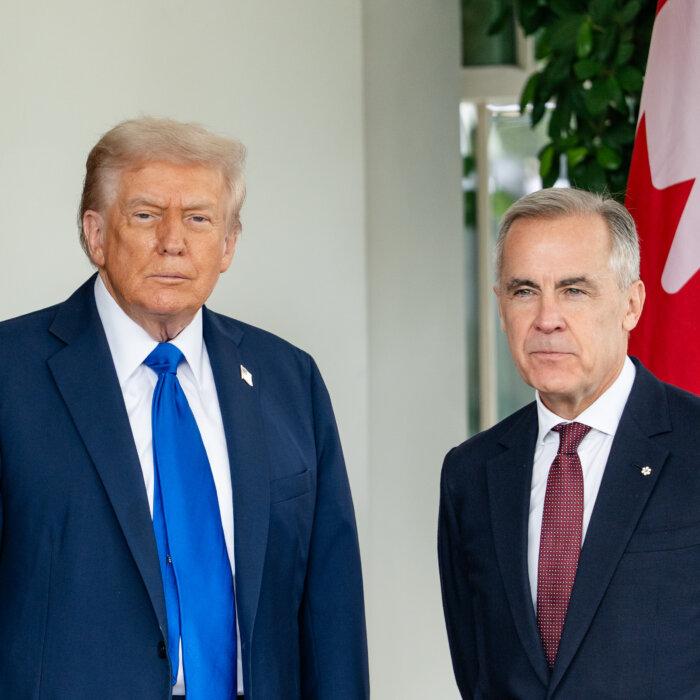
Prime Minister Mark Carney dismissed that idea on Oct. 27 when asked by reporters about potential frustration on the U.S. side.
“There were a series of very detailed, very specific, very comprehensive discussions, negotiations on the areas [of steel, aluminum, and energy] up until the point of those ads running,” he said.
The bill revamped the Broadcasting Act to direct the Canadian Radio-television and Telecommunications Commission (CRTC) to ensure that online streaming services contribute to Canadian and indigenous content.
Those services that cannot make a “maximum or predominant” use of Canadian human resources have to contribute in an “equitable manner,” the bill says.
Other trade irritants the U.S. side has been more outspoken about include the high tariffs Canada has on dairy products as a result of its supply management system.
Trump mentioned this issue specifically a day after he cancelled trade talks with Canada because of Ontario’s anti-tariff ad.
Ontario’s TV ad for the U.S. market used audio from a 1987 radio address by former President Ronald Reagan, in which he praises free trade, including with Canada. The radio address begins with Reagan explaining that he reluctantly imposed duties on Japan because of a trade dispute on semiconductors, but this part does not appear in the ad.
“They fraudulently took a big buy ad saying that Ronald Reagan did not like Tariffs, when actually he LOVED TARIFFS FOR OUR COUNTRY, AND ITS NATIONAL SECURITY,” wrote Trump.