President Donald Trump said on July 21 that the United States would “take care of business” if the Iran-aligned Houthi terrorist group in Yemen imposed a blockade of a key strait in the Red Sea.
Trump was asked about the blockade concern during a meeting with Lebanese President Joseph Aoun in the Oval Office on Tuesday. “So far, it hasn’t happened, might happen, but we take care of things,” he said.
“If something like that happens, we take care of it,” Trump added. “We’ve done that with the Houthis before, and we haven’t heard from them in a while since we did what we did originally.”
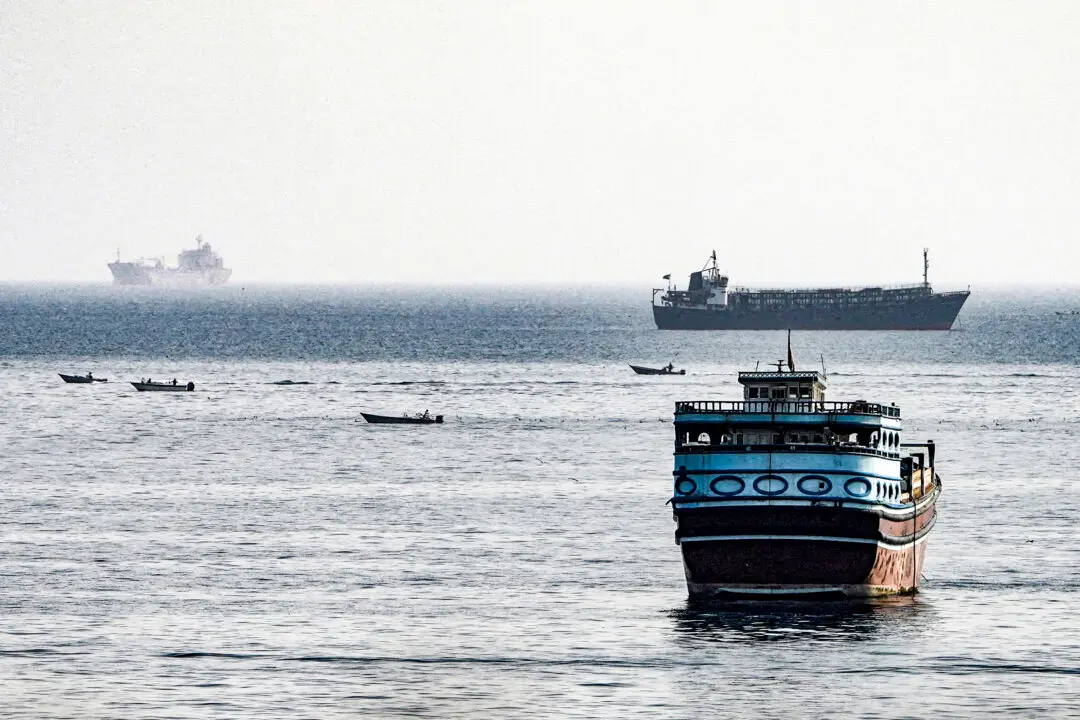
The threat by the Houthis to impose a blockade came after the terrorist group repeatedly attacked international ships in the Red Sea during the war between Israel and Hamas. More than 100 vessels were targeted by the terrorist group.
The War Department previously confirmed that the U.S. military conducted strikes on more than 1,000 targets as part of Operation Rough Rider early last year to degrade the capabilities of the Houthis. The Pentagon said the targets included senior Houthi missile and unmanned aerial vehicle officials.
Operation Rough Rider started in March 2025 and concluded in May 2025, when Trump said he would initiate a ceasefire with the Houthis after a deal was brokered by Oman.
“That was about 45 days of very powerful action we took against the Houthis,” Trump said during his meeting with the Lebanese president on July 21. “And we’ve had no problem with the Houthis. They’ve had no problem with us for a long period of time, including during this conflict.”
“We affirm the right of our great people to respond to the blockade with a blockade, and to respond to all escalation with all escalation, thus solidifying this equation,” the Houthis said. The terrorist group added that “any foolish act committed by the reckless Saudi enemy through all escalation will be met with a comprehensive and decisive escalation.”
While the Houthis did not provide exact details on what the maritime embargo would entail, Nasruddin Amer, deputy head of the Houthi media office, said the Bab el-Mandeb Strait would be closed to Saudi Arabia in response to what he described as 11 years of “unjust Saudi siege and aggression.”
The Bab el-Mandeb Strait is a key waterway that connects the Red Sea to the Gulf of Aden in the Indian Ocean. About 12 percent of the world’s trade passes through the strait.
On Tuesday morning, the Houthi-run SABA news agency said six ships had been forced to reroute following the “imposition of a naval navigation ban.”
Addressing the threat of a blockade of the Bab el-Mandeb Strait, Trump said, “I think that if there is something like that, we’ll just have to take care of business.”
Saudi Arabia’s military also said it would take action to keep the Bab el-Mandeb Strait open.
“All Houthi threats against transiting vessels will be dealt with swiftly and firmly, as such threats are a blatant violation of international law and fall under acts of maritime piracy,” said Maj. Gen. Turki al-Malki, a Saudi military spokesperson.
The Houthis play a key role in Iran’s “Axis of Resistance,” which is a loose confederation of terrorist groups that are trained and equipped by the regime’s military. The axis consists of terrorist groups, including the Houthis in Yemen, Hamas in Gaza, and Hezbollah in Lebanon. It also includes insurgent militia groups in Iran and Iraq.
While the Houthis previously had a large stockpile of drones, members of the terrorist group said the stockpile was running low following the attacks the group carried out during the war between Israel and Hamas. Members of the Iran-aligned group also said the war between the United States and Iran disrupted the flow of weapons.