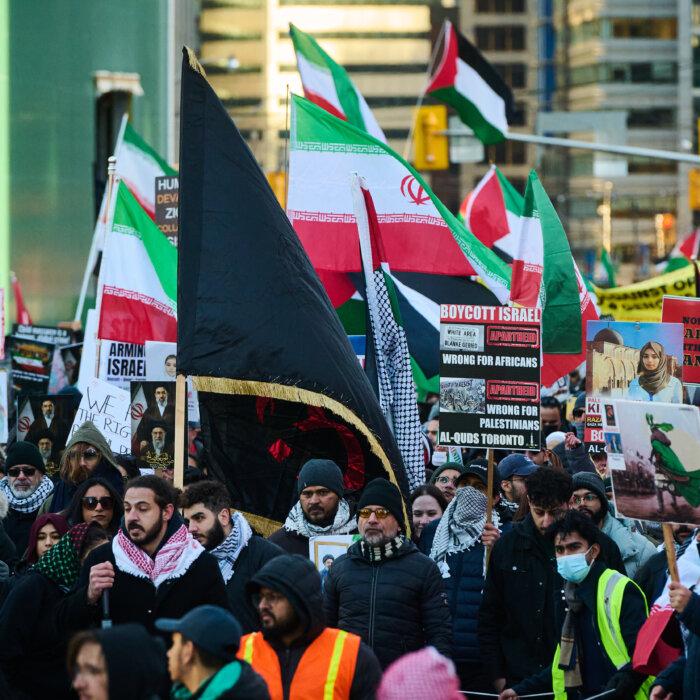
The Toronto Police Service says protests will no longer be allowed in a residential neighbourhood of the city, days after incidents of anti-Semitic placards were displayed in the area.
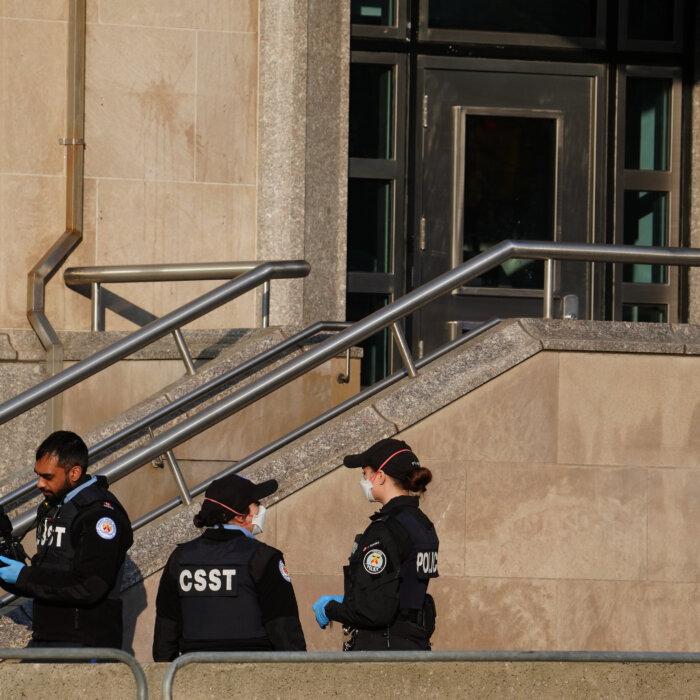
Toronto police advised protesters at the major intersection of Bathurst and Sheppard on March 22 that demonstrations would no longer be tolerated in the adjacent residential area.
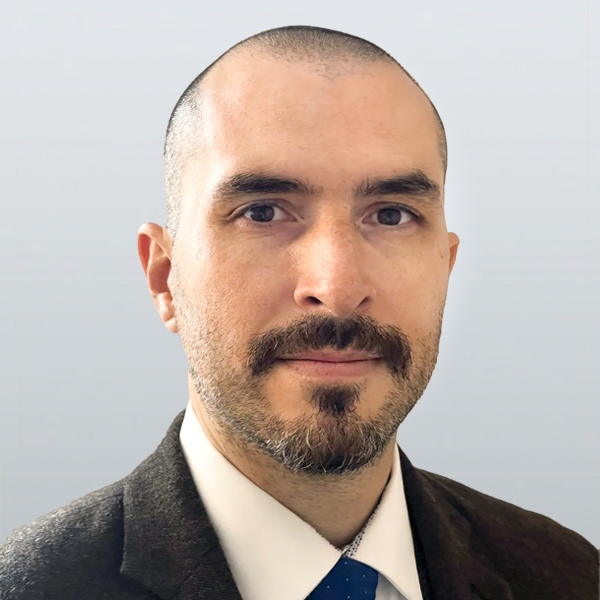
Toronto police Deputy Chief Frank Barredo made comments about the new rule at a press conference on March 24.
“The change is not so much about curtailing Charter rights any more than absolutely necessary,” Barredo told reporters. “We take limitations on that very seriously, and we think at this time that it is a reasonable limitation, as afforded to us by Section 1 of the Charter to limit the extent to which protest occurs.”
Section 1 refers to the “reasonable limits” that can be set on rights and freedoms.
Barredo said people would still be allowed to protest along Bathurst and Sheppard, but police will prevent movement inside residential areas.
“We will physically block them, and if they try to disobey that instruction, they will be arrested and charged,” Barredo said.
‘Glorified Terrorism’
Toronto police Chief Superintendent Katherine Stephenson, speaking alongside Barredo, said approximately 20 protesters have been arrested so far at that location. She also said there’s an ongoing investigation into wilful promotion of hatred related to the display of certain signs.“This weekend, extremist protestors openly made threats of violence, glorified terrorism, and displayed imagery that portrays Jewish people as sub-human in terms reminiscent of Nazi incitement,” wrote the groups B’nai Brith Canada, the Centre for Israeli and Jewish Affairs (CIJA), and the United Jewish Appeal of Greater Toronto.
“If imagery portraying Jews as vermin and celebrating the elimination of the Jewish state does not meet the threshold for enforcement under Canada’s hate propaganda laws, what does?”
CIJA said the new police directive banning protests in the residential areas near Bathurst and Sheppard is a “meaningful and long-overdue step.”
Demkiw announced other new measures on March 24 to deal with heightened political violence in the city and in response to major attacks targeting the Jewish community in Australia and the United States in recent months.
“As the biggest municipal police service in Canada, we are operating within an increasingly volatile security environment, global conflicts, extremist ideologies and online radicalization, hostile foreign states, heightened polarization,” Demkiw said.
Toronto in recent weeks has seen shooting attacks against synagogues and the U.S. consulate.
Demkiw said the police service is launching the Task Force Guardian which involves the deployment of police officers wearing tactical gear and carrying rifles in tourist areas and near places of worship. The measure is not to respond to a specific threat but to serve as a deterrent and for rapid response, the chief said.
“What it means is we are strategically positioning resources to protect our communities and to be able to respond quickly if necessary,” he said.
Demkiw also announced the creation of a new stand alone counter-terrorism unit with its own analytical capability and dedicated leadership.