Will Canadian internet users be more likely to receive a visit from the police for something edgy they posted online if Ottawa’s new hate crime bill becomes law, similar to what is happening in the UK?
While Bill C-9 is not directly focused on online content, there are aspects of the bill that could presumably lead to more Canadians being charged for the content they post on the internet. Those include removing the requirement for the attorney general to consent before laying hate-related charges, and creating an offence of wilfully promoting hatred against any identifiable group by displaying “certain symbols” in a public place. The bill also creates a new definition of “hatred,” which the government says will allow for more consistent application of the law, while critics say it creates the potential to lower the threshold established by jurisprudence.


“Absolutely not, and I think the suggestion is patently far-fetched on the face of it,” replied Fraser. The minister added shortly after that people already “could be convicted for willfully promoting hate online today.”
But Tory MPs remain skeptical.
UK Legislation
The UK has seen much of its arrests for online speech in recent years happen under three pieces of legislation. The Public Order Act 1986 created a number of new public offences that included “stirring up of racial hatred.” The Malicious Communications Act 1988 made it illegal to send an electronic message containing “indecent or grossly offensive” content with the intent to “cause distress or anxiety.” The Communications Act 2003 made it a criminal offence to send offensive or menacing communications using electronic media.
However, the number of convictions and sentences for the offences had fallen over the time period from 2010 to 2023, suggesting that many of the arrests did not result in prosecution.
In other prominent cases, retired Premier League soccer player Joey Barton was also charged in 2024 under the Malicious Communications Act for his online comments about TV personalities Jeremy Vine, Eni Aluko, and Lucy Ward.
He is accused of allegedly sending a series of “offensive” posts on social media after repeatedly referring to Vine as a “nonce” and compared Ward and Aluko to serial killers and dictators, in suggesting their commentary was so poor it was lethal to audiences. If convicted, Barton could face a maximum penalty of up to two years’ imprisonment.
Brady was later released by police and no further action was taken. This led to a police and crime commissioner (PCC) criticizing her own force for sending officers to investigate Brady, saying she was concerned over the “proportionality and necessity” of the police response.
C-9 and Online Speech
Minister Fraser has said his bill is “not identical in kind” to the laws that have been adopted in the UK, and he noted the government has studied the British experience. He said there have been “real challenges with how it’s played out.”The minister said his government has chosen a different path, noting how other unspecified jurisdictions even target the “liking” of a Facebook post.

The other parts of the legislation, however, could apply to online content posted by Canadians. The bill would also make it a crime to wilfully promote hatred against an identifiable group by publicly displaying certain terrorism or hate symbols, such as Nazi, Hamas, or Hezbollah flags.
While the Criminal Code currently requires the consent of the attorney general before someone can be charged with a hate crime, Bill C-9 would remove this requirement.
The bill would also add a definition of “hatred” to Section 319(7) of the Criminal Code, describing it as an “emotion that involves detestation or vilification and that is stronger than disdain or dislike.”
This is similar to what the Supreme Court has used to define hatred, but Tories have noted it omits the word “extreme” from the current definition.
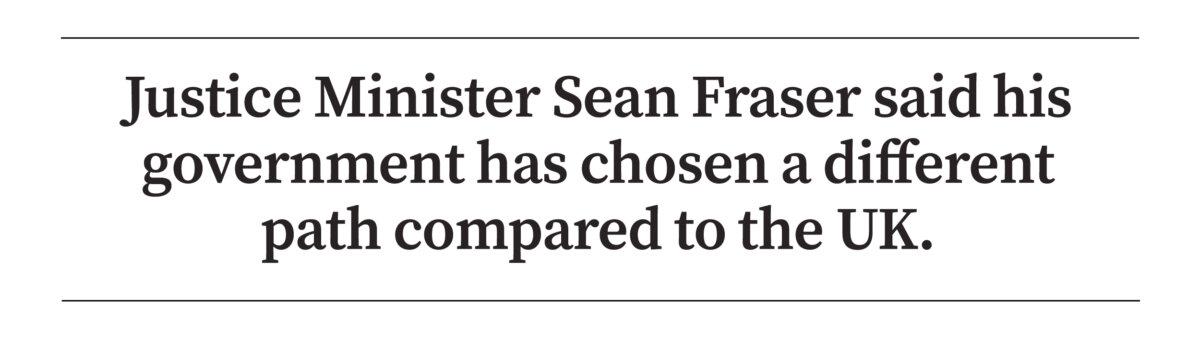
Tory MP Lawton said that the removal of the word “extreme” from the definition means that the government is lowering the threshold of what constitutes hate and simultaneously “lowering the threshold of what can be regarded as free expression in this country.”

The CCF said the requirement of the attorney general to give consent to police to charge a person with hate speech is an “important safeguard for freedom of expression.” The group also raised concerns with the bill lowering the threshold for “hatred.”
The government said the legislation would respect Canadians’ Charter freedoms of expression and peaceful assembly, and it would not “unreasonably” impact the freedom of Canadians to protest or peacefully voice their concerns.
Testimonies
Several civil liberties groups and law professors raised concerns about Bill C-9 before the Justice Committee on Oct. 23. Ryan Alford, a law professor at Lakehead University, said the bill would lower the threshold for limiting freedom of expression below what is currently allowed by the Charter.
Anaïs Bussières McNicoll, director of the Fundamental Freedoms Program at the Canadian Civil Liberties Association, said removal of the requirement to seek the attorney general’s consent before prosecuting on hate speech charges would remove a key safeguard that ensures charges are informed and proportionate.
McNicoll also concurred with Alford that the bill lowers the threshold for “hatred” set by the Supreme Court, and that the proposed definition will have to be amended to adopt “word for word” the one set out by the Supreme Court.
Nusaiba Al-Azem, director of legal affairs at the National Council of Canadian Muslims, said she was concerned that Muslim Canadians were not consulted about the contents of the bill. She said the bill “risks blurring the line between fighting hate and legitimate free speech.” She also said criminalization of the promotion of hate symbols could result in someone being arrested and charged for waving a Palestine flag if a police officer believes it to be a terrorist symbol.
Mark Sandler, chair of the Alliance of Canadians Combatting Antisemitism, told the committee that he supports several components of Bill C-9 that enhance the existing criminal law, and said the current arguments that provisions in the bill would violate the Charter “lack merit.” He suggested the bill be amended to better protect the symbology of Hindus, Jains, and Buddhists and also to include creating of an offence of willfully promoting terror activities.
Cary Kogan, professor of clinical psychology at the University of Ottawa and co-founder of the Network of Engaged Canadian Academics, said his group believes academic freedom must be strengthened while at the same time “academic freedom cannot supersede the law.
“Too many Canadian professors and students promote violence and hatred, express support for the ideologies of designated terrorist organizations and demand the exclusion of Zionists,” he said.
Kogan said his group supports the government’s efforts to develop Bill C-9.
Bruce Pardy, a law professor at Queen’s University, said Bill C-9’s omission of the word “extreme” from the definition of hatred would amount to an “infringement of freedom of speech.” Pardy also said the legislation could potentially lead to Canadians being charged with hate crimes for “misgendering” someone, putting freedom of expression at risk.