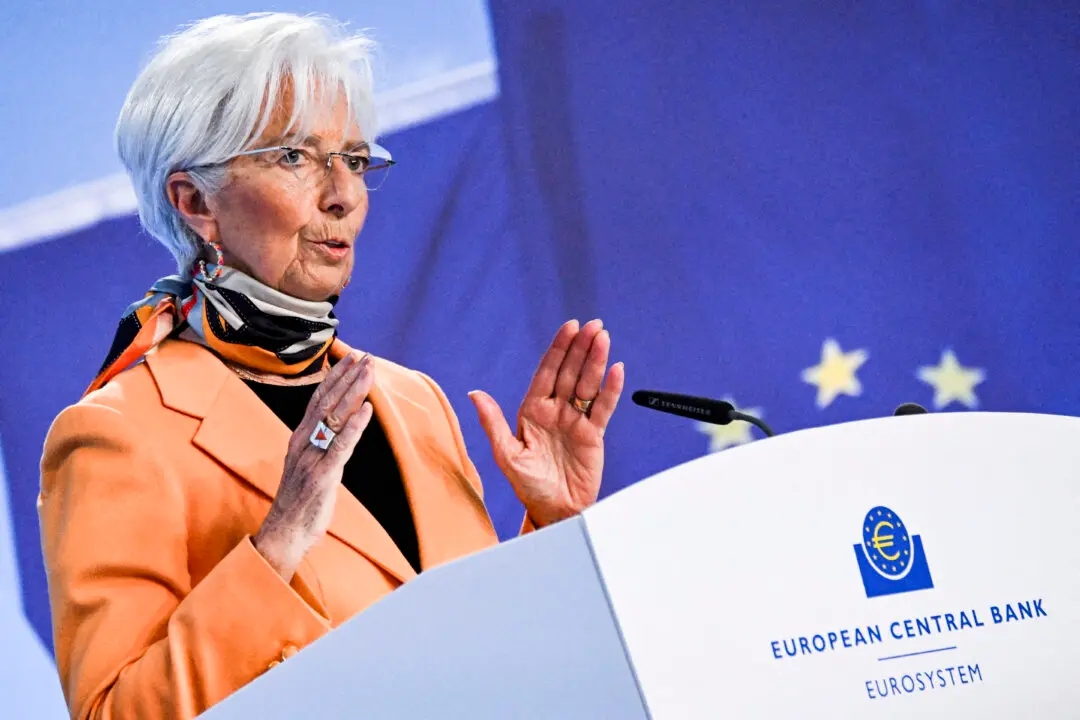
There is no immediate need for the European Central Bank (ECB) to raise interest rates further, according to a top official at the bank.
Governor of the Bank of Latvia Martins Kazaks, who is part of the 27-member Governing Council of the ECB, told Bloomberg on July 1 that though it is “too early to say what action will be taken in July, let alone September,” the “urgency of continuous action has significantly decreased.”
His statements come just under three weeks after the ECB hiked interest rates for the first time since September 2023 to contain an energy-driven inflation shock triggered by the war in the Middle East.
That shock appears to have since largely subsided after a memorandum of understanding was reached between the United States and Iran on June 14.
“There is no need to take a hard line against inflation at this time,” Kazaks continued, saying that “the shock has been limited in scale so far, with no non-linear risks or significant second-round effects on the labor market.”
The ECB lifted its three key rates by 25 basis points, taking the benchmark deposit rate to 2.25 percent. A June 11 policy statement cited inflation pressures driven by an energy price shock stemming from the war between the United States and Iran.
The rate hike also hoisted the main refinancing rate to 2.4 percent and the marginal lending facility to 2.65 percent, effective on June 17. The ECB said future rate moves would depend on incoming economic data and policymakers’ assessment of inflation risks.
Less than a week after the ECB announced its decision to raise interest rates, the U.S.–Iran memorandum led to the tentative reopening of the Straight of Hormuz and a resultant drop in oil prices, which calmed the markets.
Kazaks’s comments followed remarks made by ECB President Christine Lagarde on June 29, in which she explained the reasoning behind the rate hike.
In a speech titled “Back to Basics in an Uncertain Environment” delivered at the ECB Forum on Central Banking in Sintra, Portugal, Lagarde said that the euro area has returned to more conventional monetary policy after years of unconventional tools.
However, now the ECB president said, monetary policy “finds itself in a different position.”
“We no longer need to reach for unconventional instruments. While we have them at hand, we can now focus on stabilizing inflation with policy rates as our primary tool,” she said.
“We no longer need to act with the same force. We can make measured adjustments to rates, calibrated to the shocks we face. And we no longer need complex forms of forward guidance. Our decisions are data-dependent and taken meeting by meeting,” she continued, saying that this meant monetary policy had gone “back to basics.”
Using the recent rate rise as an example, she said that the bank had mapped out three scenarios, and the hike was “justified under every scenario considered.”
“It was, by design, a robust decision. And nothing we have observed since then has called this assessment into question. Energy futures prices remain within the range of the scenarios we have modelled,” she added.
Lagarde did not comment on whether or not a future rate rise would be required; however, since the rate hike, spiking oil prices, the main driving force behind the move, have significantly dropped off.
Crude oil prices had their largest quarterly drop in six years, capping off a tumultuous few months.
A barrel of West Texas Intermediate—the U.S. benchmark for oil prices—plunged 31 percent in the second quarter, with prices hovering around $70 on the New York Mercantile Exchange.
The last time U.S. oil prices logged a similar decline was in the first quarter of 2020, driven by the COVID-19 pandemic-related demand shock and the Russia–Saudi Arabia price war.
Brent—the global seaborne benchmark for oil prices that is more sensitive to geopolitical tensions—witnessed similar trends in the April–June period, erasing 29 percent.
Like the ECB, the Bank of Japan also voted to hike interest rates last month, with its board voting 7–1 to raise its policy rate to about 1 percent from 0.75 percent on June 16, marking the highest benchmark interest rate since 1995.
In contrast, the Bank of England declined to raise interest rates in June, as did the U.S. Federal Reserve.