Syrian Parliament Meets for First Time Since al-Assad’s Ouster

Interim President Ahmed ​al-Sharaa has tasked the parliament with forming a committee to draft a new constitution.
Syrian Parliament Meets for First Time Since al-Assad’s Ouster
Syrian President Ahmad al-Sharaa addresses the inaugural session of Syria's newly formed People's Assembly, in Damascus, Syria, on July 12, 2026. Ghaith Alsayed/AP Photo
|Updated:
0:00

Syria’s newly elected parliament convened for the first time on July 12, about 19 months after militants led by current interim President Ahmed ​al-Sharaa ousted Bashar al-Assad and toppled the Ba'athist regime.

“After liberating our homeland and regaining our freedom, we are all moving toward consolidating the state,” al-Sharaa said in an address to lawmakers on the opening of the People’s Assembly.

Two-thirds of the 210-seat assembly were chosen last year via regional electoral colleges, with the remaining third picked by al-Sharaa on July 1. The chamber has 21 female lawmakers, 15 of whom were nominated by the president.

The new parliament will serve a 30-month term while the interim government prepares for elections.

Al-Sharaa told the assembly to “make this council a model of responsibility and competence.”

The president has said that he supports holding elections when infrastructure and documentation allow, and he has tasked the parliament with forming a committee to draft a new constitution.
Al-Sharaa is a former jihadi who headed the Islamist group Hayat Tahrir al-Sham (HTS), which began as Al-Nusra Front, an affiliate of al-Qaeda, the Islamist terrorist group founded by Osama bin Laden.
In 2024, insurgents led by HTS seized Damascus and declared the end of more than 50 years of the Assad regime and Ba'athist rule in Syria. The ousting followed 13 years of civil war that was triggered by the 2011 Arab Spring and a series of pro-democracy protests and uprisings. Al-Assad fled to Moscow.

Syria’s Political Transition

After taking oaths, lawmakers elected their new speaker, Abdul Hamid al-Awak.

The state-run Syrian Arab News Agency described al-Awak as having served as a judge in the Syrian Ministry of Justice for 10 years. He has a Ph.D. in constitutional law from Beirut Arab University and has served as an assistant professor at Mardin Artuklu University, Turkey, and as a lecturer in law at al-Furat University, Syria.

The establishment of the chamber represents another stage in the Syrian government’s political transition, as the country moves on after more than a decade of civil war.

World leaders are engaging with the interim government, notably France and the United States.

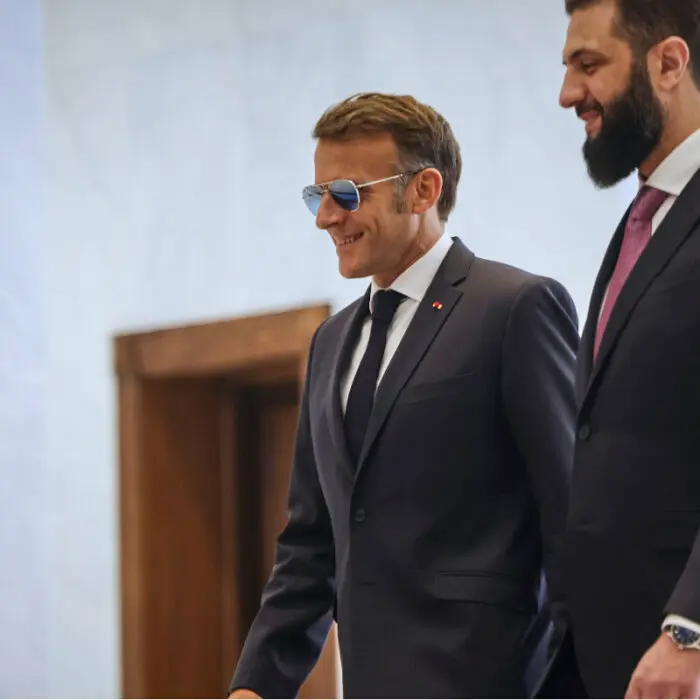
This past week, French President Emmanuel Macron became the first European Union leader to visit Syria since al-Assad’s ouster, having led the call for international sanctions to be lifted.

Macron and his delegation discussed with al-Sharaa and the Syrian government the reconstruction of the country, as well as business and development opportunities.

Some French business delegates, including TotalEnergies and container shipping company CMA CGM, have already confirmed or discussed deals with Damascus.

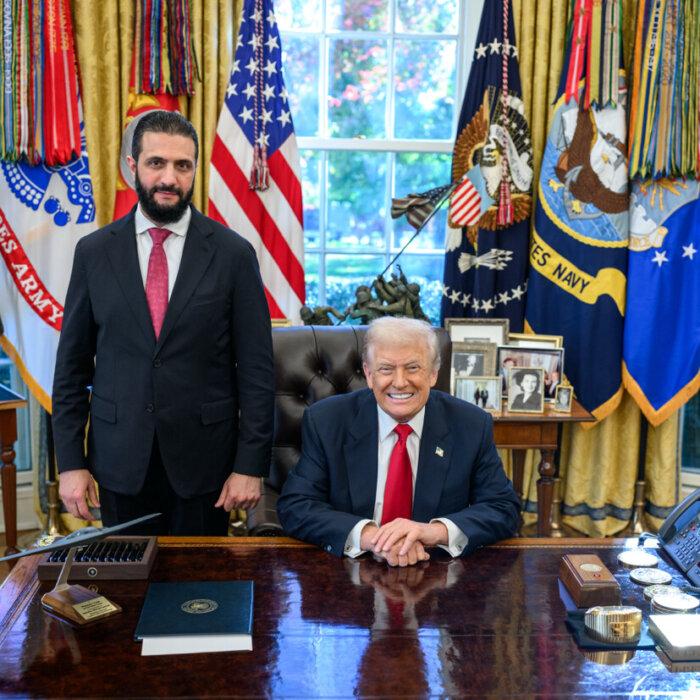
The Syrian leader has met with U.S. President Donald Trump, who welcomed al-Sharaa to the White House on Nov. 10, 2025, days after the United States and the U.N. lifted terrorism-related sanctions on the Syrian leader.
On July 8, 2026, the Trump administration said that it was going to remove Syria from its list of state sponsors of terrorism.

Secretary of State Marco Rubio described the move as a “historic step,” since Syria had remained on that list since 1979, the longest period of any nation to have that designation. Iran was not added until 1984.
Fighting ISIS

Last year, al-Sharaa’s government joined the U.S.-led coalition to fight the terrorist group ISIS.
Syrian Information Minister Hamza al-Mustafa said on Nov. 10, 2025, that Syria had signed “a political cooperation declaration” with the Global Coalition to Defeat ISIS—signed by 89 other partners to combat the terror group in Iraq, Syria, and globally—confirming its commitment to combat terrorism and support regional stability.
During Macron’s visit in July, two bombs exploded in Damascus, killing one person and injuring dozens. Syrian authorities said the incident posed no threat to the French president. Preliminary investigations point to a cell connected to ISIS as being responsible, they said, and all members of the cell involved had been arrested.
Reuters and The Associated Press contributed to this report.
Google LogoMark Us Preferred on Google
Victoria Friedman
Victoria Friedman
Author
Victoria Friedman is a UK-based journalist covering a wide range of international stories, with a particular interest in technology, eastern Europe, and defense.