
A legal challenge to South Africa’s controversial Expropriation Act that allows the government to seize private land began in Cape Town on Aug. 3.
The bill replaces the Expropriation Act of 1975, which required the state to compensate owners for the land it sought to seize.

The legislation was passed as part of Ramaphosa’s efforts to address economic inequality following decades of white minority rule in South Africa that ended in 1994, when Nelson Mandela was elected president as head of an ANC government.
The ANC lost power after the June 2024 election and is now the largest party in a unity government, which includes the Democratic Alliance (DA), which has joined activists challenging the Expropriation Act in the Western Cape High Court.
Making a statement outside the court, the DA’s national spokesman, Jan de Villiers, said that it was standing up for the rights of property owners.
“Whether you own a house, land, an apartment, or a farm, you have the value of that asset, and it belongs to you, and it should be protected because you’ve paid for it,” de Villiers said.

‘Property Rights Make the Economy Work’
“Property rights make the economy work, and it allows jobs to be created,” de Villiers said. “Without property rights, the economy will tank, and jobs will be killed.”
Also speaking outside court, Bonginkosi Madikizela, the DA’s public works and infrastructure spokesman, said that in 2016, under then-President Jacob Zuma, the Expropriation Act was passed by Parliament but lapsed before it could be signed into law.
He said when Ramaphosa’s government sought to push the legislation through the upper house of parliament—the National Council of Provinces (NCOP)—it was compromised by “procedural irregularities.”
Ashor Sarupen, the chair of the DA federal council, said there were clear legal grounds for the challenge and that the legislation had been rushed through the South African parliament in the spring of 2024 while the ANC still had a majority.
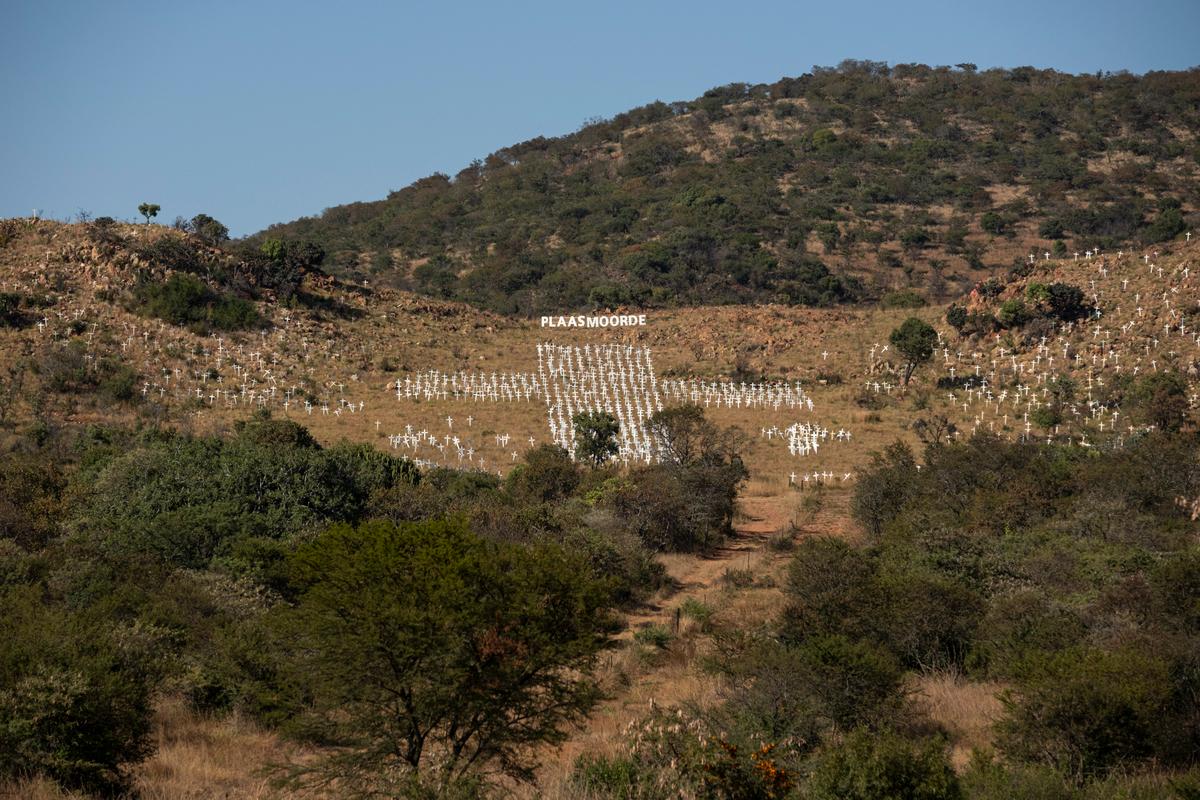
The South African government says it allows expropriation of land if it is in the public interest, but it does not allow property to be taken arbitrarily.
During the debate in March 2024, Cathlene Labuschagne, the DA’s leader in the NCOP, said the bill represented the ANC’s “desperate attempt to broaden state authority over property ownership” to mask its land reform failures.
‘More Rapid Transfer’ of Farmland
The South African government’s National Development Plan states that land reform will “enable more rapid transfer of agricultural land to black beneficiaries” and “offer white commercial farmers and organized industry bodies the opportunity to significantly contribute to the success of black farmers through mentorships, chain integration, preferential procurement and meaningful skills development.”
In a statement published on Feb. 3, 2025, Ramaphosa’s office said the South African government had not confiscated any land.
“South Africa is a constitutional democracy that is deeply rooted in the rule of law, justice, and equality,” the statement read.
Ramaphosa’s office stated that the reasons for expropriating land can include promoting inclusivity and allowing access to natural resources.
The legal proceedings in the Western Cape High Court are expected to last all this week, and it could be weeks or months before the judges deliver a ruling.