Recent research by the Reserve Bank of New Zealand suggests that “immigration shocks” can lead to higher house prices and greater household credit.
An immigration shock refers to a situation in which a country experiences a sudden, unexpected or large-scale increase in the number of migrants.
The study also showed that older immigrants (ages 30 to 44) were more strongly linked to increases in labour productivity, whereas younger immigrants (ages 15 to 29) had a more noticeable impact on reducing unemployment.
In addition, it found that while the overall headline Consumer Price Index (CPI) was not affected by high migration, the cost of “non-tradeables”—locally produced goods and services that cannot be imported or exported, including housing and credit—was “significantly elevated” approximately one year after an immigration shock and remained so for an extended period.
According to the authors, immigration accounted for about 20 percent of the variation in house prices, and about 30 percent of changes in economic growth and unemployment three years after a surge in arrivals.


During this period, New Zealand experienced a sharp rise in immigration numbers.
As a result, between 1990 and 2019, the share of immigrants as a percentage of the total population rose from 15 percent to 27 percent. That exceeded most OECD countries, including Canada (21 percent), the United States (14 percent), and the United Kingdom (13 percent).
“Among comparable economies, only Australia (29 percent) has a higher immigrant share,” the report noted.
From 2013 to 2019, New Zealand saw stronger net migration growth than natural population increase (births minus deaths), with net migration more than doubling natural increase in some years.
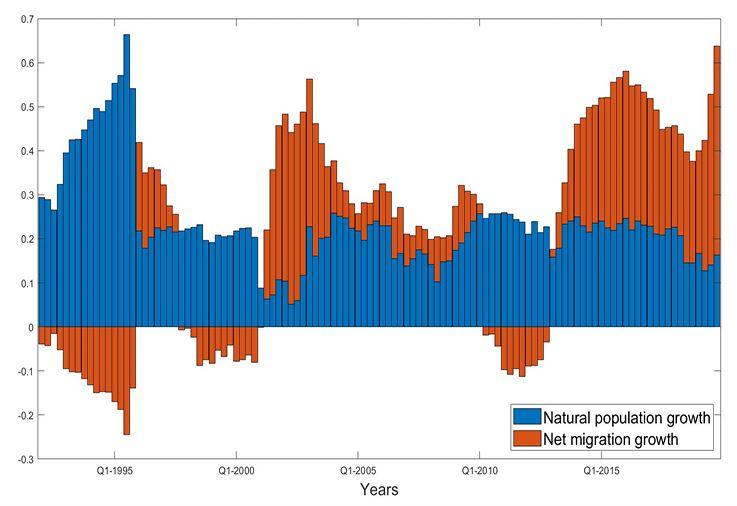
The report cautioned that the data has limitations, but also cited another study finding that the foreign-born employment rate has increased by 302 percent since 2000, compared with 11 percent for native-born New Zealanders.
Based on New Zealand’s points-based migration system, most immigrants are assumed to be highly skilled and likely to enter the labour market relatively quickly, thereby generating more economic activity and raising GDP, the study explained.
Although over 60 percent of foreign-born workers had a tertiary education, higher levels of immigration appeared to have had little measurable impact on overall labour productivity.
The study also found that despite the workforce participation rate rising significantly after immigration shock, the effect on real wages—incomes adjusted for inflation—remained significantly negative for at least the first four months.
“However, in the long-term, the effect on real wages is likely to be positive,” it said.