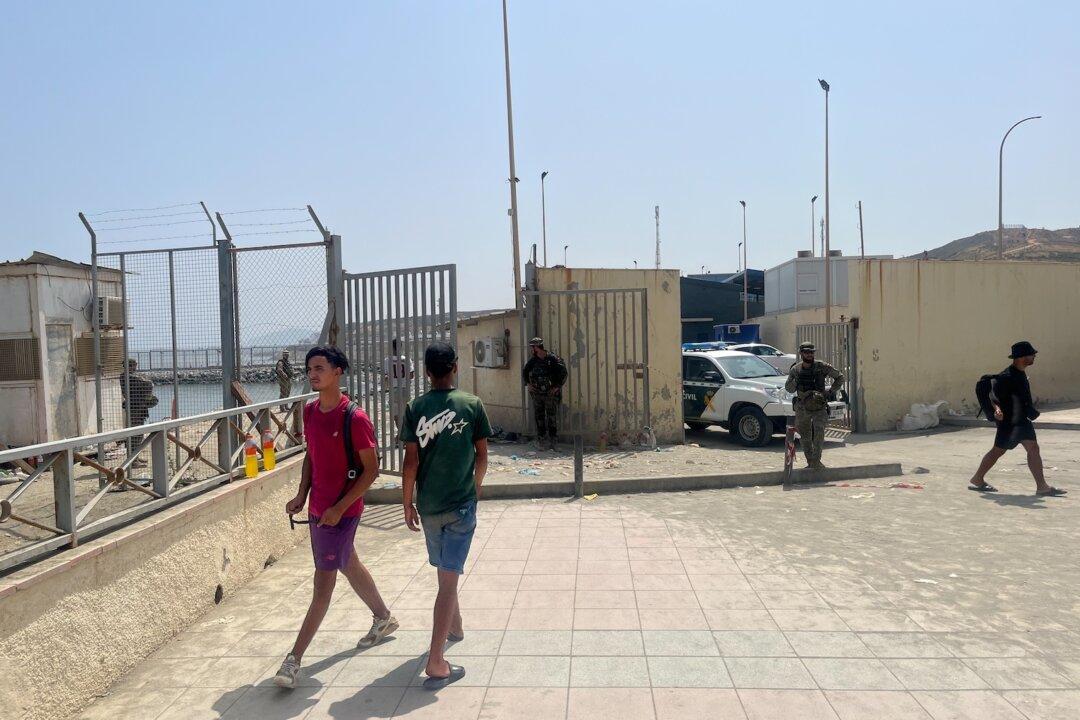
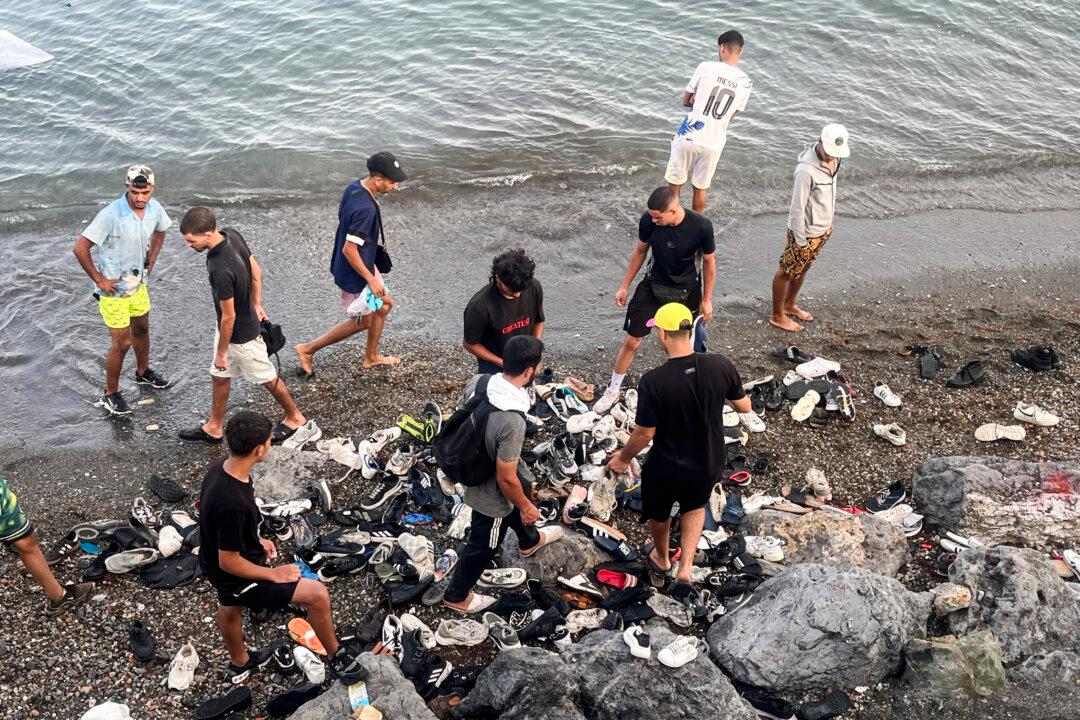
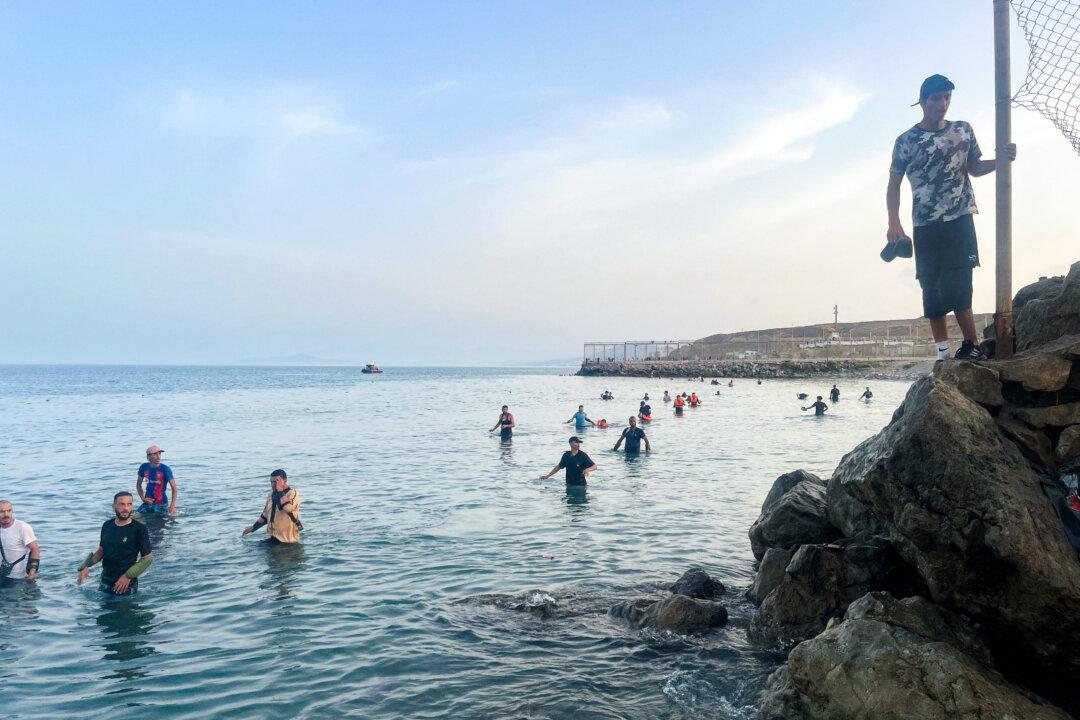
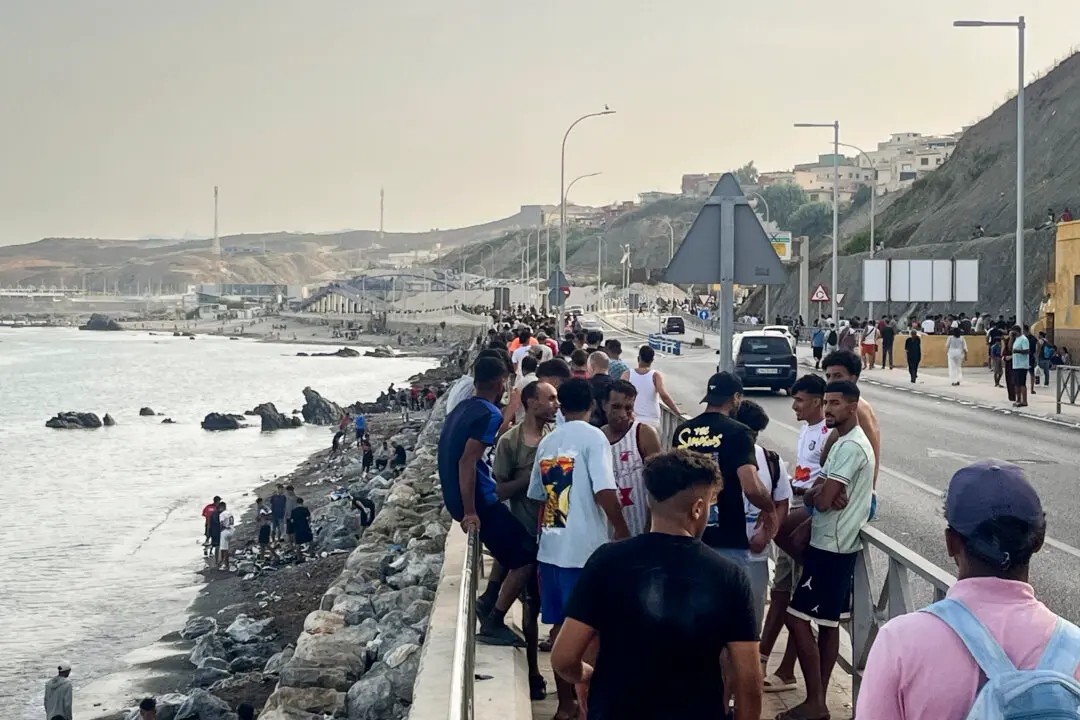
TANGIER, Morocco—Islamist and socialist opposition parties are taking aim at the Moroccan government over the mass crossing of its nationals into the Spanish exclave of Ceuta on July 30 and July 31, turning the border emergency into a campaign issue less than six weeks before the country’s general election.
Abdelilah Benkirane, leader of the Islamist Justice and Development Party (PJD) and prime minister from 2011 to 2017, has called for the resignation of Prime Minister Aziz Akhannouch.
He faulted Akhannouch for leaving on vacation on Aug. 1, two days after the crisis began, and accused him of failing to publicly explain the situation to Moroccans or offer condolences to the families of those who died in the attempted crossings.
Morocco’s King Mohammed VI ordered Akhannouch to cut short his vacation and return to the country, which he did on the night of Aug. 2.
The Party of Progress and Socialism, the successor to the Moroccan Communist Party, for its part cited “an urgent need to break with the current government’s failed economic, social, and democratic policies” in a statement, accusing the Akhannouch government of pursuing policies that “have deepened class inequalities.”
Both parties, criticizing the government’s initial silence, are demanding an independent investigation into the Ceuta crisis.
Diplomacy in Morocco falls under the authority of the palace, not the elected government.
Akhannouch and his ministers were reported on Aug. 6 by Spain-based newspaper El País to have waited for a pronouncement from the monarch, which came through the “sovereignty” ministers the king appoints directly, chief among them the minister of the interior.
“This silence stems from Morocco’s institutional workings,” Mehdi Alioua, a Moroccan sociologist and professor at the international university of Rabat, told The Epoch Times. “Since 2017, the Interior Ministry has been headed by a wali, a senior civil servant with no partisan affiliation appointed directly by the king, and as long as it remained silent, institutional deference kept everyone else from speaking out.”
Alioua attributed the authorities’ initial reticence to disarray and consternation. “In his Throne Day address, the king cited a stable nation as one of his greatest sources of pride, even as some of his own people were dying trying to reach Europe: devastating images, seen across the whole world, for the monarchy, the government, and Morocco,” he said.
On Aug. 2, the Interior Ministry attributed the crossings to misleading information circulating online, human-trafficking networks, and misreadings of a Spanish Supreme Court’s decision that led some to believe they could avoid immediate return.
The ruling widely blamed for the surge, issued on June 29 and reported on July 8, held that Spain’s summary border-rejection procedure cannot be applied to migrants intercepted at sea.
The opposition’s demands break with the national consensus on migration policy, according to Mohamed Chtatou, a professor of Middle East and North Africa studies at the International University of Rabat and a professor of education science at Mohammed V University in Rabat.
The parties are asking how tens of thousands of citizens, including minors, could suddenly reach the border “if the state apparatus was functioning normally,” he told The Epoch Times, while also noting the politicians’ electoral motives.
Chtatou told The Epoch Times he suspected a “deliberate or politically tolerated relaxation of controls,” without believing that the state “personally organized thousands of migrants” to cross the border.
Deliberate Move or Loss of Control?
Accusations that Morocco deliberately facilitated, or passively allowed, migrants to cross into Spain have drawn heavily on the precedent of the 2021 migration crisis.
In 2021, after Spain allowed Brahim Ghali, head of the Polisario Front, a separatist movement at war with Morocco, to receive treatment for COVID-19 on the Spanish mainland, as many as 12,000 Moroccans were allowed under the PJD-led government to cross into Ceuta in what was widely seen as an act of reprisal.
Spanish intelligence services concluded at the time that the crisis had been engineered by Fouad Ali el-Himma, an adviser to the king, in coordination with Foreign Affairs Minister Nasser Bourita, who still holds the foreign affairs portfolio under the center-right RNI-led government.
Speaking on French radio station Europe 1 on May 23, 2021, Nasser Bourita had defended the move, arguing that “you cannot plot against a partner one evening and then ask them to be loyal the next day” and stressing that Morocco “protects Europe” against illegal immigration not out of “an obligation” but as a partner.
He laid responsibility for the crisis at the time on Sanchez’s government, accusing it of using false documents to allow a man facing accusations of terrorism, torture, and rape before the Spanish courts into the country, and then attempting to drag the whole of Europe into a political crisis of its own making.
This time, several theories have circulated over the cause of the latest crisis, including that Morocco sought to pressure Spain over Ceuta and Melilla, territories it has long considered under Spanish occupation; or that it acted to punish Madrid after Spanish leaders met with Algerian officials, Morocco’s main rival and supporters of the Polisario Front, days before the crisis.
“My overarching interpretation is that the episode demonstrated migration is a form of geopolitical leverage,” Chtatou said.
“It is difficult to believe that the Moroccan security apparatus was entirely unaware of a mobilization occurring directly around Fnideq,” the Moroccan town immediately south of Ceuta, he said.
Others have taken issue with this view.
For Alioua, the theory of an orchestrated influx rests on a fundamental misunderstanding of the region. “This narrative thrives because people are unfamiliar with the geography of the area,” he told The Epoch Times. “They picture an empty desert, with no one around, where 70,000 people would suddenly have arrived from the rest of Morocco. That is absolutely not what happened.”
Far from deserted, he explained, the area surrounding Ceuta stretches along some forty kilometers (about 25 miles) of coastline whose population rises sharply in the summer, crisscrossed by roads and highways, served by two airports, and home to Tanger Med, the largest port in the Mediterranean, through which over 2 million travelers pass each summer. “How could that be controlled? It is impossible,” Alioua said. “It makes no sense, short of outright banning Moroccans from moving about.”
Timing compounded the difficulty: on July 30 and 31, Morocco was celebrating Throne Day, and the security services were focused on protecting the royal procession and ceremonies taking place a few dozen kilometers away, at a moment when many civil servants, including within those services, were on leave.
Nor did the crowds need to travel far, according to the sociologist: many were already on site, with the urban sprawl adjacent to Ceuta spanning three towns and some 250,000 year-round inhabitants, a figure that swells considerably in the summer. “Finding 70,000 young people ready to attempt the crossing after the rumors that spread on social media was therefore extremely easy,” he said.
On July 28, the Royal Navy intercepted several hundred would-be illegal immigrants at sea, according to reporting by EFE, a Spanish news agency, while Royal Gendarmerie units detained roughly 1,500 Moroccans and foreign nationals preparing to cross along the Fnideq and Belyounech coastline, according to independent Moroccan outlet Le Desk.
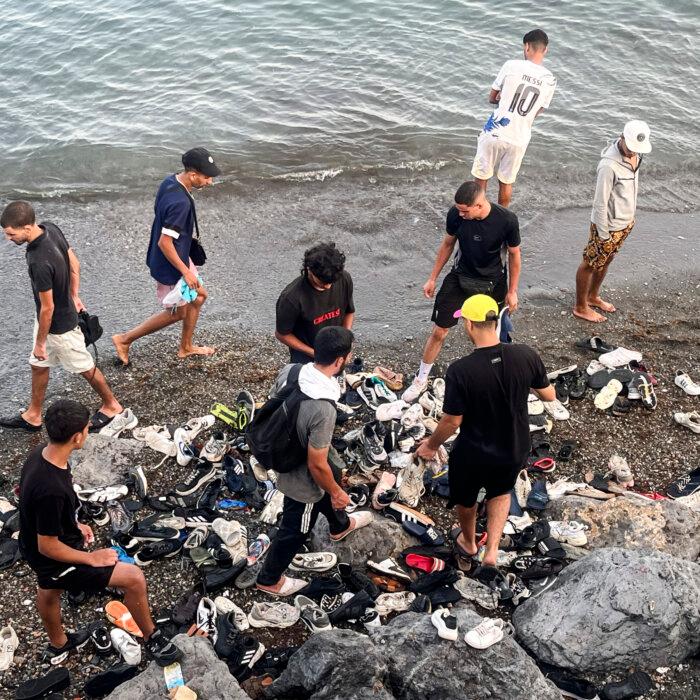
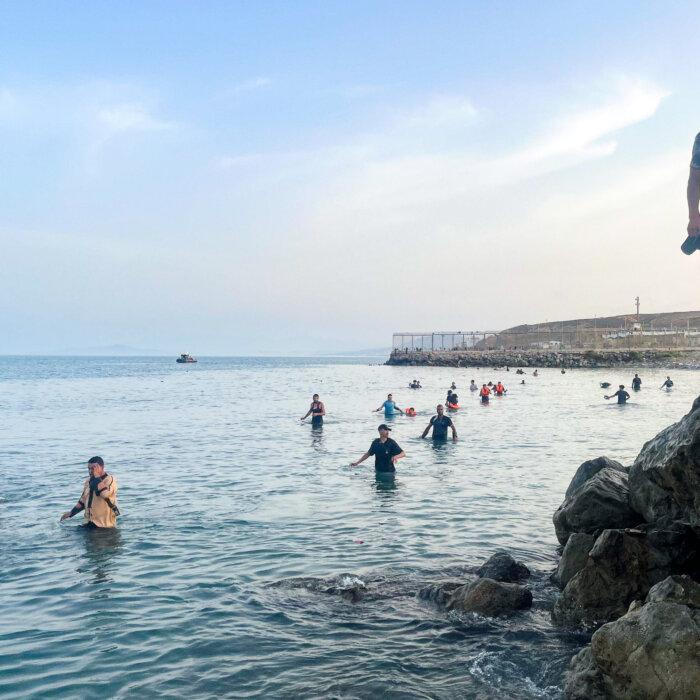
When the mass crossing began, Moroccan forces at the border initially tried to hold back the crowds, turning water cannons on them in an attempt to deter the crossing.
The authorities also stepped up checks on roads leading to Fnideq, carried out inspections at railway stations, and installed barriers, according to EFE.
Spanish authorities said 72,000 people entered Ceuta illegally, of whom around 69,500 returned to Morocco within the first four days.
At least 80 migrants died, Spain reported, while Morocco reported 11 deaths on its side of the border.
Said Saddiki, professor of international relations at Sidi Mohamed Ben Abdellah University in Fez, told The Epoch Times that while the possibility that Morocco sought to send Spain a message cannot be ruled out, such a move over Ceuta would make little strategic sense at a time when Rabat is seeking Western support for its position on Western Sahara and can ill afford to create new adversaries.
Facilitating a mass movement of migrants from Morocco would also have sent a contradictory message to international audiences, Saddiki noted: At the very moment Mohammed VI was highlighting the kingdom’s economic development, scenes of tens of thousands of Moroccans attempting to reach Ceuta risked undermining that narrative and damaging the country’s image abroad.
The priority, Saddiki said, is therefore to establish who was behind the digital campaigns that helped trigger the crisis.
The Algeria Question
Several Moroccan media outlets have pointed to Algiers.
Hespress, Morocco’s leading news outlet, ran a headline declaring the “Algerian networks lead” to be “confirmed.”
A journalist from Le360, an outlet regarded as close to the royal palace, presented the events in an article as an assault directed remotely from Algerian territory, invoking “the hand of the system,” shorthand for Algeria’s military establishment.
On Aug. 9, in his weekly broadcast on Moroccan channel Chouf TV, commentator Abou Wael Riffi accused Algerian military intelligence of orchestrating the rush on Ceuta through fake accounts, invented identities, and hijacked Moroccan phone numbers, claiming four mobilization attempts had failed between September 2025 and May 2026 before the campaign succeeded.
He named Algerian platforms such as “Algeria Gate” and an “Algerian Electronic Army” as open amplifiers, along with a London-based influencer, and cited linguistic slips as evidence: the calls to mobilize used Algerian dialect terms for August and the word “wilayas” for regions, vocabulary he said no Moroccan would use.
Algerian media responded.
“Moroccan propaganda faced a choice: either acknowledge that the kingdom is a hell its population is trying to escape by any means possible, or admit that the regime had once again unleashed its migration bomb on Spain and Europe.
“Blaming Algeria is more convenient.”
El Moudjahid, Algeria’s historic public newspaper, has characteristically described the migrant crisis in Ceuta as “an unprecedented invasion” and a “despicable plot” orchestrated by Morocco.
Moroccan journalists and commentators are mainly leaning on a 70-page open-source intelligence report completed Aug. 2 by Spanish security analyst Jose Maria Gil Garre, which concluded that the crossings were preceded by a seven-week digital mobilization campaign that began in mid-June, spanned half a dozen platforms, and assigned each a distinct role.
A public WhatsApp group detected on July 28 was administered from a phone number carrying Algeria’s +213 country code, circulating gathering points, timing, and instructions to move in small groups, the report says.
After Ceuta was sealed, a second group run from the same prefix opened July 31 to redirect the push toward Melilla, a pivot the report reads as a sign of adaptive coordination rather than spontaneous imitation.
In the report’s mapping of the campaign, that operational role is what sets the Algerian-registered numbers apart.
Most of the accounts it documents, the bulk of them Moroccan, confined themselves to amplifying content, while the +213 numbers handled logistics.
The report itself, however, names no state actor.
A chapter devoted to weighing the Algerian angle notes that a country code establishes only where a SIM card was registered, and that the analysis cannot determine whether the numbers were operated by one person or several, nor whether any structure sat above them.
The report documents participants in Morocco, Algeria, Tunisia, France, and the United States.
Algerian outlets reacted sharply to the report’s publication, branding Gil Garre an agent of Morocco and recalling that Moroccan documents leaked in 2014 listed him among Spaniards enlisted to defend Rabat’s position on Western Sahara before the United Nations.
In an interview with The Epoch Times, Gil Garre brushed off the attacks. After decades of work in intelligence analysis, security, and international terrorism, he said, he has observed that “state actors, and those who may sympathize with them, tend to react angrily when they sense that an analyst is producing information that does not please them.”
Rather than refuting the report’s findings one by one, he argued, his critics have chosen to go after its author.
As for his stance on Western Sahara, Gil Garre said he has publicly defended for 20 years the position now embraced by major Western powers, including the United States, the United Kingdom, France, Germany, and Spain.
The decades-old conflict over Western Sahara, which erupted in 1975, sets Morocco, which views the territory as its own, against the Algeria-backed Polisario Front, which aims to establish an independent Sahrawi state there.
On July 30, as Morocco celebrated Throne Day, Secretary of State Marco Rubio said that “under President Trump’s leadership, the United States has been unequivocal” in recognizing Moroccan sovereignty over Western Sahara.
He described Rabat’s autonomy proposal as “the only basis for a just, lasting, and mutually acceptable solution” and dismissed “any other path” as unacceptable.
That position runs counter to the wishes of the Polisario Front and its allies, including Algeria, China, Cuba, Iran, Russia, and South Africa.
Gil Garre has also pushed back against those who said his report incriminated the Algerian state. “From the existence of a phone terminal with an Algerian prefix, no conclusion of attribution of responsibility can be drawn; doing so would not be correct. It is not correct, and some media outlets have done it,” he told The Epoch Times.
Official Moroccan findings are more guarded.
The National Human Rights Council, an independent state institution, said on Aug. 7 it monitored 23 groups with more than 1 million members combined, finding foreign accounts inside them spreading false information.
One group deleted every number carrying a particular foreign country code, it said, while another held more than 18 numbers tied to that state, which the council did not name.
A source at the National Human Rights Council with knowledge of the matter told The Epoch Times, on condition of anonymity, that the unnamed state referred to by the council is Algeria.
Saddiki described relations between Morocco and Algeria as “characterized by mutual mistrust and suspicion.”
Chtatou went further, calling them a “strategic rivalry bordering on institutional hostility.” He nonetheless cautioned that while “Algerian involvement is a hypothesis worth investigating,” it “should not be presented as an established fact on the basis of telephone numbers or WhatsApp activity alone.”
Alioua likewise said that attributing the crisis to manipulation by the Algerian state would require more evidence than has been presented so far. But for the sociologist, the question of who manipulated social media matters less than addressing “a long-running social crisis that is driving so many young people from Morocco to want to flee the country.”
“The real debate is there,” he added.