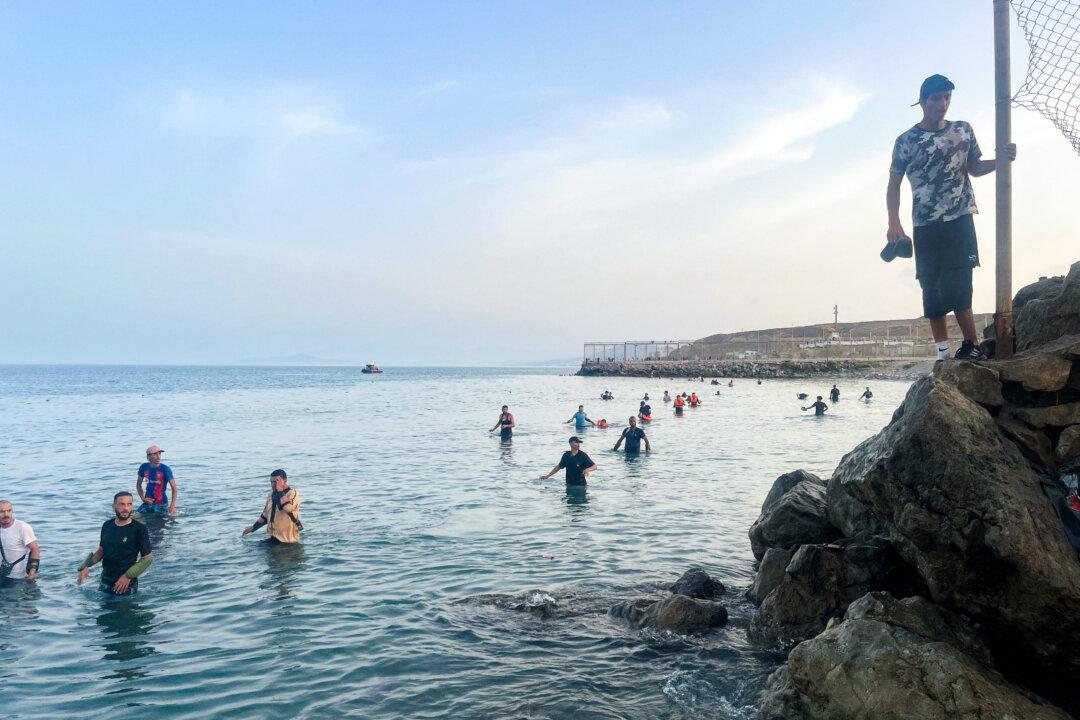
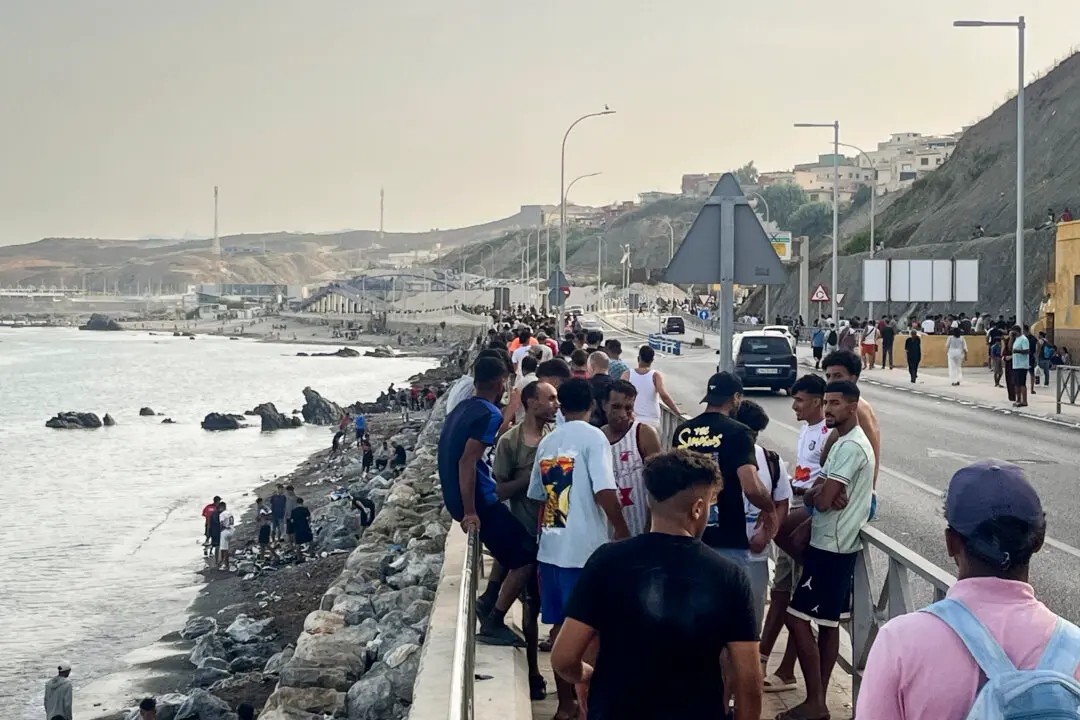
CEUTA, Spain—Numerous recent illegal border crossers are still in Ceuta, and the Spanish exclave is straining under their presence.
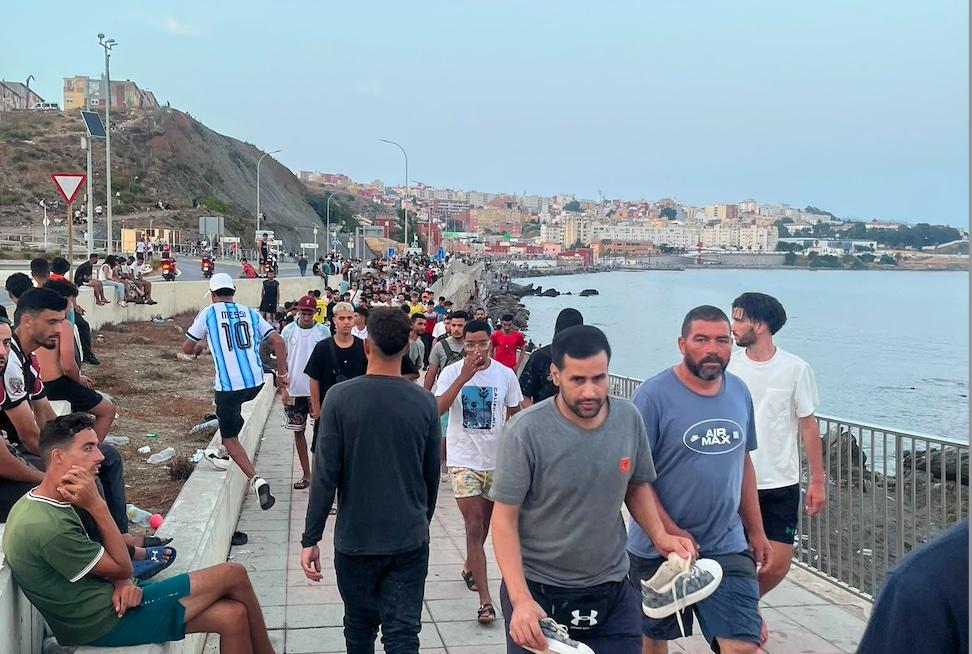
Authorities reported tens of thousands crossing into the city from Morocco starting July 30, but the majority returned home.
While Ceuta’s border fence is now nearly deserted, the situation facing the city’s migrant reception center is the opposite, with crowds pressing against the gates of a facility filled far past capacity.
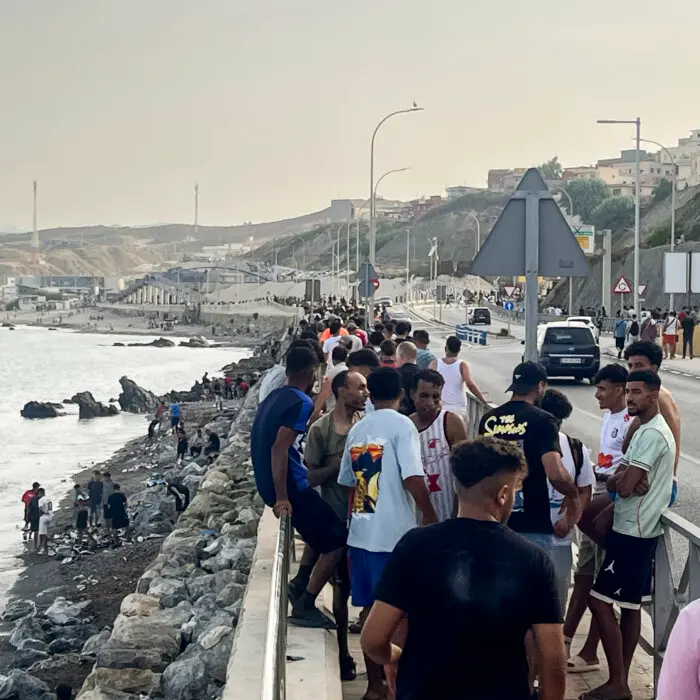
Built to accommodate 512 people, the facility was already at capacity, with hundreds more waiting outside, The Epoch Times observed on Sunday.
The strain is particularly acute for minors. The city, which has designated capacity for 29 children, said Monday that it was caring for 862 unaccompanied minors, nearly 30 times its allotted capacity, and was converting an industrial building and a warehouse into emergency shelters.
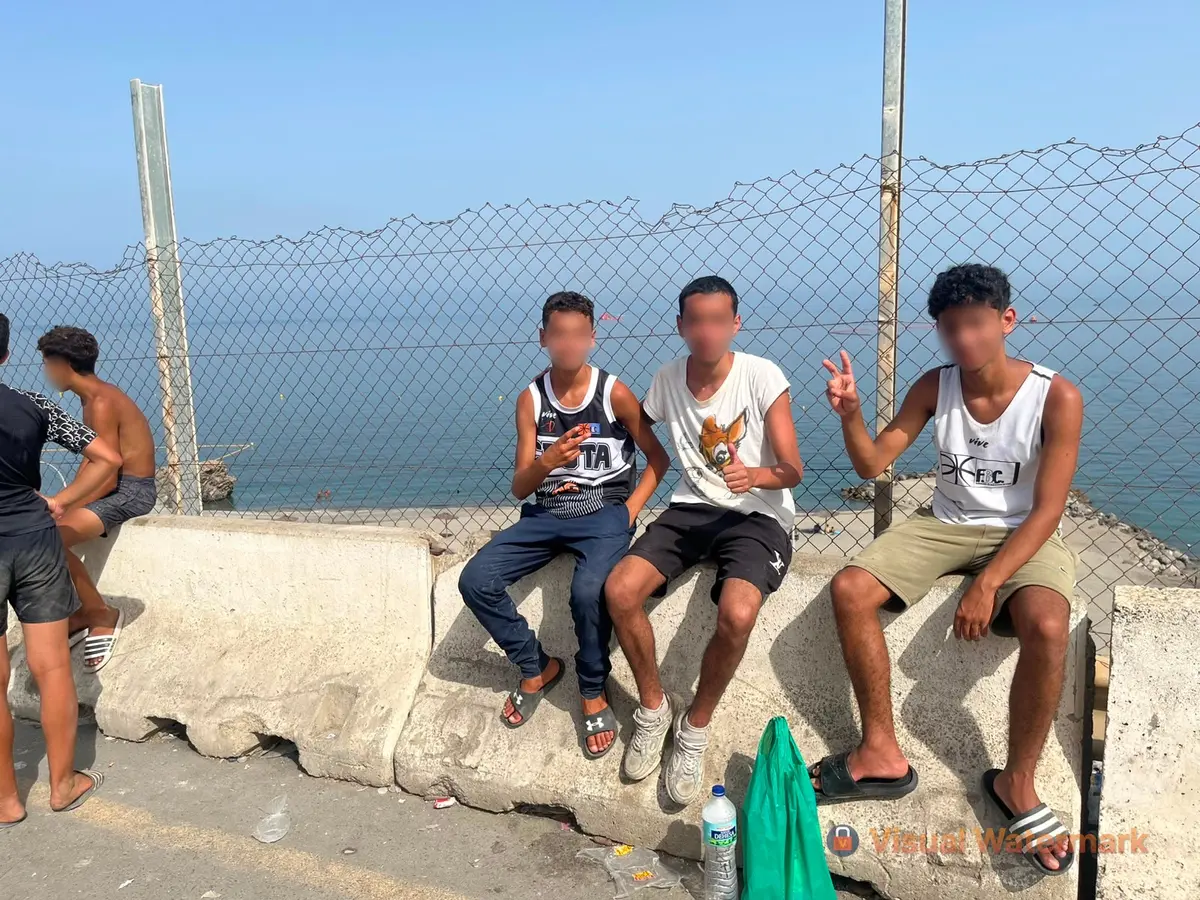
While many of the new arrivals in the city are in their 20s or older, some are very young. Several of those The Epoch Times spoke with were as young as 13.
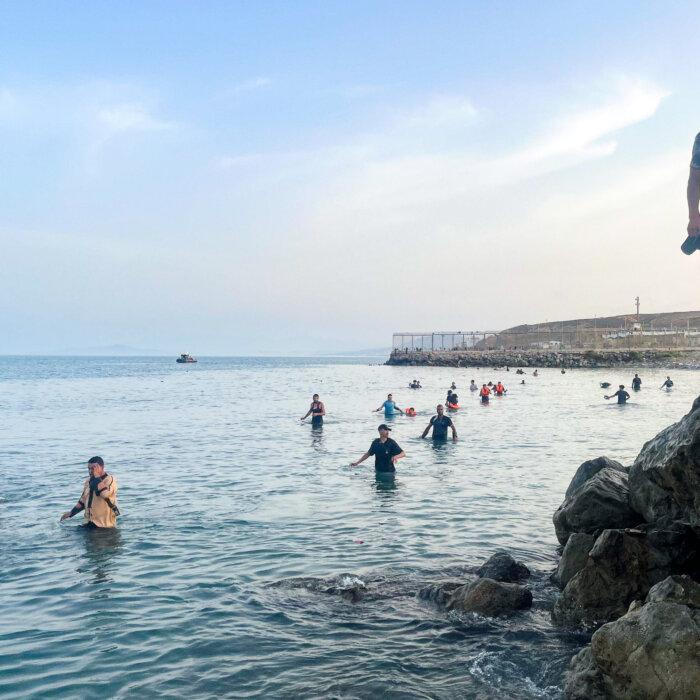
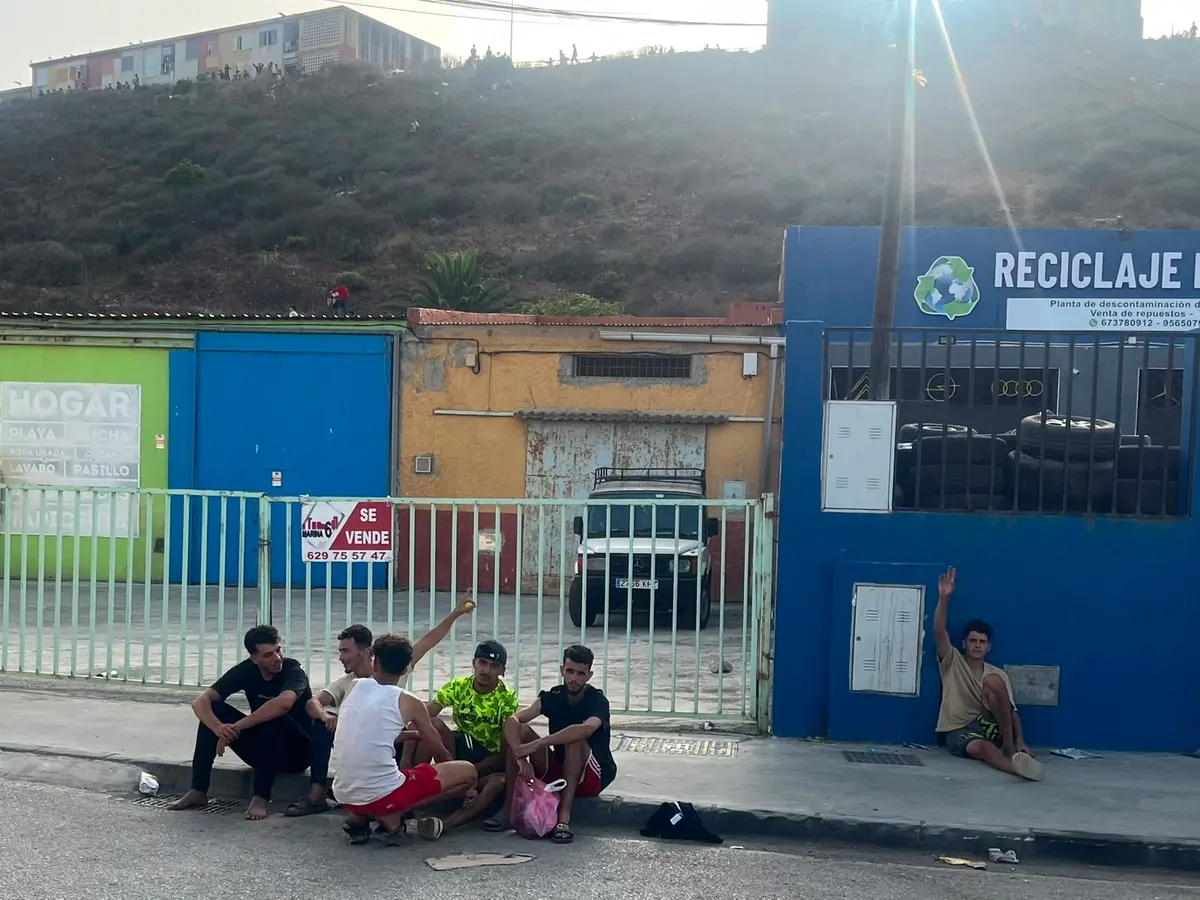
Among them, Nazir, 14, and Wassim and Yassine, both 15, reported sleeping in the streets. But they are determined to stay. They said that their parents knew of their circumstances and had even encouraged them to head to Europe for work.
Beyond the harsh living conditions, these teenagers also face danger, particularly those who drift into Barrio del Príncipe, a neighborhood known for gang violence, jihadism, and drug trafficking.
Near the crossing, a woman of Moroccan origin named Georgina, who had entered Ceuta with her daughter with plans to travel on to Madrid, lashed out at members of the army Aug. 1, saying she had seen some of these teenagers being assaulted and accusing the soldiers of not doing enough to protect them.
“The Moroccan residents of Ceuta are beating these children who came in illegally. They don’t want anyone here. Only themselves. These poor boys have no one to protect them, no one but God!” she told The Epoch Times.
On Tuesday, Spanish Minister of Inclusion, Social Security and Migration Elma Saiz announced an extraordinary allocation of 25 million euros for the care of minors in Ceuta, on top of 5.5 million euros already earmarked for the city in July. She called on Spain’s regional governments, most of which are led by the opposition Popular Party (PP), to take on their share of responsibility for the unaccompanied children who remain in the city without their families.
Spain adopted a legal mechanism in 2025 that lets the central government relocate unaccompanied minors from an overwhelmed territory such as Ceuta to other regions. Whether those transfers will actually happen is uncertain, as many of the PP-run regions expected to take them in are wary of reports of crime and a potential pull factor that could draw further arrivals.
Spain’s right, led by Vox, has increasingly blamed unaccompanied minors for a rise in crime, making their presence one of the most heated flashpoints in the national immigration debate.
Thousands Remain
Mayor-President of Ceuta Juan Jesús Vivas told Spanish newspaper El País that 88 people were confirmed to have died in the surge.
With most of those who crossed now back in Morocco, they say the city’s biggest challenge “no longer comes from the border but from the migrants who stayed.”
Vivas estimated on Aug. 3 that 3,000 to 5,000 immigrants remain in the city, scattered across neighborhoods and hillsides. Officials warned that normal life has not yet returned.
On Aug. 2 and Aug. 3, army units were still combing Ceuta’s outlying districts, trucking groups of illegal immigrants back to the border crossing.
Impact on Ceuta
Ceuta’s relatively affluent historic center sits apart from its poorer city districts along the border, such as El Príncipe and Los Rosales. The migrant influx and its most visible incidents have unfolded largely out of sight of downtown.
In the border districts, residents have been improvising their own defenses: In Los Rosales, streets have been sealed off with construction fencing.
While some residents in the poorer districts were shielding themselves from the migrant influx, blaming Morocco and Spanish Prime Minister Pedro Sánchez’s government for their ordeal, others interviewed Aug. 1 in downtown cafés told The Epoch Times that, despite their anger at the situation, they do not hold Sánchez responsible. They fear the crisis will benefit the right.
On the evening of Aug. 1, tensions reached the city center itself: A group of residents of Moroccan origin and left-wing activists protested the arrival of Alvise Pérez, a conservative member of the European Parliament who had come to Ceuta with the activist Vito Quiles amid the border crisis.
Protesters forced Pérez to take refuge in a bar as the crowd chanted “Get out,” “Ceuta united, not divided,” and “I am Spanish,” before police evacuated him from the area.
“These Nazis tell us we are not Spanish. Those who are Islamophobic, racist, and fascist are the ones who should get out of here,” one protester told The Epoch Times.

Assigning Blame
Spanish authorities say more than 60,000 people entered, the largest influx Ceuta has ever recorded. The Vivas government puts crossings closer to 80,000.
Questions have mounted over how the crisis came about.
Madrid first found itself at the center of a controversy after Spanish online outlet The Objective published an Aug. 1 article alleging that the government had received multiple intelligence warnings of a potential migrant surge in Ceuta and Melilla in the days leading up to Morocco’s Throne Day.
The government ignored those warnings, the outlet stated, even though intelligence services pointed to the unusual arrival of large numbers of buses in Castillejos, the Moroccan town closest to the Ceuta border, and to the likelihood that King Mohammed VI would temporarily ease controls at the border for the major national public holiday.
Spain’s center-right Popular Party leader Alberto Núñez Feijóo told reporters the influx was “a premeditated occupation” and said that Spaniards “have the right to demand that the Government explain why it failed to act.”
The same day, the Spanish government denied receiving such intelligence reports.
Interior Minister Fernando Grande-Marlaska already told reporters on Aug. 1 that Spain’s intelligence agency, the CNI, which answers to the Defense Ministry, had not warned him of an imminent surge.
At a press conference in Ceuta on Aug. 2, leader of Spain’s right-wing nationalist Vox party Santiago Abascal denounced what he called “an act of war promoted by Morocco, and tolerated and permitted by Pedro Sánchez.” Abascal demanded permanent militarization of the border, no crossings until Moroccan leaders in Rabat provide guarantees, and the suspension of the EU’s preferential agreement with the kingdom.
On the far left, Antonio Maíllo of the socialist United Left called the episode a “hybrid attack,” urged the recall of Spain’s ambassador to Morocco, and dismissed the government’s “appeasement strategy” as a “resounding failure.”
Sánchez, who called the influx “an attack and violation of Spain’s territorial integrity” during a July 31 visit to the city, has nonetheless avoided blaming Morocco directly and has not convened the government’s crisis bodies, confining the army to a police-support role.
On Aug. 3, National Court Judge María Tardón opened preliminary proceedings into whether the mass entry was “a concerted or directed action” by a criminal group.
Morocco Blames ‘Mafias,’ Misinformation
Rabat has kept its official response low-key.
In a statement, the Moroccan Interior Ministry blamed the “malicious exploitation” of social media, trafficking gangs, and misreadings of the Spanish court ruling, pledging that Morocco would remain “a reliable and responsible partner.” The country’s ambassador to Spain, Karima Benyaich, called the situation “undesired” and the work of “criminal mafias.”
Moroccan authorities did not respond to requests for comment.
According to the ministry, authorities in 2025 thwarted 73,640 attempted irregular crossings toward Europe and dismantled more than 300 migrant smuggling networks, after 78,685 interceptions in 2024.
The backlash against the Moroccan government has come not only from abroad; it has also erupted at home.
The Islamist Justice and Development Party (PJD), the main opposition force, and two left-wing parties, the Socialist Union of Popular Forces (USFP) and the Party of Progress and Socialism (PPS), have seized on the crisis to attack the competence of the ruling center-right National Rally of Independents (RNI) and to hold it responsible.
The timing could hardly be worse for the government, with a general election set for Sept. 23.
For Said Saddiki, a professor of international relations at one of Morocco’s top public universities, Sidi Mohamed Ben Abdellah University, the crisis “came as no surprise.” The wealth gap between Europe and Morocco, youth unemployment, a court ruling interpreted online as Spain opening its doors, and Madrid’s plans to regularize hundreds of thousands of immigrants had all converged, he said, with the viral social media campaign supplying the spark.
“However, the main question is who manipulated the situation through social media,” he told The Epoch Times.
He was circumspect about the theory that Rabat let the wave through to punish Sánchez’s recent outreach to Algeria, Morocco’s regional rival. “It cannot be ruled out entirely,” he said, noting that migration “has become a bargaining tool,” but the risk for Rabat “would be considerable.”
“Morocco was also holding its Throne Day celebrations, and the king’s speech highlighted the country’s economic and social achievements. Such a move, with waves of migrants leaving Morocco, would have sent a contradictory message to international opinion and would have damaged Morocco’s image,” he said.
Nor does he believe Rabat is after the Spanish exclaves themselves, “especially because the Western Sahara question remains unresolved.”
“Morocco cannot open several diplomatic fronts at once,” Saddiki said.
The recent surge has drawn comparisons to Ceuta’s May 2021 crisis, with video footage at the time appearing to show Moroccan border guards opening fences and letting people through.
This time, some Moroccan immigrants said authorities tried to deter them from crossing; others reported that they did nothing.