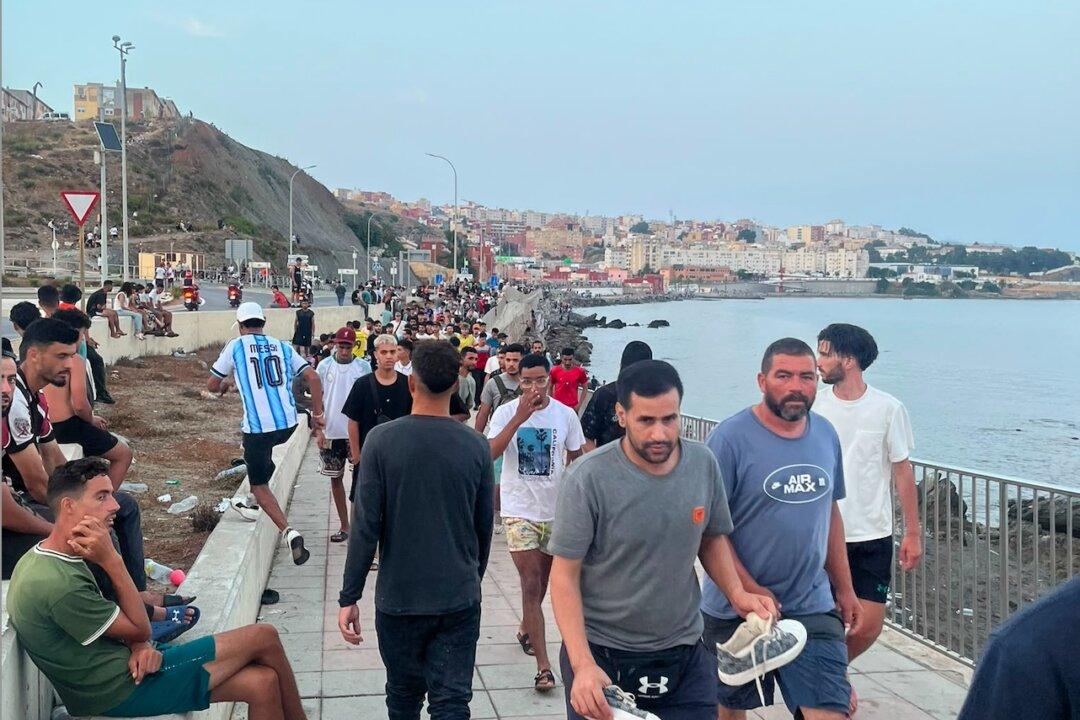
Ceuta Mayor-President Juan Jesús Vivas on Aug. 14 called for suspending the right to asylum in Spain’s North African enclave in cases of mass border “invasion,” two days after Morocco’s justice minister blamed Spanish Prime Minister Pedro Sánchez’s migration policies for fueling illegal crossings.
Appearing alongside Senate President Pedro Rollán, a fellow member of the conservative Popular Party (PP), Vivas demanded the immediate return to Morocco of the migrants who have remained in the city since tens of thousands poured across the border on July 30, as well as a new legal framework allowing an automatic response to mass entries.
Warning that coexistence and national security face maximum risk, he said the response to the crisis “has not been up to the task” on the part of those responsible for providing it.
A day earlier, after meeting with Interior Minister Fernando Grande-Marlaska, Vivas urged the government to dismiss asylum applications filed by those who entered on July 30 from the outset of the procedure, a request he said had gone unanswered.
“Return to Morocco. No regularization, no asylum. That message must be absolutely clear,” he said, presenting the measure as necessary to defuse what he said was the use of migratory pressure as a weapon to destabilize Ceuta.
The city government estimates that at least 9,000 migrants are still in the Spanish enclave.

The PP’s national leadership endorsed the asylum suspension on Aug. 14, saying that Morocco is designated a safe country under the European Union’s migration pact and pointing to Greece’s temporary suspension of asylum as a precedent.
Deportation Easier Said Than Done
The mayor-president of Ceuta is facing “an extremely complex situation,” Nicolas Klein, a French Hispanist and author, told The Epoch Times.
But this issue does not fall solely on Sánchez’s government, which is itself constrained by a number of European and Spanish rules on deportation, as illustrated by the July 8 Supreme Court ruling that Spain’s summary border-rejection procedure does not apply to migrants intercepted at sea, Klein said.
Madrid therefore has limited room for maneuver and finds itself in a delicate position, he added.
“In practice, it is far easier to call for migrants to be sent back than to actually carry out their immediate removal.”
Morocco Pushes Back
The pressure from Ceuta comes as Rabat, Morocco, has gone on the offensive.
In an Aug. 12 interview with Spanish news agency EFE, Moroccan Justice Minister Abdellatif Ouahbi accused Madrid of undercutting his country’s border controls, saying Morocco blocks the departure of migrants, Moroccans and others alike, “but when they arrive in Spain they are accepted,” and their status is regularized.
Intercepted migrants, he said, now ask Moroccan officers why they are being stopped if Spain accepts them, and he warned that two states sharing the same borders cannot pursue contradictory policies.
Ouahbi also said his ministry is weighing a suspension of the extradition treaty with Spain over handovers of wanted individuals that fail to materialize and demanded the swift return of the Moroccan minors who reached Ceuta, invoking the approaching school year.
The July 30 surge, in which tens of thousands of mostly young Moroccan men entered the enclave by sea and land, followed viral social media claims that the July 8 Spanish Supreme Court ruling that disapproved immediate pushbacks on migrants arriving by sea, combined with Spain’s regularization drive, had opened a path to stay.
Both governments have blamed human trafficking networks for spreading that misreading.
It is natural for Rabat to voice concern when a neighbor carries out a major regularization, given the considerable resources Morocco devotes to fighting irregular migration, El Yazid Mouhsine, Morocco’s honorary consul in Lausanne, Switzerland, told The Epoch Times.
However, the two countries “are so interdependent that these issues should be discussed through dialogue rather than through public statements traded back and forth,” Mouhsine said. “Neither Morocco nor Spain has an interest in transforming a migration episode, however serious, into a lasting political crisis.”
“Geography makes us neighbors; political wisdom must turn that proximity into a partnership,” he said.
On Aug. 12, Spain’s Interior Minister Fernando Grande-Marlaska stated at a press conference that of the thousands of people still remaining in the autonomous city, “no one will stay in Ceuta, no one will go to the mainland, no one will be granted legal status,” with the exception of “those exceptional cases of extreme vulnerability.”