German Chancellor Friedrich Merz has admitted Europe spent too long relying on the United States for its defense and security, but said they were now on the “same page.”
Europe has accelerated defense investment and cooperation since U.S. President Donald Trump returned to the White House in January and renewed pressure on NATO allies to shoulder more of the responsibility for defending Europe.
Merz’s comments were made during a visit to Britain aimed at strengthening defense ties between Germany and the United Kingdom.

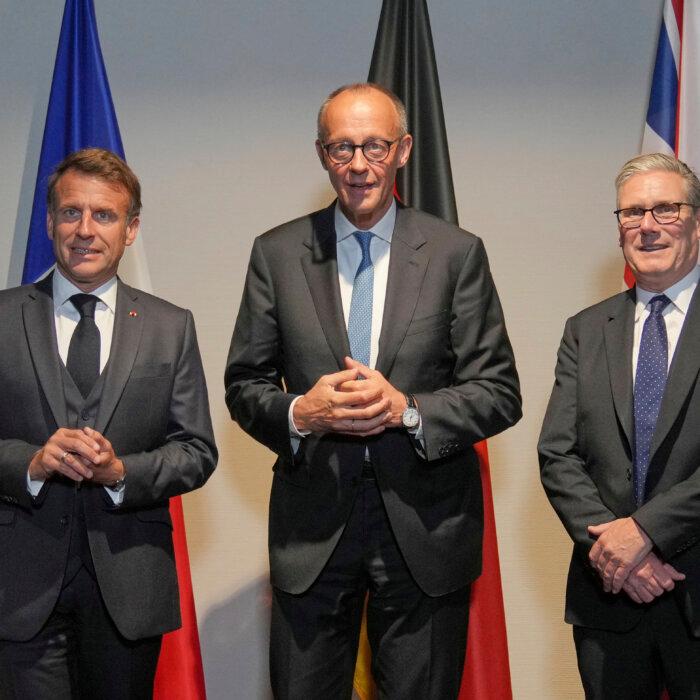
Merz and British Prime Minister Keir Starmer committed to developing, in the next decade, an advanced missile system with a range of more than 1,200 miles.
“Well, at least he is not as clear and committed as former U.S. presidents were ... and that’s the reason why we are all looking for more independence from American defense,” Merz said.
The German leader said he had noticed over the years that the United States was pivoting away from Europe and toward Asia because it was in a “very hard competition” with China.
‘On the Same Page’
“I think President Trump is on the same page. We are trying to bring this war to an end,” Merz said.“We are on the phone once a week. We are coordinating our efforts. One issue is the war in Ukraine, and the second is our trade debates and tariffs.
“We are seeing a big threat, and the threat is Russia. And this threat is not only on Ukraine. It’s on our peace, on our freedom, on the political order of Europe.”
Merz said that German armed forces were “not strong enough, our army is not strong enough, so that’s the reason why we are spending a lot of money.”
On June 24—the day before the agreement was announced at the NATO summit—Germany’s finance minister, Lars Klingbeil, said Berlin would increase its core defense spending to 3.5 percent by 2029, with another 1.5 percent spent on defense-related infrastructure.
“We will raise defense spending step by step so that we will reach a NATO quota of 3.5 percent in 2029,” Klingbeil said.
Since returning to the White House in January, Trump has tried to end the war in Ukraine.
But his efforts have been rebuffed by Russian President Vladimir Putin, and on July 14, Trump said he would ramp up tariffs on Moscow and impose secondary tariffs if Putin does not accept a peace deal with Ukraine within the next 50 days.