It was Carney’s first participation at the event in New York City as head of government, having previously served with the U.N. in a climate finance role.
Trump warned that countries with open border policies that pursue the “green energy” transition are “going to hell.”
“You need strong borders and traditional energy sources if you are going to be great again,” he said.
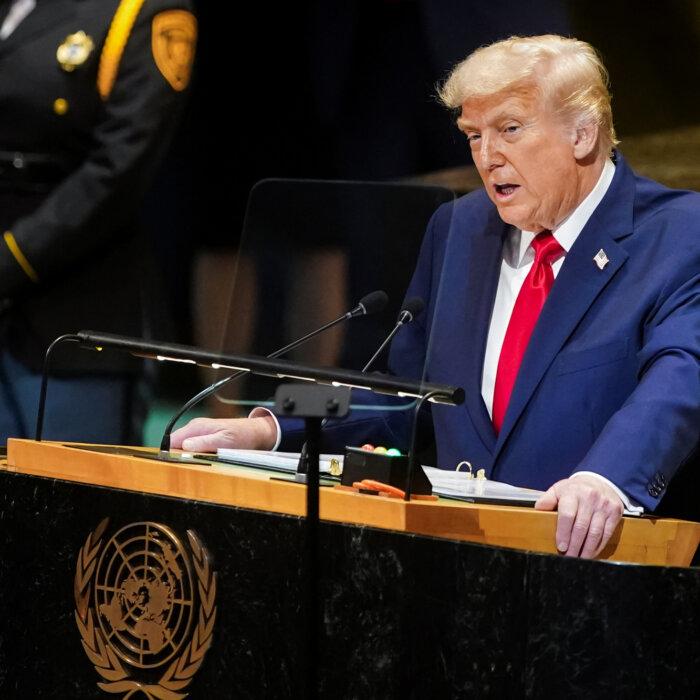
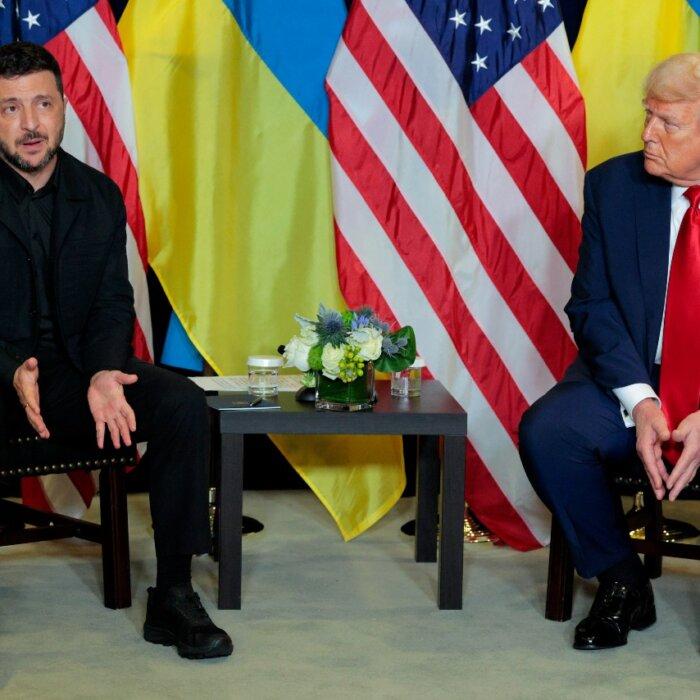
The shots Trump took at multilateralism and progressive policies illustrated the gap existing between Washington and Ottawa on a host of issues. This is on top of the trade dispute as Trump continues to levy tariffs against Canada.
“We would like the old system back,” Carney said during a talk hosted by the Council on Foreign Relations think tank on Sept. 22. “We prospered out of the old system and we were able to pursue a values-based foreign policy, based on, or anchored on, a rules-based multilateral trading system, an open global financial system.”
Carney the Diplomat
Even though Carney has called the changes to the international trading system a “rupture,” he did not vigorously push back on Trump’s U.N. speech running counter to many of his own stances.“I heard every word from the president and I took a few notes,” Carney said at a press conference at the end of the day on Sept. 23.
He said the first important point he noted was on the efficiency of the United Nations, adding that it must be reinforced to be more relevant in efforts to resolve armed conflicts.
Carney agreed Trump was able to stop seven wars, including the long-standing dispute between Armenian and Azerbaijan.
“He’s right ... when he said he solved these conflicts by himself” without assets from the United Nations, Carney said.
Carney also suggested that Trump echoed “in his own words” some fundamental U.N. principles toward the end of his speech. Trump mentioned the need to defend free speech, protect religious liberty, and safeguard countries’ sovereignty. Carney said this leaves an opening for greater U.N. involvement in “certain circumstances” to achieve peace.
The prime minister also did not put himself at odds with Trump on the issue of green energy policies.
Carney has been a strong advocate of net-zero emissions policies while also demonstrating some pragmatism since becoming prime minister.
“I saw a great opportunity for Canada,” he said, noting that Canada is an energy “superpower” that will have a competitive trade advantage due to a lower carbon footprint. “We can offer solutions, and if currently that’s not in the interest of Americans, we are lucky,” he said.
Trump, in his speech, called green policies a “scam” and the carbon footprint a “hoax.”
Key Move
While Carney did not rise in opposition to Trump during his time in the president’s former hometown of New York City, he did take a stance that represents a clean break with U.S. foreign policy and with Canada’s long-standing position on the Israel-Palestine conflict.It didn’t come as a shock when Carney announced on Sept. 21 that Canada is recognizing Palestinian statehood, given that he had made his intention known in late July.
It is not yet clear what the ramifications will be for Canada for siding against the United States and Israel. Trump had previously sent mixed signals about the issue, saying it would be harder for Canada to reach a trade deal, while not being a “deal breaker.”
Canada remains without a specific trade deal to address Trump’s sectoral tariffs on metals and cars, which are having the biggest impact on the Canadian economy. Carney said negotiations are ongoing but there doesn’t appear to be any momentum to resolve the issue.
“Let’s be absolutely clear: We have the best trade deal of any country in the world right now with the United States,” Carney said when asked by reporters if recognizing Palestine could alienate the United States and impact Canada’s ability to reach a deal.
Carney went on to say that recognizing Palestine is a matter of principle and that Canada has an independent foreign policy. “We make decisions that are consistent with our values,” he said.
Palestinian territories are split in two, with the Palestinian Authority and Palestine Liberation Organization ruling the West Bank, and Hamas ruling the Gaza Strip. Carney said the recognition is necessary because of diminishing peace prospects with the Hamas attack of Oct. 7, 2023; the encroachment of Jewish settlements in the West Bank; and Israel’s “contribution to the humanitarian disaster in Gaza.”
Trump said in his speech before the United Nations assembly that recognizing Palestine would be a reward “too great for Hamas terrorists for their atrocities” and that the unilateral move will prolong the conflict. Israeli Prime Minister Benjamin Netanyahu said there will never be a Palestinian state and that Jewish settlements will continue to be established.
Likes China on Climate
One area of foreign policy continuity with the previous Liberal government is the approach of using climate change as a way to find common ground with China and engage that country.“In my experience with China, they are, amongst other things, very sincere and engaged on climate,” Carney said before the Council on Foreign Relations when asked to assess the effectiveness of Canada and the United States working to influence China’s behaviour and how to do things differently.
He added that Canada has to be clearer on the areas in which it engages, noting sectors like commodities, aspects of energy, and basic manufacturing while leaving aside sectors that “bridge into national privacy.
Ottawa has been pushing to increase engagement with Beijing amid a trade conflict. Canada targeted Chinese metals and electric vehicles with tariffs, and China responded by imposing duties on canola and seafood.
Liberal MP Kody Blois, Carney’s parliamentary secretary, travelled to China earlier this month with Saskatchewan Premier Scott Moe. Blois said cabinet ministers can be expected to travel to China as well.
According to an account of the meeting reported by Chinese state media Xinhua, Li said China is willing to move the relationship forward by expanding cooperation in “energy, green development, tourism, and other fields.”
Li also reportedly said Canada should “adopt a correct perception of China.”
Ukraine
Canada has been a steadfast ally of Ukraine as it pushes back against Russia’s invasion. Ottawa has sought to play a leading role in the efforts in some instances, such as in coordinating sanctions. Chrystia Freeland, who resigned from cabinet in mid-September, led the charge when she was deputy prime minister and minister of finance under Prime Minister Justin Trudeau.This meeting took place three days after Trump hosted Russian President Vladimir Putin in Alaska.
Carney said during his time in New York City that Canada is the largest contributor of humanitarian and military aid to Ukraine on a per capita basis. On Sept. 23 he co-chaired a meeting with Zelenskyy at the United Nations to advocate for the return of Ukrainian children forcibly taken by Russia.
Resolution of this conflict has remained elusive despite Trump’s attempts using various strategies, including to play nice with Putin.
The Trump administration had previously said Ukraine would have to make territorial concessions to end the conflict.
Commenting on Trump’s latest stance, Carney said the president made “very sincere and multiple efforts to try to establish peace” using his relationship with Putin. “Putin has failed every occasion, every opportunity.”
Carney said discussions are underway with G7 finance ministers to impose secondary sanctions on Russia. “We have been rightly aggressive in terms of our financial sanctions. We are ready to do more,” said Carney.