This copy is for your personal, non-commercial use only. Distribution and use of this material are governed by our Subscriber Agreement and by copyright law. For non-personal use or to order multiple copies, please contact The Epoch Times Reprints.
Air Force Gen. Dan Caine, chairman of the Joint Chiefs of Staff, watches a video of a bombing test of the GBU-57A/B Massive Ordnance Penetrator used in the attack on the Iranian Fordow Fuel Enrichment Plant, during a news conference at the Pentagon in Arlington, Va., on June 26, 2025. Andrew Harnik/Getty Images
Iranian Foreign Minister Abbas Araghchi has said the Fordow nuclear site was “seriously and heavily damaged” by U.S. B-2 bombers on June 21.
“No one exactly knows what has transpired in Fordow,” Araghchi said during an interview with CBS News, broadcast on July 1. “That being said, what we know so far is that the facilities have been seriously and heavily damaged. The Atomic Energy Organization of the Islamic Republic of Iran [AEOI] is currently undertaking evaluation and assessment, the report of which will be submitted to the government.”
The AEOI is a state-owned agency responsible for Tehran’s nuclear program.
On June 21, several U.S. B-2 bombers attacked three of Iran’s nuclear sites, including the Fordow facility. Fordow was targeted with the GBU-57, also known as the Massive Ordnance Penetrator or bunker buster, a 30,000-pound bomb designed to burrow and explode deep underground.
On June 26, Iranian leader Ali Khamenei said the U.S. airstrikes on June 21 had “achieved nothing.”
When asked if the Fordow facilities had been “obliterated,” as U.S. President Donald Trump has said, Araghchi said: “It appears they have been heavily and seriously damaged. However, I would like to reiterate that I do not have accurate information regarding the damage. We need to wait until the [AEOI] reports come in to see whether or not they will [be] able to be relaunched or if they will be relaunched.”
Rafael Grossi, director general of the International Atomic Energy Agency, said in a June 27 interview with CBS News that Iran could begin enriching uranium again within a few months.
“The capacities they have are there,” Grossi said. “They can have, you know, in a matter of months, I would say, a few cascades of centrifuges spinning and producing enriched uranium, or less than that. But as I said, frankly speaking, one cannot claim that everything has disappeared and there is nothing there.
“It can be, you know, described in different ways, but it’s clear that what happened in particular in Fordow, Natanz, Isfahan, where Iran used to have and still has, to some degree, capabilities in terms of treatment, conversion and enrichment of uranium have been destroyed to an important degree.”
Iran Could ‘Expeditiously’ Repair Damage
Araghchi was asked about Grossi’s comments during the July 1 interview with CBS. He said Grossi’s assessment was based on Iran’s technology and know-how.
“Iran has got an enrichment industry that is localized; we have not imported it from abroad, and this technology cannot be bombed down,” Araghchi said. “One cannot obliterate technology and science through bombardment. ... No one at the moment is saying that facilities are intact. It is the technology and know-how that is still there.”
Araghchi said if the will is there, Iran could “expeditiously repair the damages and make up for the lost time.”
He said the Iranian regime would not back down over uranium enrichment, but he insisted that there was a fatwa, or religious decree, from Khamenei forbidding nuclear weapons.
AEOI’s website quotes a statement from Khamenei in which he said: “The Islamic Republic of Iran regards use of nuclear and chemical weapons as a cardinal and unforgivable sin. We raised the slogan ‘Middle East free from nuclear weapons,’ and we remain committed to this slogan.”
On July 2, state-affiliated news outlet Nour News said Iran had put into effect a law that suspended all cooperation with the International Atomic Energy Agency and said any future inspection of its nuclear sites by the agency’s inspectors needed to be approved by the country’s Supreme National Security Council.
On June 25, the White House published a statement titled “Iran’s Nuclear Facilities Have Been Obliterated—and Suggestions Otherwise are Fake News.”
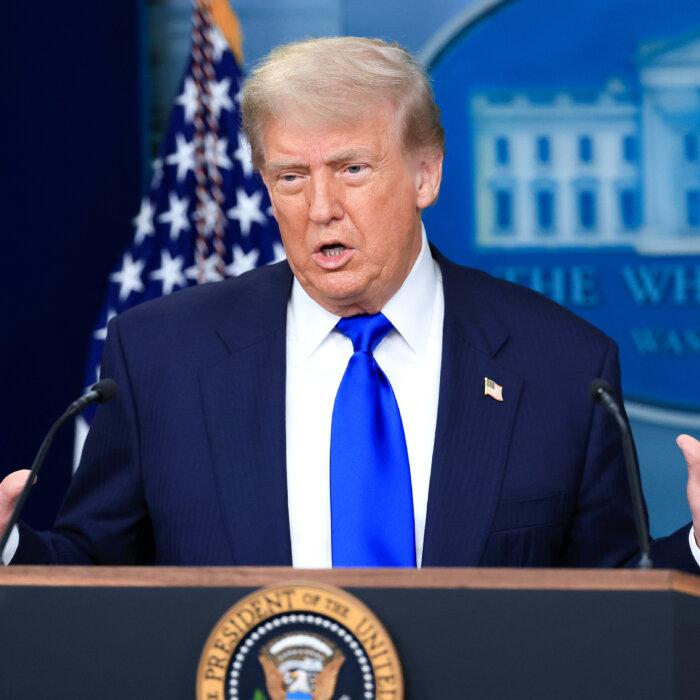
“Monumental Damage was done to all Nuclear sites in Iran, as shown by satellite images,” Trump said in the statement. “Obliteration is an accurate term!”
Defense Secretary Pete Hegseth said: “Based on everything we have seen—and I’ve seen it all—our bombing campaign obliterated Iran’s ability to create nuclear weapons. Our massive bombs hit exactly the right spot at each target and worked perfectly.”