Prime Minister Mark Carney says while Canada’s economy is doing “reasonably well” and his government is working on diversifying the economy, there will be challenges ahead requiring sacrifice.
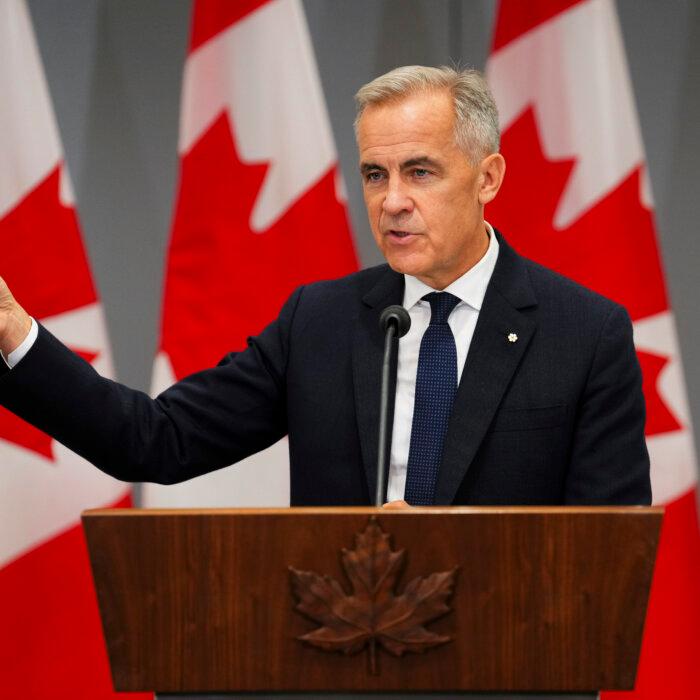
“We won’t transform our economy easily or in a few months. It will take some sacrifices, and it will take some time,” Carney said in a rare televised address related to the Nov. 4 budget, while speaking to University of Ottawa students on Oct. 22.
“Our government will work relentlessly to cut waste and drive efficiencies, and when we have to make difficult choices, we will be thoughtful, we will be transparent, we'll be fair, we will work collaboratively with our colleagues across the aisle to build, protect, and empower Canadians.”
The upcoming budget is expected to include steep deficit projections, with Government House Leader Steven MacKinnon saying the deficit will be “substantial.” The Liberal government so far hasn’t announced if there will be cuts to specific programs, saying key support programs such as national dental care and child care will be maintained.
Carney said his government will balance the “operating deficit” in three years, adding the focus will be on “reducing wasteful government spending,” citing as an example government initiatives to reduce red tape.
“The fact is that federal spending has been growing over the course of the last decade by more than 7 percent year-over-year. We’ve been spending faster than our economy was growing. We have to change that,” he said.
Priorities
Carney said the upcoming budget will focus on growing non-U.S. exports, getting major projects approved via the Major Projects Office, boosting the construction of affordable housing, and expanding a “buy Canadian” approach.He said the budget will include a reduced immigration intake plan prioritizing skilled workers, and maintain a strong focus on reducing emissions while helping to grow the economy and making sure Canada is an “energy superpower.”
Comments on US
Carney repeated comments he has made in the past about Canada’s changing relationship with the United States, which he has not emphasized in public addresses since the campaign leading up to the April election.“Our relationship with the United States will never again be the same as it was, even though in this new world of protectionism we have the best trade deal of any other country, and we’re working to make it even better still,” Carney said, referring to the existing United States–Mexico–Canada Agreement.
“Many of our former strengths as a country ... strengths based on close ties to America, have become our vulnerabilities.”
Despite referring to a “rupture” in trade relations with the United States, Carney’s Oct. 22 remarks avoided singling out the Trump administration the way he did earlier this year during the federal election and the Liberal leadership campaign, when he accused U.S. President Donald Trump of “attacking Canadian families, workers and businesses” with “unjustified tariffs.”
Pre-Budget Announcements
Carney also repeated some of the pre-budget announcements his government has made.Carney has also announced the hiring of 2,000 additional law enforcement personnel and expanded security programs, including at the border.
Ottawa is also boosting defence spending to meet NATO’s target of allocating 2 percent of the nation’s GDP to defence.
Deficit
The Liberal government has faced growing pressure from the Opposition to explain how the deficit will be curbed. Carney has said his government will “spend less” in order to “invest more,” with Finance Minister François-Philippe Champagne promising “generational investment.”Opposition Stances
Carney’s Liberal government holds 169 seats in Parliament, three short of a majority, meaning it needs budget support from another party to avoid a vote of non-confidence.The NDP, which supported the Liberal government in the last parliamentary session through a supply-and-confidence agreement, has not ruled out supporting the government, provided it doesn’t produce an “austerity budget.”
Following an earlier meeting with Carney about the budget on Oct. 22, Poilievre said that while the two had a “good conversation,” he told the prime minister “we need this to be an affordable budget.”