Children’s use of social media is a considerable worry for many parents and political figures, and there is much evidence to support their concerns.
In Australia, discussions have been made for an age-restricted ban on social media, and both Australian Prime Minister Anthony Albanese and Opposition Leader Peter Dutton have advocated for banning social media for children under 16.
However, experts have argued that the solution is more nuanced than simply implementing a ban.
Communication Skills
Social media has been associated with significant impacts on social development, particularly affecting children’s communication abilities. The rise in social media has resulted in reports of young people struggling to communicate in person or over the phone.Psychologists state that without physical communication during childhood, the developmental process of succeeding and failing in real-time interactions is lost. Consequently, the ability to read physical social cues remains underdeveloped, which may impede the building of healthy relationships.
However, others maintain that social media helps friendships because it provides a space where kids can connect with their friends and express their emotions more carefully and clearly.
Bullying
While social media has become integral to young people’s friendships, it has also increased bullying.Before social media, children who experienced bullying at school could come home and be safe. However, today, children can be bullied anywhere and there is a wider audience to witness and perpetuate the abuse.

People also tend to be more hostile online than in person, as the virtual setting tends to lower their inhibitions. However, lowered inhibitions can also help people express their emotions more deeply.
Some find that text-based communication allows for greater reflection before responding, offering a sense of control that is not always present in face-to-face conversations.
Unlike in-person communication, online spaces allow kids to pause, think, and edit before expressing themselves.
Constant Socialisation
On the other hand, the relentless connectivity of social media can leave people feeling perpetually accessible, leading to mental fatigue.Engaging in multiple online conversations simultaneously, often while undertaking other tasks such as gaming, is now commonplace.
However, humans are inherently poor multitaskers, so this constant digital communication can become overwhelming and lead to anxiety.
Social media may also impact children’s ability to pay attention.
“Screens and social media may serve as constant distractions to homework for example, if they are not managed well,” Associate Professor at the University of Queensland Alina Morawska said.
Yet, if kids ignore online conversations parents report that it is similar to if they were often absent from school. The friendship group moves on without them, resulting in isolation.
Social media apps are displayed on an iPad in Miami, Fla., on Feb. 26, 2024. Joe Raedle/Getty Images
What Can Parents Do?
Some psychologists recommend parents treat social media like alcohol, in that they try to stop children from engaging with it for as long as they can. They also suggest that parents designate tech-free zones in their household.However, Dr. Morawska said technology is present everywhere.
“That means we have to find effective ways to make the most of the technology and minimize its risks,” she said.
She emphasised that although a social media ban would help parents manage and negotiate their kids’ social media use, it would not give them the skills to talk to their kids about proper usage.
“We need ways to assist parents to help their children learn to use social media safely, and to access screens in ways that is considered, conscious, and planful,” she said.
“Parents also need strategies to navigate the issues that technology brings to everyday family life.”
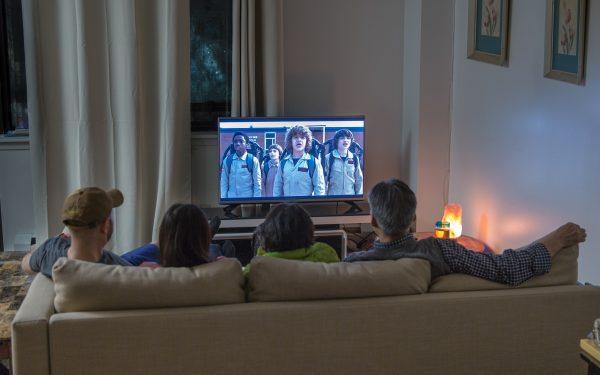
A family watches the TV series "Stranger Things," on Netflix at their home in Queens, New York, on Dec. 6, 2017. Benjamin Chasteen/The Epoch Times
Family Engagement
Another way to influence children’s behaviour is parental and familial modelling of device usage.According to Dr. Morawska, the frequency and timing of parents and family members using their phones—such as during meals or leisure time—have a direct impact on children.
She suggests that engaging with technology together, like watching a video or playing a game as a family, is better than children scrolling through content on their own.
While technology is a useful tool for learning that is not going to go away, establishing guidelines such as not engaging during dinner can help manage its impact.