The death toll of the 7.4 magnitude earthquake that struck western Colombia on the morning of Aug. 10 increased to at least 111 people by the afternoon. An additional 87 people were injured.
The earthquake struck at a depth of about 68 miles near San José del Palmar in Colombia’s Choco region, and the U.S. Geological Survey (USGS) reported that about 10.5 million people experienced strong to very strong shaking.
Colombian President Abelardo de la Espriella—who was sworn in on Aug. 7—declared a national state of emergency following the earthquake.
“The national government has all of its capabilities deployed to protect lives, assist affected communities and deliver aid wherever it is needed,” de la Espriella said in a national address. “The first priority is rescuing the people trapped under the rubble.”
The Colombian Geological Service stated that the earthquake was “the highest magnitude earthquake registered in Colombia in the last decade” and confirmed that the initial quake was followed by 2.8- and 4.8-magnitude aftershocks.
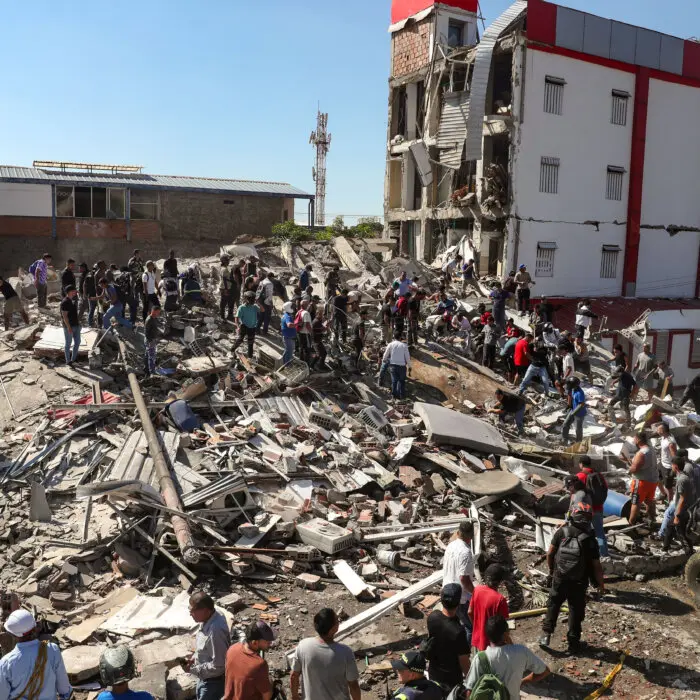
The earthquake damaged cities in the western part of Colombia, including Cali, Choco, Manizales, Pereira, and Quibdo. Colombia’s interior minister confirmed that more than 20 municipalities across the country were hit by the earthquake.
The earthquake was also felt in Ecuador and Panama, which both share borders with Colombia. However, minimal damage was reported in the two neighboring countries.
De la Espriella said that about 1,600 buildings were damaged on Aug. 10, including at least 61 buildings that completely collapsed.
Cali Mayor Alejandro Eder confirmed in a statement on social media that at least 20 structures had collapsed in the city, causing people to be trapped.
“I ask the citizens to remain calm. Check if there are any apparent structural damages in your buildings,” he said. “If you do not feel safe, if you see very large cracks, please, leave the building. Let us support our rescue teams with whatever is necessary.”
The Colombian Maritime Authority ruled out any tsunami threat to Colombia’s Pacific coast on Aug. 10 following the initial earthquake.
“In the face of the emergency, the State responds: united, coordinated, and in action to protect the lives of Colombians,” de la Espriella said in a social media post update on the afternoon of Aug. 10.
“I am at the forefront of the situation. It pains me deeply what the families and affected regions are going through. Colombia is united and we will move forward together.”
Before the Aug. 10 earthquake, Colombia experienced two other earthquakes of magnitude 7 or higher within 155 miles of the most recent earthquake, USGS stated. However, the USGS noted that the two previous earthquakes were located near Colombia’s coast and that the region around the Aug. 10 earthquake typically experienced smaller earthquakes.
The earthquake in Colombia followed Venezuela’s back-to-back 7.2- and 7.5-magnitude earthquakes in June. The pair of earthquakes left more than 5,000 people dead and hundreds of buildings destroyed, according to officials.
U.S. Secretary of State Marco Rubio expressed the Trump administration’s support for Colombia following the Aug. 10 earthquake.