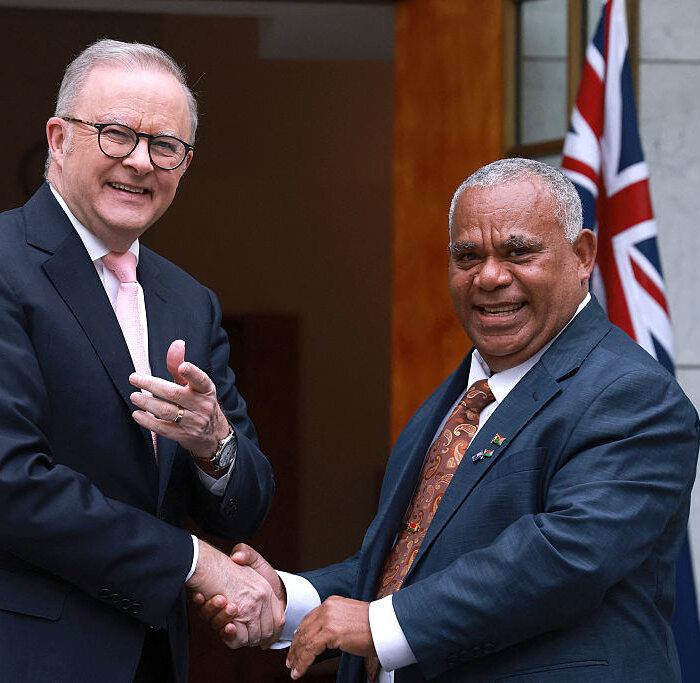
While Australian Prime Minister Anthony Albanese was preparing to sit down with his Vanuatu counterpart, Jotham Napat, to negotiate the final parts of a new security deal, a squad of Chinese police were renewing their deployment in Port Vila.
Yet days earlier on June 24, the Chinese Communist Party (CCP) Embassy’s website announced a new rotation of “police experts” in Vanuatu during a formal ceremony attended by Ambassador Li Minggang, two embassy counsellors, and officials from Beijing’s Ministry of Public Security and the Jiangsu Provincial Public Security Department, which supplies the officers.
The Ministry’s website mentions it has sent police to more than 40 countries, but does not disclose which ones. Police technically fall outside the definition of a military presence.
The embassy’s statement said law enforcement cooperation between China and Vanuatu have “continuously deepened” in recent years, part of the comprehensive strategic partnership between the two countries.
It also stated that the Ministry had deployed a police team to Vanuatu, where it has spent the past three years promoting “in-depth and practical cooperation” in areas such as police equipment, capacity building, personnel training, and law enforcement exchanges.

Meanwhile, Li reportedly told the new rotation of police officers that he hoped they would be “guided by Xi Jinping’s diplomatic thought” and fully implement the communist regime’s Global Security Initiative.
The redeployment of the Chinese officers comes as it continues fostering ties with the CCP despite concerns from Australia.
Following a visit to Beijing in September 2025, Vanuatu Internal Affairs Minister Andrew Napuat announced that the two countries would sign a new Memorandum of Understanding (MoU) to strengthen Beijing’s police assistance programs, including a new tranche of equipment such as INTERPOL systems, motorcycles, drones, and other gear worth $635,000 (US$437,000).
Australian authorities have previously signed off deals with Tuvalu, Nauru, or Papua New Guinea to effectively block off or “veto” any attempts by third parties, like the CCP, to be involved in local security matters.