This copy is for your personal, non-commercial use only. Distribution and use of this material are governed by our Subscriber Agreement and by copyright law. For non-personal use or to order multiple copies, please contact The Epoch Times Reprints.
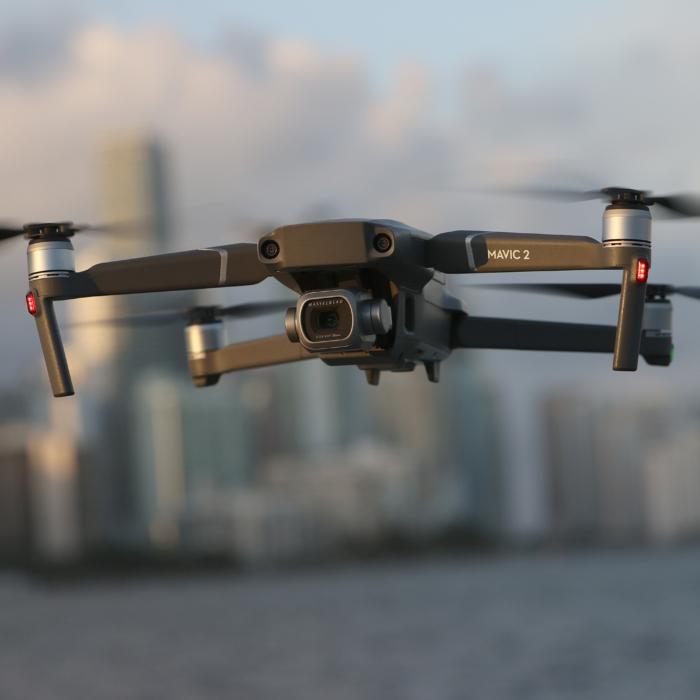
China-made drones are deployed during a demonstration at the Los Angeles Fire Department ahead of DJI's AirWorks conference in Los Angeles, Calif., on Sept. 23, 2019. ROBYN BECK/AFP via Getty Images
A China-born Canadian citizen has been deported from the United States after receiving probation for illegally photographing a U.S. defence facility with a drone.
Brampton, Ont., resident Xiao Guang Pan was deported back to Canada on Aug. 15, a U.S. Immigration and Customs Enforcement (ICE) spokesperson told The Epoch Times in an Aug. 29 statement. Pan was charged earlier this year by the U.S. District Court for the Middle District of Florida with three counts of using a drone to photograph defence installations and equipment at the Cape Canaveral Space Force Station (CCSFS) in Florida.
He later pleaded guilty to all three counts, according to a court document filed on June 18. His case comes amid heightened concerns about drone sightings at U.S. military bases and other sensitive sites.
“This blatant violation of U.S. federal law and national security underscores the seriousness of protecting America’s critical defense infrastructure,” reads the ICE statement. “There is zero tolerance for actions that jeopardize the safety and security of our military assets.”
Pan was born in China and moved to Canada in 2001, according to a biography posted by the Brampton Arts Organization. He is described as an “enthusiastic” drone photographer and videographer who previously worked at Best Buy for 18 years until his retirement in 2022.
Pan took nearly 250 drone photos and videos of “vital” military installations at Cape Canaveral Space Force Station between Jan. 5 and 7, according to the court document, which was signed by Pan. That space force base supports the United States’ space launch capabilities, and also hosts space launch complexes and U.S. Navy submarine wharfs.
U.S. federal law prohibits taking unauthorized photographs of vital defence installations or equipment.
NASA detected drone activity near the space force base on Jan. 7 and alerted local authorities, who later found Pan operating a drone–a Mavic 3 Pro model made by Chinese company DJI–from a nearby parking lot. A subsequent examination of Pan’s drone and phone revealed he had taken 243 photos and 13 videos of military structure at the space force station.
“At no point did Pan ask for or receive permission to take photographs or videos of CCSFS,” reads the court document.
Structures captured in Pan’s photos and videos included space launch complexes, a payload processing facility, mission control and power distribution infrastructure, security checkpoints, and fuel and munitions bunkers.
When interviewed by federal agents, Pan told them he had “flown his drone to take pictures of the beauty of nature, the sunrise, and the cruise ship port,” and that he didn’t know he was near a military installation, says the court document.
He also said his drone hadn’t provided him any alerts or warnings while flying, but subsequent forensic examination of the drone revealed the aircraft had sent the operator messages about altitude and airspace violations.
Pan’s case has been investigated by multiple U.S. security and intelligence agencies, including Homeland Security Investigations, the Air Force Office of Special Investigations, and the Federal Bureau of Investigation.
Editor’s note: This report was updated to include a statement from the U.S. Immigration and Customs Enforcement.