This copy is for your personal, non-commercial use only. Distribution and use of this material are governed by our Subscriber Agreement and by copyright law. For non-personal use or to order multiple copies, please contact The Epoch Times Reprints.
Canadian Prime Minister Mark Carney welcomes Brazilian President Luiz Inácio Lula da Silva to the G7 Summit in Kananaskis, Alta., on June 17, 2025. The Canadian Press/Darryl Dyck
Ottawa and Brasilia have announced that trade negotiations for Canada to join the South American trading bloc Mercosur will resume shortly, amid both capitals seeking to diversify away from the United States.
The announcement about the resumption of trade talks was made in a jointstatement issued by Canada’s International Trade Minister Maninder Sidhu and Brazilian Foreign Minister Mauro Vieira on Aug. 25.
The Mercosur is a customs union and trade bloc comprising the countries of Brazil, Argentina, Uruguay, and Paraguay.
“The resumption of trade negotiations between Canada and Mercosur sends a clear signal of our shared commitment to deepening our mutually beneficial economic ties and unlocking meaningful opportunities for our businesses, workers, and communities on both sides,” says the statement.
Canada and Brazil have agreed to a meeting of their chief negotiators in early October to resume trade talks as part of a “timely step toward greater economic diversification.” Brazil will also conduct a trade mission to Canada in September to explore business opportunities.
Ottawa once viewed joining the Mercosur, formed in 1991, as a priority. After negotiations were launched in 2018, talks stalled in 2021 amid other political priorities and delays caused by COVID-19. Ottawa considers the Mercosur a “highly protected market.”
Efforts to resume negotiations are being made as both Canada and Brazil have faced turmoil in their relationships with the new U.S. administration after President Donald Trump imposed tariffs on various sectors.
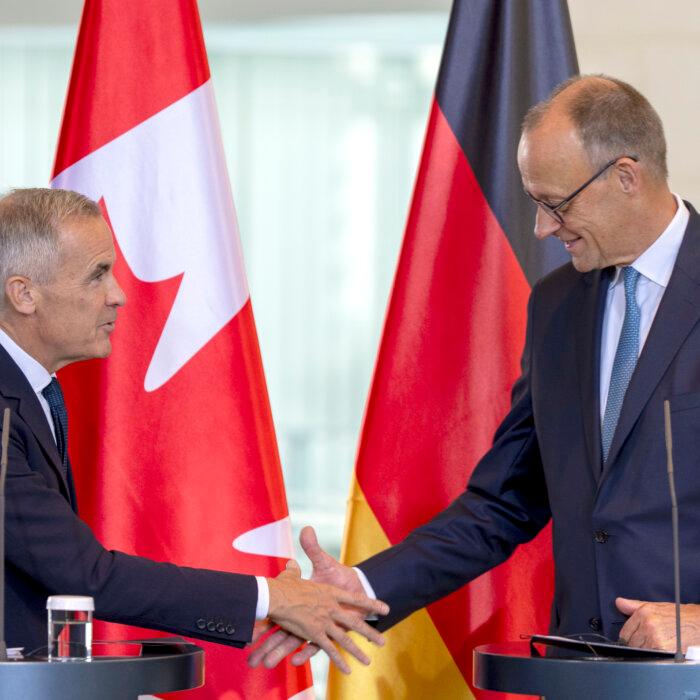
Ottawa has been working to remove or reduce Trump’s sectoral tariffs imposed on goods like steel and automobiles, while also maintaining its diversification strategy to reduce dependence on the United States. Carney announced initiatives to strengthen relations with Germany and Poland during his visitto Europe from Aug. 25 to 27.
Brazil has also been impacted by the Trump administration, which has imposed a tariff of 50 percent on the country, accusing it of posing an “unusual and extraordinary threat to the national security, foreign policy, and economy of the United States.”
The White House has called Brazil’s prosecution of Trump’s ally, former President Jair Bolsonaro, a “politically motivated persecution” and has imposed visa restrictions on Brazil’s justice minister and a Brazilian Supreme Court judge. Bolsonaro stands accused of plotting a coup to remain in power after the 2022 election won by Luiz Inácio Lula da Silva.
Lula has called the U.S. actions “interference” in his country’s affairs and a violation of the principle of sovereignty. “These attitudes are unacceptable - not only against [Justice] Minister [Ricardo] Lewandowski, but also against Supreme Court justices or any Brazilian official,” Lula said on Aug. 26.
Trade Mission
The announcement on the Mercosur was made during Minister Sidhu’s visit to Brazil and Colombia to deepen ties from Aug. 25 to 28 and from Aug. 28 to 30 respectively.
Sidhu held meetings with Brazil’s Vice President Geraldo Alckmin and the Minister of Mines and Energy Alexandre Silveira.
“We discussed ways to strengthen trade and investment, advance cooperation in mining, energy, and clean technologies, and support inclusive economic growth in both our countries,” Sidhu said on Aug. 26 after his meeting with Alckmin. He also noted that Canadian companies have already invested $20 billion in the Brazilian mining sector.
Brazil is the third-largest economy in the Americas after the United States and Canada, as well as Canada’s most important trading partner in South America.
Total bilateral merchandise trade between the two countries stood at $12.7 billion in 2024, with Canada exporting $2.5 billion to Brazil and importing $10.2 billion from Brazil, according to Global Affairs Canada. Canada’s largest export was fertilizers while its largest import was precious stones and metals.
In comparison, Canada and the United States have traded in recent years more than $12 billion worth of goods and services every four days.
The Mercosur as a trading bloc is the world’s fifth-largest economy, and had exports worth US$296 billion in 2024 and imports worth US$237 billion.
The European Union and the Mercosur reached a political agreement for a trade deal in late 2024, but ratification by EU members is pending.