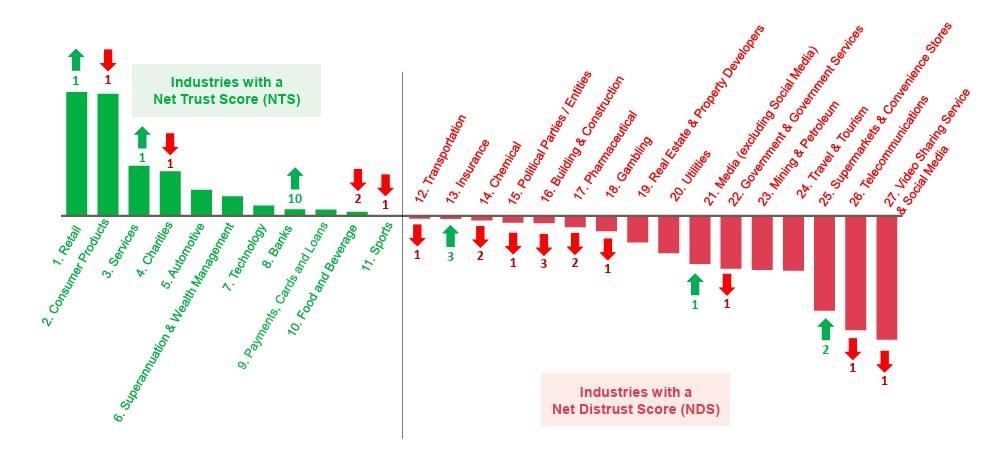
Australians trust most retailers and service providers, except supermarkets, convenience stores, social media, and telecommunications companies.
That’s one of the findings from Roy Morgan’s annual summary of its trust survey, which asks 1,500 to 2,000 people about their level of trust in various sectors and brands every month. The period covered is the 12 months to September each year.
While retailers gained one place to top the ranking, supermarkets and convenience stores gained two places but remained very much in negative territory.
Banks will be celebrating as they’ve risen ten places to become the eighth most trusted sector.
Even insurance companies have moved up, although this is mainly due to a decrease in distrust.
The survey company points out that distrust can have a material impact on a brand, citing examples such as Medibank’s loss of $1.6 billion of market value in the days after its data breach, AMP’s market cap collapsing by 80 percent after the Banking Royal Commission, and Qantas losing 30 percent of its value after a series of scandals.

The Most and Least Trusted Brands
When it comes to individual brands, those at the top in the previous year retained their positions.In 1st place is Bunnings, followed by Aldi, Kmart, and Apple. Commonwealth Bank overtook Toyota, becoming the fifth most trusted brand in Australia, while the carmaker slipped to sixth place.
Rounding out the top 10 were Big W, Myer, JB HiFi, and Australia Post.
Brands that managed to get themselves past the halfway mark and into net favourability over the year include Wesfarmers and insurer GIO.
There was also little change at the bottom of the rankings, with the bottom four remaining the same as they were in 2024.
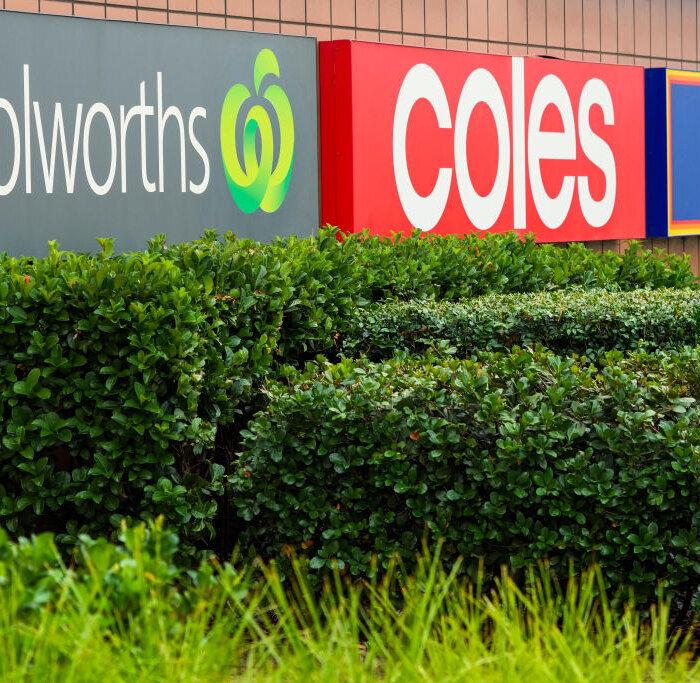
Woolworths takes out the title of Australia’s least trusted brand, with its main rival Coles just behind it.
Third and fourth were Facebook/Meta and Optus. Temu and Qantas swapped places to become the fifth and sixth least trusted, respectively. Rounding out the bottom 10 were Tesla, Telstra, X, and Amazon.
There was especially bad news for three companies. Volkswagen fell by 21 to the 47th most distrusted, as fewer Australians reported they saw the brand as reliable or customer-centric.
Dodo deteriorated to 50th place, with rising mentions of poor service or misleading communication.
Ergon Energy dropped 13 places to 49th, driven by negative experiences and concerns about customer treatment.
“These shifts show how quickly operational friction and service failures can escalate into entrenched distrust,” Roy Morgan said.
Bad news, too, for the smaller banks. While still winning on trust, the major banks, which used to be the most distrusted institutions in the sector, are now matching or even overtaking the institutions that were positioned as the trusted alternatives.
For instance, while Bendigo Bank ranks 15th and ING is 20th, Westpac has climbed five places to become the top-rated bank in 14th place, and NAB is in 19th.
Regaining Trust
While still the least trusted businesses in the country, Woolworths and Coles have begun to recover following the Reserve Bank of Australia’s first interest rate cut, perhaps a result of consumers finding it easier to pay for their groceries rather than any shift by the supermarkets themselves.In fact, Roy Morgan says that its decision back in 2018 to separate supermarkets from the broader retail sector proved correct.
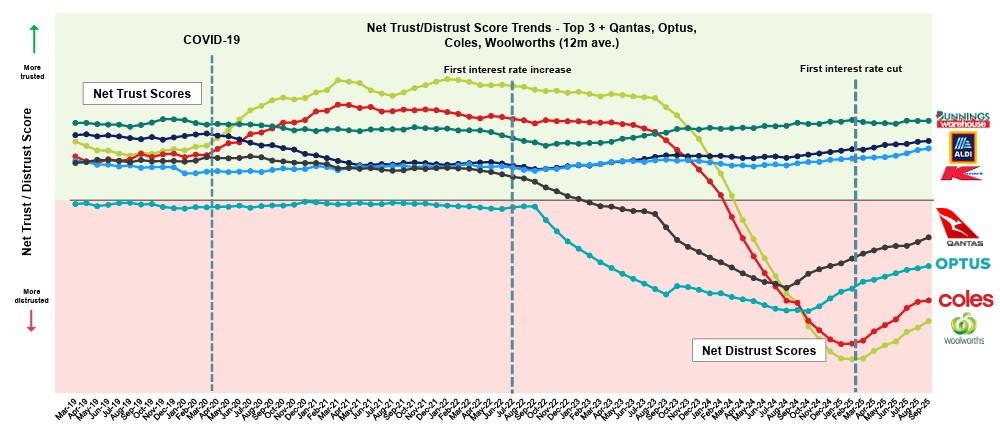
“Woolworths and Coles have shifted the supermarket sector from being among the most trusted to among the most distrusted, an unprecedented reversal for any major industry group.”
Optus and Qantas have made steady gains in recent months, but the results of the October survey will be pivotal following the latest triple-0 outage at Optus and the release of Qantas customer data on the dark web.
“An early look at October suggests those events are already shaping sentiment,” Roy Morgan said.
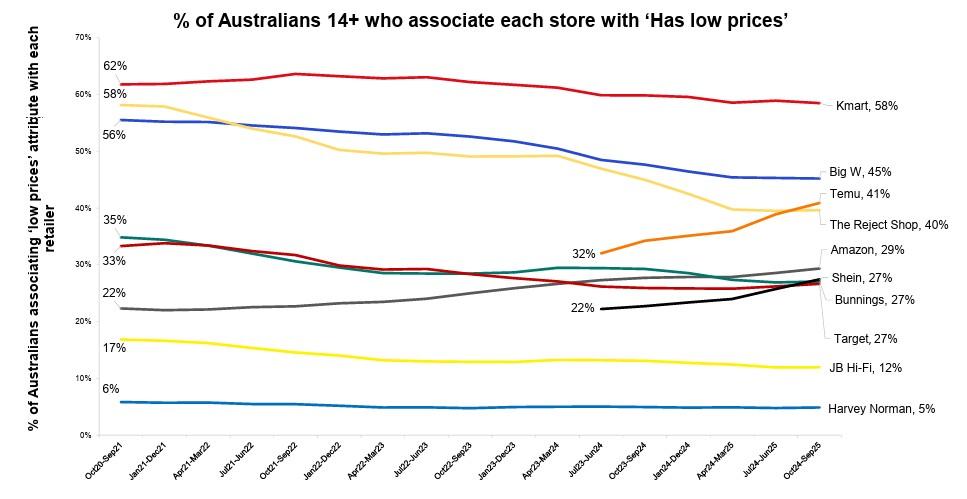
While Temu is the fifth most distrusted brand and Shein the 11th, online platforms still rank highly in Australians’ perceptions of who offers low prices—and they’re gaining on their bricks-and-mortar competitors, something Roy Morgan says is also systemic and thus bad news for retailers.
That, in turn, translates into higher gains in the number of people shopping with online brands rather than on high streets and in malls.
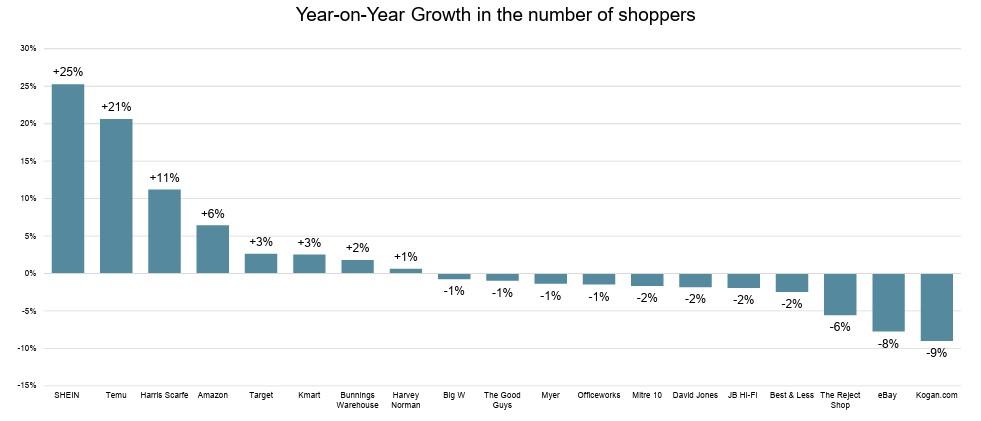
Consumers are not just purchasing in greater numbers at Amazon, Temu, and Shein, they are also making more frequent purchases than they were a year ago.
In contrast, traditional retailers such as Kmart and Target show little year-on-year increase in shopping frequency.
This is all counterintuitive given the deteriorating trust rankings of most online platforms—which is attributed to their “unethical attitudes and behaviour”—but it seems Australians simply can’t resist a bargain.
“The recent reputational deterioration of the online marketplace channel is concentrated around Temu and Shein, both of which are trending down. Amazon is also deeply distrusted,” Roy Morgan said.
“AliExpress and Kogan are more distrusted than trusted, with only eBay enjoying net trust.
“Interestingly, it appears that when it comes to the Chinese marketplace platforms, Temu and Shein, ’the more people buy from them, the faster their distrust grows.'”