Belarusian President Alexander Lukashenko has said both Ukraine and Russia must make concessions to negotiate a deal to end the war.
Lukashenko, one of Russian President Vladimir Putin’s closest allies, said during an interview with Al Arabiya television, aired on June 15, that “every step must be used in order to reach a peace agreement through compromise.”
“If they, on both sides [not only Putin and Ukrainian President Volodymyr Zelenskyy, but also European leaders], realize that this is a dead end, that we can’t go on, that escalation will continue, and the situation will get even worse,” Lukashenko told Al Arabiya in the interview, republished by Belarus’s state-owned Belarusian Telegraph Agency news agency.
“If this takes shape in the minds of the warring parties and their supporters, then a compromise can be reached,” he said.
The Belarusian president would not discuss what he believed would be needed to reach an agreement, saying it is the parties directly involved who need to decide.
Russia is yet to establish control over all of the Donbas region, but, as a condition for a peace agreement, has described full Russian control of the industrial region, which includes much of the Ukrainian oblasts of Donetsk and Luhansk.

Zelenskyy has said his country should have assurances of protection against future Russian attacks and has been reluctant to relinquish territory to Moscow as a precondition to ending the war.
Lukashenko also told Al Arabiya that a current feature of the war is that both sides are experiencing a shortage of personnel.
Ukraine “doesn’t have the people,” he said. “And this is one of the features of this year. There has always been a shortage of people on one side or the other. The Russians have this shortage. Perhaps not as much as in Ukraine, but they do. But this is the main issue of this conflict—they’ve run out of people.”
The Belarusian president also said that Russia was making progress on the battlefield and that Ukraine was successfully defending itself, at times, on the front.
Ukrainian officials earlier this month said their armed forces had recaptured more than 230 square miles of territory from the Russians so far this year, regaining almost 40 square miles in May.
Independent groups that map battlefield data have reported that Russia’s total advances have slowed in recent months.
Based on data from Black Bird Group shared with Reuters, the news agency said that Russian forces captured 32 square miles of Ukrainian territory in May, compared with 36 square miles in April and 10 square miles in March.
Last month, the Institute for the Study of War said, “The character of the war is shifting in favor of Ukrainian forces, at least for now.”
The think tank stated in its report on Russia’s battlefield performance that Russian forces’ rate of advancement is “plummeting,” while “[Ukraine is] starting to regain more ground than it is losing for the first time since 2023.”
According to a May war report card from Russia Matters, a project by Harvard Kennedy School’s Belfer Center for Science and International Affairs, Russian forces control about 20 percent of Ukraine, which includes Crimea and parts of Donbas that Russia had seized prior to the full-scale invasion on Feb. 24, 2022.
Trump Pushes for Deal
Speaking at the G7 summit in Évian-les-Bains, France, on June 16, U.S. President Donald Trump called for Russia to make a deal with Ukraine.
Trump told reporters he had a “very good meeting” with Zelenskyy and other G7 leaders.
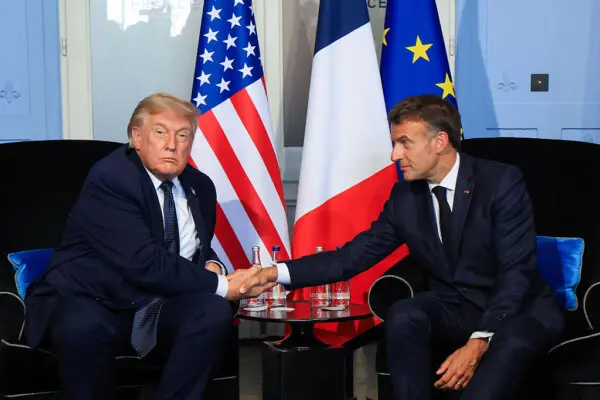
“Russia should make a deal,“ he said after the meeting. ”Russia has lost tremendous amounts of people and so has Ukraine.”
Trump said that before the roundtable, he had had a private meeting with Zelenskyy and planned to have another discussion with him later in the day.
The U.S. president said he would do whatever he could to end the war in Ukraine.
Before heading to France for the G7 summit, Trump said he had spoken separately by telephone with Putin and Zelenskyy, adding that he had had “a very good conversation” with both.
“I think maybe we can do something there,” Trump said following his bilateral meeting with French President Emmanuel Macron on June 15. “I really do. I think they’re both open to it.”