This copy is for your personal, non-commercial use only. Distribution and use of this material are governed by our Subscriber Agreement and by copyright law. For non-personal use or to order multiple copies, please contact The Epoch Times Reprints.
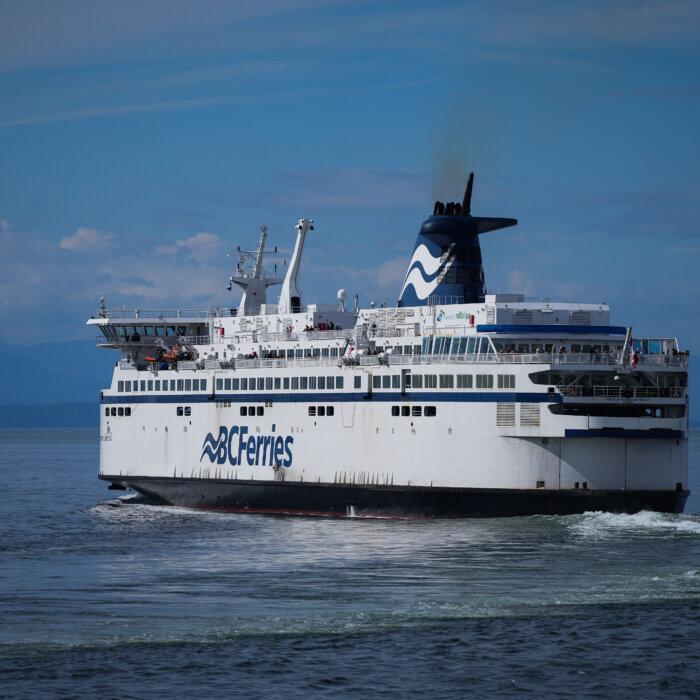
A B.C. Conservative MLA is calling on the federal transport minister to clarify whether a loan from the Canada Infrastructure Bank for BC Ferries to buy four vessels from a Chinese state-owned shipyard will be withdrawn or reconsidered, following the minister’s criticism of the deal.
MLA Harman Bhangu, who is his party’s transportation critic, wrote an open letter to federal Transport Minister Chrystia Freeland on June 26, seeking “immediate clarification” on the $1 billion loan recently announced by the Canada Infrastructure Bank (CIB) for BC Ferries to purchase new vessels from China Merchants Industry Weihai Shipyards.
He said he shared Freeland’s concerns about the choice of the Chinese state-owned company, citing China’s “punitive” tariffs on Canada and “ongoing cybersecurity threats” from Beijing, and asked whether Ottawa would act to redirect the investment toward the domestic economy.
“I respectfully request clarification on whether the Canada Infrastructure Bank’s financing will be withdrawn, renegotiated, or reconsidered, in order to bring these vital shipbuilding jobs and investments back home to support Canadian workers, businesses, and national security,” he wrote.
Freeland last week raised concerns over BC Ferries’ selection of the Chinese firm, pointing to tariff tensions, national security risks, and the need to prioritize Canadian firms.
In a June 16 letter to B.C. Transport Minister Mike Farnworth, she highlighted the financial support Ottawa has provided to the ferry operator and asked Farnworth to “verify and confirm with utmost certainty that no federal funding will be diverted to support the acquisition of these new ferries.”
She also pointed to a previous $75 million loan from the CIB, but made no mention of any future loans, such as the recently announced $1 billion, which the bank says was approved by its board in early March.
“Notably absent from your communication was clarity about the status of the Canada Infrastructure Bank’s substantial financial involvement,” Bhangu wrote, “specifically whether the $1 billion in low-interest loans, which includes $690 million directly allocated to the vessels, will continue now that BC Ferries has awarded the contract to a foreign competitor instead of investing in Canada’s robust shipbuilding sector.”
The office of the transport minister did not respond to a request for comment by publication time.
Following the CIB’s loan announcement on June 26, Conservative MP and federal transport critic Dan Albas wrote a letter to the House of Commons transport committee calling for an urgent hearing into the $1 billion federal loan, as reported by the Globe and Mail.
Albas has previously raised concerns over BC Ferries’ deal, saying it misses an opportunity to support Canadian jobs, particularly amid U.S. tariffs on Canadian steel and aluminum, while sending investment to places that “subsidize their steel, that have lower environmental regulations and also substandard labor situations,” referring to China.
BC Ferries announced its decision to hire China Merchants Industry Weihai Shipyards on June 10, saying it followed a “rigorous global procurement process” that evaluated proponents on bid strength, technical capabilities, safety and quality standards, experience, costs, and delivery timelines.
BC Ferries president Nicolas Jimenez told The Epoch Times in a statement that financing tools like the CIB loan allow the ferry operator to invest in new, reliable vessels amid financial strains.
The CIB told The Epoch Times it has no role in the contracting decisions of its partners, and that it believes its recent investments in BC Ferries will benefit people and businesses in the Vancouver region through expanded capacity, a “cleaner and more reliable” travel experience, and reduced fare pressure.
B.C. Premier David Eby has said that while the selection of the state-owned company is “not ideal,” he will not ask BC Ferries to reopen the procurement process, citing the time and financial costs involved and the urgent need for new vessels.
He pointed out that no Canadian shipyard submitted a bid for the contract, but has committed to ensuring that the next round of ferries “is built right here at home.”
Reactions
The BC Ferries deal has raised concerns across party lines, with provincial and federal Conservatives expressing strong opposition to CIB’s loan.
Conservative Leader Pierre Poilievre argued that the federal government was complicit in the decision to grant the federal loan to a foreign firm.
“Freeland and the Liberals knew they were bankrolling a BC ferry purchase from a Chinese state-owned company with $1 billion of your money,” he wrote in a June 27 social media post.
“Instead of backing Canadian jobs here at home, the Liberals quietly write cheques to a foreign hostile regime, using taxpayer dollars.”
Tory MP Shuv Majumdar said the loan contradicts the CIB’s mission of supporting Canadian growth. The bank’s stated purpose is to invest and seek to attract investment in infrastructure projects “in Canada or partly in Canada” that are expected to generate revenue and be in the public interest.
“The Infrastructure Bank was sold as a catalyst for Canadian growth. Under the Liberals, it’s become a pipeline—funnelling your tax dollars out of Canada and into Beijing,” Majumdar wrote in a June 26 post.
Tory MP Aaron Gunn expressed a similar view, saying that the federal loan for the BC Ferries deal amounts to “sending taxpayer money to subsidize dictators overseas.”
B.C. Conservative Leader John Rustad has questioned the economic impact of BC Ferries’ deal with the Chinese shipyard, saying it should support jobs in the province.
He has also called the decision a national security issue, citing China’s role in fentanyl trafficking, money laundering, and election interference in Canada.
B.C. Conservative MLA Elenore Sturko, shadow minister for public safety, has voiced similar concerns, saying the BC Ferries deal poses a “national security threat.”
Opposition to Investment in China-Led Firms
The federal Conservatives have also criticized the federal government’s investment in the Beijing-controlled Asian Infrastructure Investment Bank (AIIB).
Ottawa indefinitely suspended all activity with the AIIB in June 2023 amid allegations that the bank was controlled by the Chinese Communist Party.
However, the Tories have called for Canada to completely withdraw from the bank.
Conservative MP Michael Chong, foreign affairs critic, said at the time that Ottawa’s decision “confirmed” what Tories had been saying for years, that the bank was “a tool of ... Beijing to export its authoritarian model of governance throughout the Indo-Pacific region.”