While fuel prices across the five capital cities have eased thanks to the federal government’s decision to halve the fuel excise on April 1, long-term uncertainty is prompting Australians to switch to battery-powered transport in record numbers.
Average terminal gate prices for petrol had increased by 78.6 cents per litre (cpl) or around 52 percent from Feb. 20 to the end of March.
However, by early April, prices had begun to ease. Across the 5 largest cities, the daily average retail petrol price was 16.7 cpl lower compared to the peak.
Similarly, daily average retail diesel prices were 15.0 cpl lower.
EV Sales Share Doubles
Sales of electric vehicles boomed in March, accounting for 14.6 percent of total vehicle sales, almost double the 7.5 percent they registered a year before, according to the Federal Chamber of Automotive Industries (FCAI).
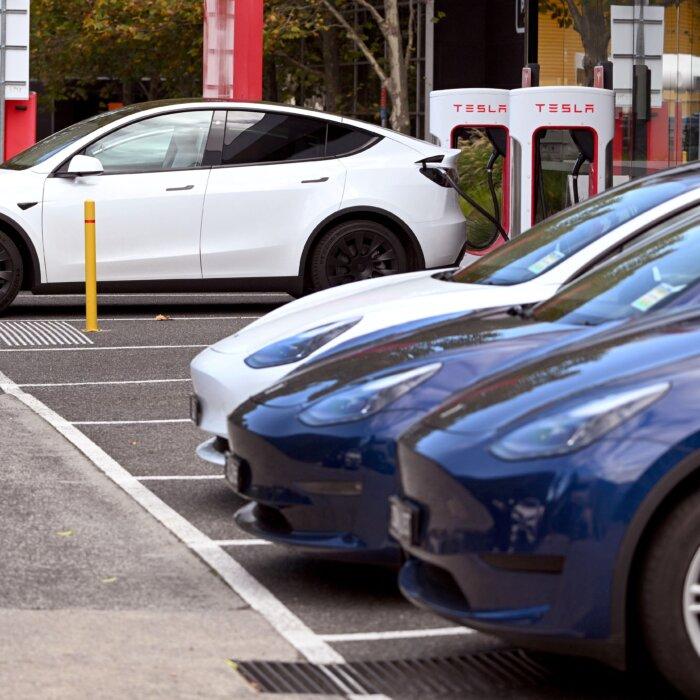
Out of a total of 105,058 vehicle sales nationwide, 15,839 were EVs, 17,953 were hybrids, and 8,215 were plug-in hybrid models.
Toyota was the market leader with sales of 16,574 in March, followed by Kia (7,320) and BYD (7,217). Other big sellers were Mazda (7,156) and Ford (7,149).
FCAI chief executive Tony Weber said the figures showed strong growth in demand across all types of electric vehicles, but warned that the increase may be a reaction to current events.
“It is too early to determine whether this represents a structural shift in the market,” he said.
“More consumers are considering EVs due to the disruption to fuel supply caused by conflict in the Middle East, along with the review into the fringe benefits tax concession for EVs.
While the industry welcomes the shift toward meeting NVES (New Vehicle Efficiency Standard) targets, Weber warned that infrastructure remains a hurdle.
“A long-term shift to EVs will require Australian governments to boost public charging infrastructure, particularly in regional areas,” he said.
Two Wheels Also Gaining in Popularity
Meanwhile, not everyone has opted for cars and utes as their electric alternative—e-bike sales are also booming.Data from Expert Market Research predicts national sales of 288,911 units in 2026, up from 253,987 in 2025.
Key drivers include government incentives, a growing number of retail and online sellers, and a growing demand across commuter, recreational, and utility segments.
Peter Bourke, general manager of Bicycle Industries Australia, said sellers had experienced a “massive spike” in interest over the past few weeks, a trend he attributed directly to fuel price shocks and supply concerns.
“It took a few weeks for people to understand the price rise wasn’t going to be a one- or two-week thing,” he said. “That’s when shops began to see a lot more foot traffic.”