An Australian think tank has catalogued over 150,000 red tape restrictions or rules developed since 2003 that are holding back the country’s economy.
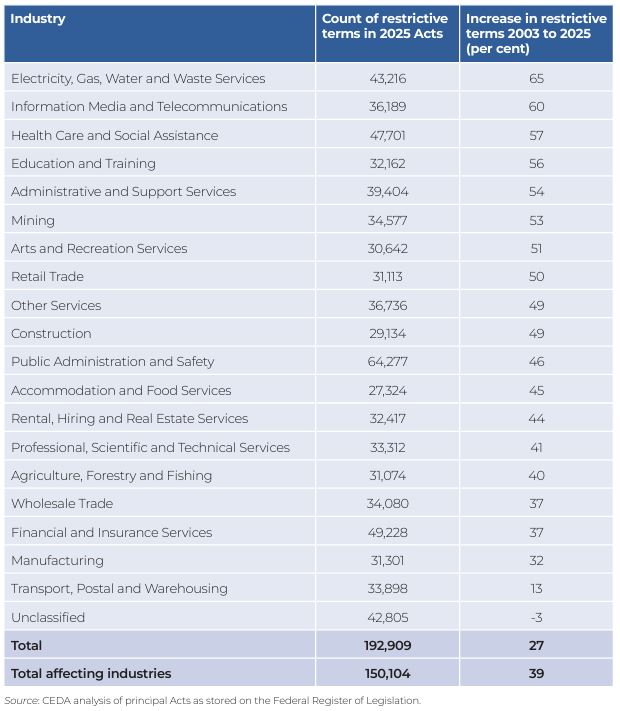
Ahead of its annual conference, the Committee for the Economic Development of Australia (CEDA) released its latest report which found a 39 percent increase in the sheer volume of restrictions on businesses over a 20-year period.
Some sectors were more affected than others, however, with electricity, gas, water and waste services seeing a 65 percent rise, while information media and telecommunications restrictions rose by 60 percent.
In contrast, financial and insurance services sector saw a slightly lower increase, having 37 percent more restrictive clauses applied to it over the same period.
CEDA defines a restriction or “restrictive term” as legislative clauses, rules, or statutory mandates in federal legislation that limit business operations.
In terms of mining, almost 35,000 more restrictions have been added, which has caused approval times for mining projects to push out by another 18 months on average.


 The State of the Nation report (pdf) says that, partly as a result, productivity growth is languishing, while fewer people want to assume the risk of starting a new enterprise, with business entry rates falling from 15.1 percent to 10.7 percent over two decades.
“History is clear on this,” it says. “Past reforms succeeded because economic dynamism and social outcomes were pursued together, not in competition. Australia is not moving fast enough, and on too many fronts, we are drifting.”
Critically, productivity, investment, and innovation are declining, with Australia falling from a global competitiveness ranking of 4th in 2024 to 18th last year.
It has not ranked among the top 10 most competitive or most innovative countries since 2011. On innovation, it’s currently ranked 22nd, and this should be a major priority for government and industry, CEDA says.
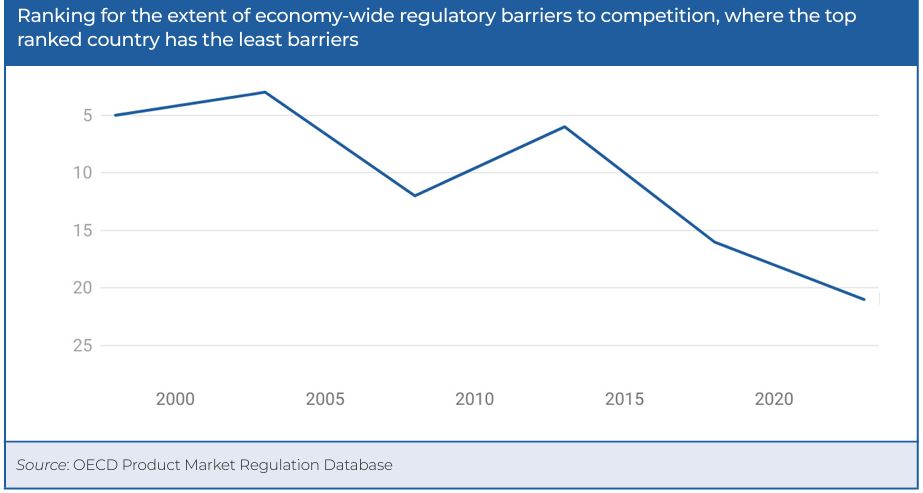
As a result, Australia’s ranking on regulatory barriers to competition has worsened.
“In turbulent times, governments play a critical role in shoring up resilience, but governments do not create prosperity. They create the conditions in which businesses and workers create prosperity. The distinction matters enormously. Business is not a risk to be contained. It is the primary engine of growth, employment, innovation, and national wealth.”
The report says legal complexity, duplication, and an “adversarial regulatory posture” impose real costs on innovation.
“Improving this will require not just cutting red tape but a fundamental shift in how government relates to business. Australia needs a policy posture that treats business as a capability to be drawn on, not a problem to be solved.”
It acknowledges recent progress on cutting red tape, such as the passing of the Regulatory Reform Omnibus Bill last year, and federal budget commitments to further deregulation and regulatory harmonisation, but says more needs to be done.
CEDA wants to see the creation of a new cabinet post—a Minister for Business Dynamism—to draw together responsibilities for regulation, and competitiveness.