Australia and small Southeast Asian nation of Timor-Leste (also known as East Timor) have signed a new partnership agreement pledging closer economic and security cooperation.
Prime Minister Anthony Albanese has just concluded a formal visit to Dili, where he met with President José Ramos-Horta and Prime Minister Xanana Gusmão while addressing the country’s parliament.
As part of the deal, Australia will provide another $8.2 million to support Timor-Leste’s participation in the Association of Southeast Asian Nations (ASEAN) and the World Trade Organisation (WTO), and will fund an $80 million private sector development programme to support its economic diversification through access to credit, business services and marketing support.
In addition, Albanese announced a new $220 million human development initiative to help deliver high-quality health, education and disability services, and an increase in annual Overseas Development Assistance funding to over $135 million in 2025/26.
The two countries are already collaborating on the Greater Sunrise project, which aims to develop significant gas and condensate fields located 150 kilometres south of Timor-Leste.
Key partners, including Woodside Energy and Timor Gap, intend to pipe the gas to Timor-Leste for processing, with production planned to start between 2028 and 2030.
The joint venture has already contributed almost $5 million towards community programmes, but Albanese announced that when the gas starts flowing, around a third of Australia’s share of future revenue from the 10 percent royalty paid to both governments would go to an infrastructure fund to support Timor-Leste’s development.
He hailed the agreement as marking “a new era of cooperation between our nations.
“It reflects our longstanding friendship and sets out our shared vision for the future,” he said.
“It was an honour to visit Timor-Leste at this important moment in its history following its accession to ASEAN. Australia will continue to work with Timor-Leste to ensure this delivers peace, stability, and prosperity for the Timorese people and our shared region.”
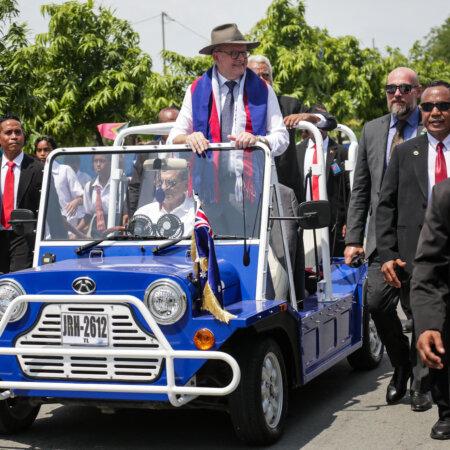
Speaking to the Timor-Leste parliament, Albanese reminded MPs that Australia has supported the country’s claim for independence from Indonesia, committed 5,500 Defence Force personnel to help maintain order “in the troubled times that followed,” and went on to lead the International Stabilisation Force in 2006.
While he didn’t refer directly to the surveillance incident which strained relations between the two countries in 2004, he did say “some actions taken by Australian governments did not honour—and were not worthy of—the close friendship between our nations.”
The Australian Secret Intelligence Service (ASIS) had secretly planted listening devices in a room next to the Timor-Leste Prime Minister’s Office, hoping to obtain information to give Australia the upper hand in negotiations over the Greater Sunrise gas field.
Meanwhile, the aim of the latest agreement was to build on Timor-Leste’s comparative advantages and strengthen Timor as a growing market for Australia, facilitating hundreds of millions of dollars of bilateral trade in sectors spanning resources, financial services, shipping and manufacturing, he said.
In 2024, two-way merchandise trade was worth $288.7 million.
Australia’s exports to Timor-Leste totalled $170.8 million, with major items including business travel and passenger motor vehicles, while imports totalled $177.9 million, including recreational and business travel, and coffee.
Gusmāo’s remarks to a joint press conference reflected that aspect of the relationship.
The two countries had, he said, “reaffirmed the importance of international law, including the United Nations Convention on the Law of the Sea,” and he referenced the 2018 Maritime Boundary Treaty as “a powerful example of how disputes can be resolved peacefully and fairly through dialogue and law.”