A Navy helicopter and an F/A-18F Super Hornet fighter jet went down in the South China Sea on the afternoon of Oct. 26 in two separate incidents.
The U.S. Navy’s Pacific Fleet made the announcement on X, stating: “At approximately 2:45 p.m. local time, a U.S. Navy MH-60R Sea Hawk helicopter, assigned to the ‘Battle Cats’ of Helicopter Maritime Strike Squadron (HSM) 73, went down in the waters of the South China Sea while conducting routine operations.
“Following the incident, separately, at 3:15 p.m., an F/A-18F Super Hornet fighter assigned to the ‘Fighting Redcocks’ of Strike Fighter Squadron (VFA) 22 also went down in the waters of the South China Sea while conducting routine operations from Nimitz.”
All five personnel involved in both accidents—three on the helicopter and two on the fighter jet—were recovered safely in swift search and rescue operations and are in stable condition.
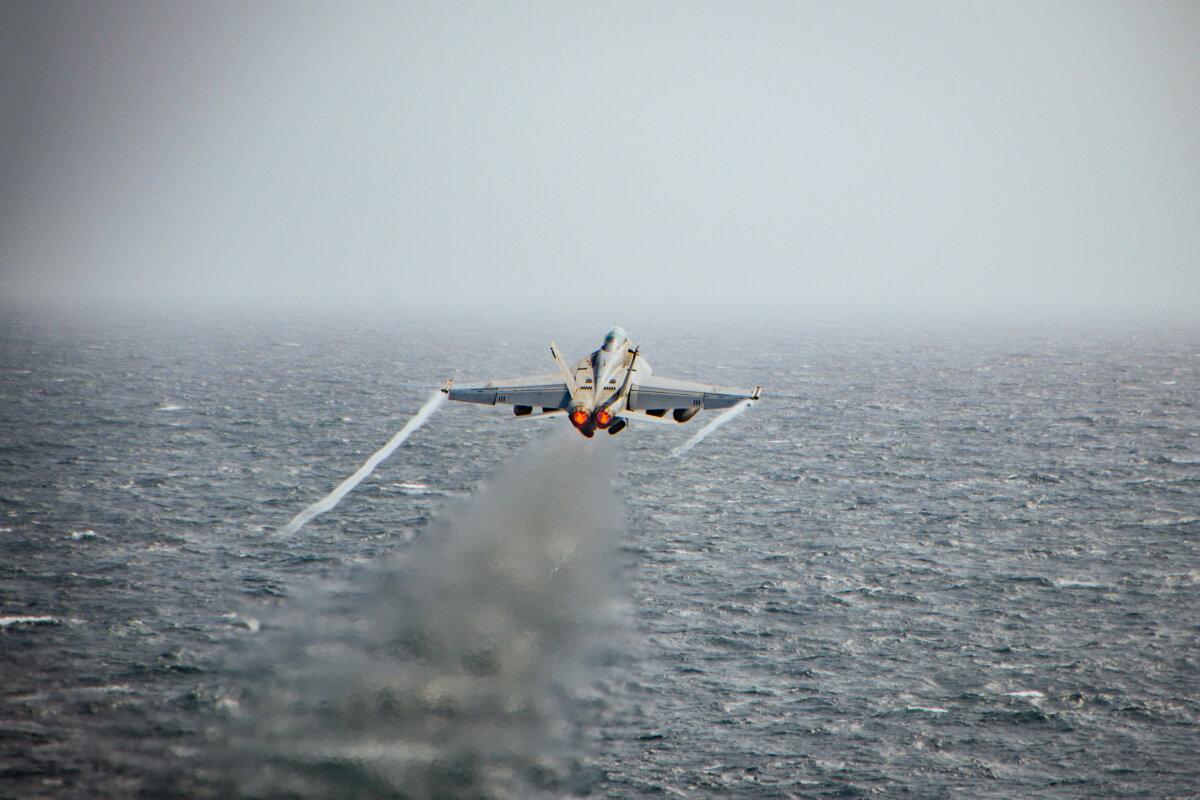
The accidents are under investigation and no further details about the missions such as weather conditions, possible mechanical issues, or the nature of the missions have been released.
Both operations originated from the USS Nimitz, the Navy’s oldest active aircraft carrier currently deployed to the Indo-Pacific region as part of the aircraft carrier strike group 11.
They come as concern escalates over communist China’s provocations in the South China Sea, especially regarding its maritime offensive with the Philippines.
“We stand with our Philippine allies as they confront China’s dangerous actions which undermine regional stability,” U.S. State Department deputy spokesperson Tommy Pigott said in an Oct. 13 statement.
“China’s sweeping territorial and maritime claims in the South China Sea and its increasingly coercive actions to advance them at the expense of its neighbors continue to undermine regional stability and fly in the face of its prior commitments to resolve disputes peacefully.”
Meanwhile, the USS Gerald R. Ford aircraft carrier strike group had been sent to the Caribbean to assist in efforts to crack down on drug trafficking into the United States from Latin America.
“In support of the President’s directive to dismantle Transnational Criminal Organizations ... and counter narco-terrorism in defense of the Homeland, the Secretary of War has directed the Gerald R. Ford Carrier Strike Group and embarked carrier air wing to the U.S. Southern Command ... area of responsibility,” Pentagon spokesman Sean Parnell said in a statement on Oct. 24.