The number of job openings eased below 7.4 million for the first time since March as demand for labor cooled heading into the summer, new government data show.
June’s job vacancies declined by 178,000 to 7.36 million, from a downwardly revised 7.54 million in May, according to the Bureau of Labor Statistics report released on Aug. 4.
Economists had projected a reading of 7.4 million.
Heading into this week’s nonfarm payrolls report for July, various indicators suggest employment conditions remain stable, from hiring to layoffs.
New job openings were largely concentrated in two sectors: transportation, warehousing, and utilities (97,000) and the federal government (39,000).
Vacancies declined in wholesale trade (negative 74,000), nondurable goods manufacturing (negative 55,000), and mining and logging (negative 9,000).

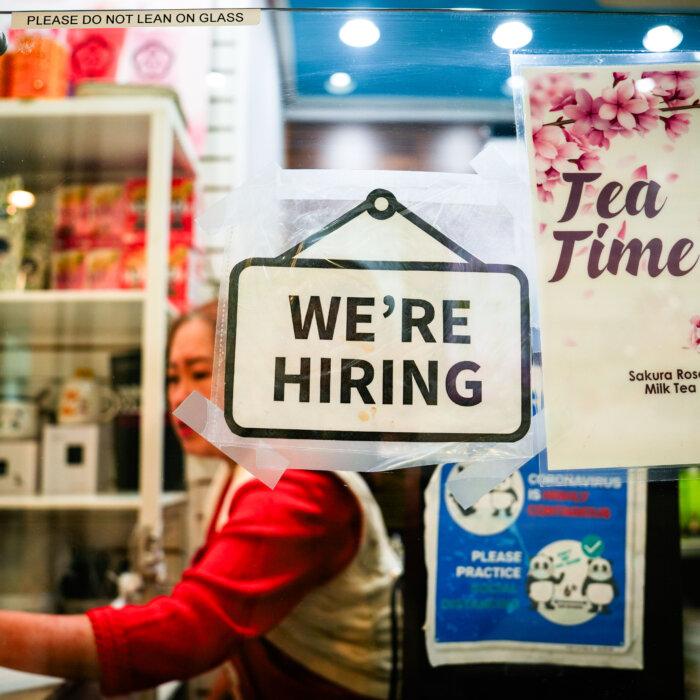
Reaffirming the present “low-fire, low-hire” climate, the number of hires and terminations changed little in June.
“Hires and quits have been low during the strong labor market over the past year or so, when layoffs have also been low,” Bruce Fallick, senior vice president at the Cleveland Federal Reserve, said in an Aug. 4 paper.
“This combination is historically unusual. However, it is likely a continuation of long-term trends rather than something unique to the current period.”
Hires were flat at 5.3 million while layoffs and discharges were unchanged at 1.8 million, the bureau reported.
Hiring momentum has decelerated in recent weeks as companies traverse uncertainty, whether due to elevated inflationary pressures or higher borrowing costs.
Private-sector hiring has stalled, with companies adding an average of 15,000 jobs per week in the four weeks ending on July 11, according to payroll processor ADP.
Last month, the economy created a smaller-than-expected 57,000 new jobs, far below the three-month average of 164,000. Looking ahead to later this week, the market consensus suggests the economy likely added approximately 80,000 jobs in July.
Fewer Americans are also receiving unemployment benefits, indicating either an easier time finding job opportunities or many recipients exhausting their benefits.
In a sign that the public could be more confident about their job prospects, the number of workers voluntarily leaving their jobs reached the highest level since December.
The number of quits jumped by 79,000 to 3.23 million in June, from an upwardly adjusted 3.153 million. Still, the quits rate—a share of people exiting their jobs as a percentage of total employment—held steady at a six-year low of 2 percent.
Employment Outlook
Survey data suggest that more Americans are pessimistic about the national labor market.
The Conference Board’s July consumer confidence index indicated a decline in the number of consumers reporting that jobs were “plentiful.” Likewise, those noting that jobs are “hard to get” also slipped over the month.
“Looking ahead, consumers anticipate little improvement in business conditions over the next six months, but expectations for the labor market were slightly less negative. Expectations for household incomes moderated but remained optimistic overall,” Dana Peterson, the board’s chief economist, said in a statement.
This may not be enough for the Federal Reserve to initiate an easing policy bias.
While the Fed maintains a dual mandate of price stability and maximum employment, officials have indicated that inflation is the primary objective right now. Although policymakers do see some downside risks to the labor market, the focus has been on inflation, which has missed its 2 percent target for 64 months.
Traders widely expect the central bank to raise interest rates at next month’s meeting for the first time since July 2023.
But it is a guessing game at this point, says Thomas Browne, portfolio manager at Keeley Gabelli.
“We’ve got a brand-new chairman who doesn’t want to signal his intentions. You can say, ‘Yes, he will,’ or ‘No, he won’t,’ but there’s really no track record to go on, and he’s made it pretty clear that he doesn’t want to tell the market what he’s going to do,” Browne said in an emailed note to The Epoch Times.
“I don’t think he raises rates, but my level of confidence in that conclusion isn’t all that high.”
Fed Chairman Kevin Warsh will convene the next two-day Federal Open Market Committee policy meeting on Sept. 15 and 16.