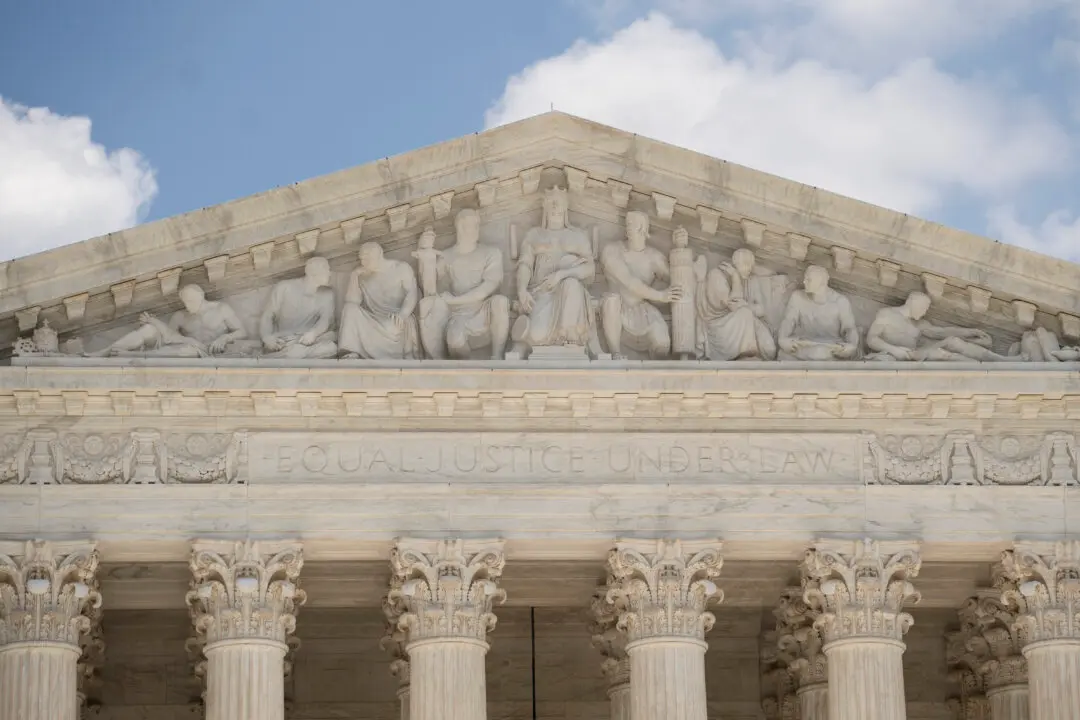
The Supreme Court has upheld Tennessee’s ban on providing such interventions as cross-sex hormones and puberty blockers for minors experiencing gender dysphoria.
In a 6–3 decision released on June 18, the court disagreed with the Biden administration’s argument that the law should face higher legal scrutiny than had been applied by an appeals court.
The U.S. Court of Appeals for the Sixth Circuit upheld Tennessee’s law, stating that it passed something known as “rational basis” review, which is a relatively low level of scrutiny to determine whether the law is constitutional.
Supreme Court Chief Justice John Roberts wrote the majority opinion. Three of the justices—Justices Sonia Sotomayor, Elena Kagan, and Ketanji Brown Jackson—dissented from the decision.
Writing for the majority, Roberts said the law didn’t classify individuals on the basis of sex and therefore didn’t force courts to apply greater scrutiny. Instead, the majority said, the law classified individuals according to age.
Sotomayor, who penned the primary dissent, disagreed.


“Tennessee’s law expressly classifies on the basis of sex and transgender status, so the Constitution and settled precedent require the Court to subject it to intermediate scrutiny,” she said.
“The majority contorts logic and precedent to say otherwise, inexplicably declaring it must uphold Tennessee’s categorical ban on lifesaving medical treatment.”
The case was perhaps the most hotly anticipated for the term. Besides touching on a hot-button issue, it prompted the justices to reconsider its 2020 decision in Bostock v. Clayton County, wherein the court held that employers violate the Civil Rights Act by firing an individual “merely for being gay or transgender.” More specifically, Justice Neil Gorsuch said that type of firing was effectively based on an individual’s sex.
The Biden administration attempted to apply that reasoning to say that Tennessee’s law discriminated on the basis of sex. Roberts disagreed in his majority opinion and said the Bostock case didn’t apply to the decision before them.
It also contains a provision banning surgical procedures, like those altering minors’ organs, but that portion was not at issue by the time the Supreme Court reviewed the case.
Gorsuch, who was notably quiet during the December 2024 oral argument, joined Roberts in the majority.
The justices’ decision on June 18 was somewhat complicated with Justice Samuel Alito only partially joining the majority opinion and filing a concurrence of his own. Kagan only joined part of the dissent written by Sotomayor and also issued a dissent of her own.
Writing separately, Alito said he thought there was a “strong argument” that Tennessee’s law classified individuals on the basis of “transgender status” but that he would nonetheless uphold the law.
While Kagan thought the law should be more heavily scrutinized, she declined to opine on how the law would fare under that level of scrutiny.
Justice Amy Coney Barrett penned a separate concurrence to explain why she thought “transgender status” wasn’t a “suspect class,” which is a legal term for a group of people who, if targeted, prompt courts to review laws more carefully.
Barrett said that “transgender status” differed from race and sex in that it did not contain the same type of immutable characteristics as those other two categories.
She also encouraged other states to follow Tennessee’s lead.
“This Department of Justice will continue its fight to protect America’s children and parental rights,” Bondi said.
The department had opposed Tennessee’s law under the Biden administration. That changed, however, after President Donald Trump entered office and his deputy solicitor general said the previous administration’s position was no longer the United States’ position.
However, he said the court should nonetheless consider the case, noting that the Supreme Court’s decision would bear on other cases in lower courts.