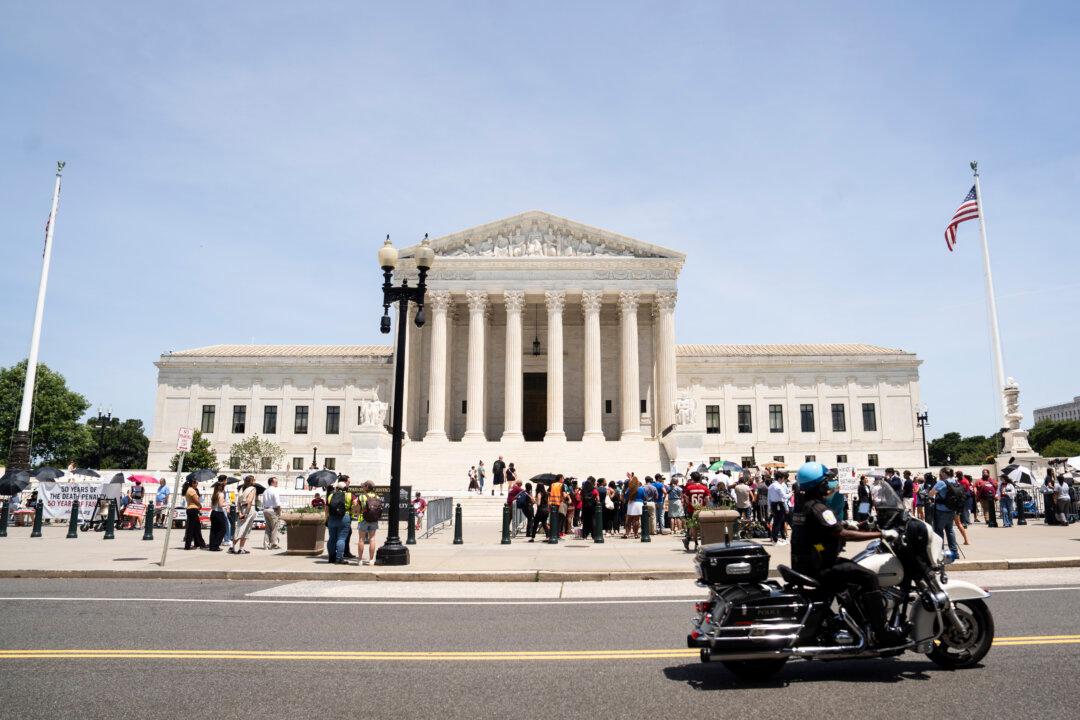
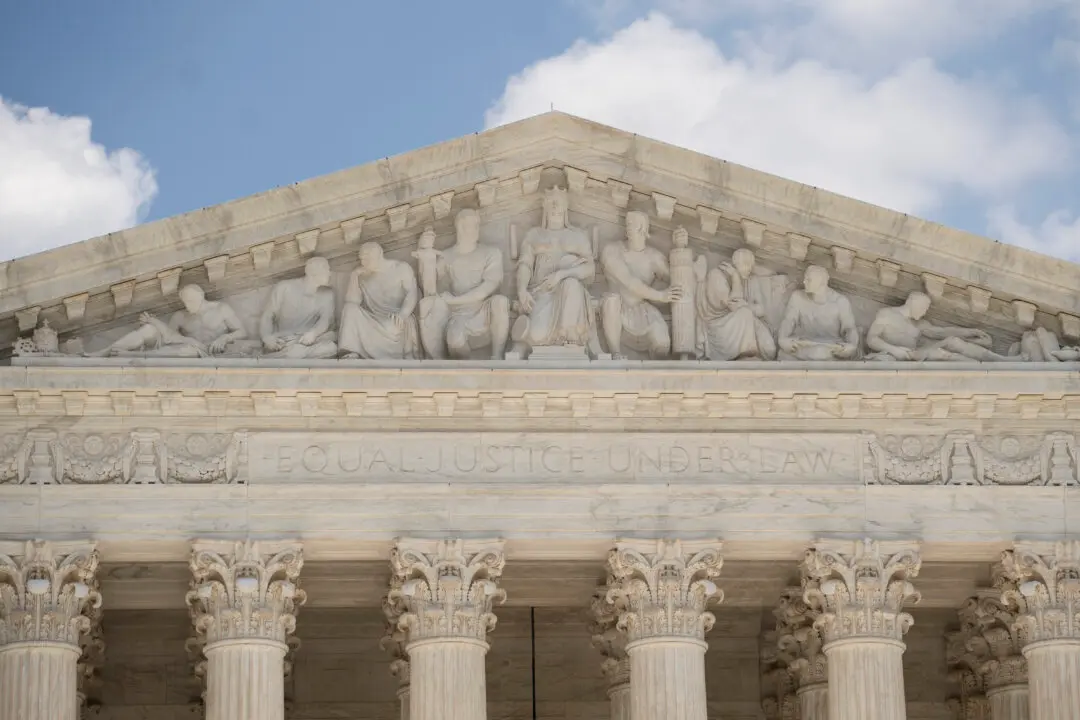
The U.S. Supreme Court on June 30 struck down federal limits restricting political parties from coordinating spending with candidates.
Justice Brett Kavanaugh wrote the court’s majority opinion in National Republican Senatorial Committee (NRSC) v. Federal Election Commission (FEC), which was the NRSC’s challenge to provisions of the Federal Election Campaign Act.
Kavanaugh wrote, “The Federal Election Campaign Act, known as FECA, limits a political party’s campaign spending. Those spending limits necessarily abridge political parties’ freedom of speech.”
He added that the “constitutional text, history, and precedent establish that the political-party coordinated-expenditure limits violate the First Amendment.”
Justices Elena Kagan, Sonia Sotomayor, and Ketanji Brown Jackson dissented.
Congress passed the Federal Election Campaign Act in 1971 to limit campaign spending and fundraising for federal political office and amended it in 1974 to limit how much political party committees may accept and spend to influence a federal election.
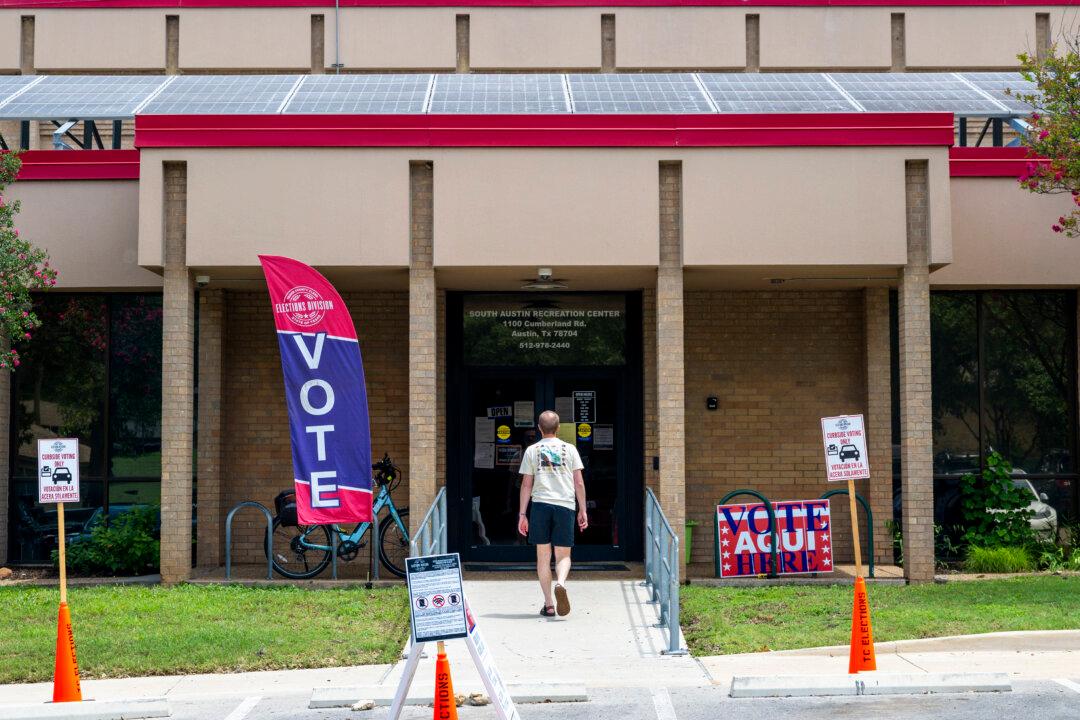
Limits on spending coordinated between party committees and candidates were created based on the theory that a lack of restrictions encourages corruption and allows wealthy donors to exert outsized influence.
The case was the NRSC’s challenge to provisions of the Federal Election Campaign Act.
The petitioners were the NRSC, the National Republican Congressional Committee, Vice President JD Vance, and former Rep. Steve Chabot (R-Ohio). The respondent was the FEC.
A divided U.S. Court of Appeals for the Sixth Circuit ruled against the petitioners in September 2024, finding that because the Supreme Court never reversed a landmark 2001 decision known as FEC v. Colorado Republican Federal Campaign Committee, the limits remained constitutional.
Although the appeals court determined that coordinated party expenditure limits were inconsistent with recent Supreme Court rulings on the First Amendment, it upheld them, finding that the issue was controlled by the still-binding 2001 precedent.
In the 2001 ruling, the high court held that party-coordinated expenditures, unlike party expenditures given independently of any candidate or campaign, may be limited by law to “minimize circumvention of [individual] contribution limits.”
Supporters of the coordination limits argued that because federal law allows larger donations to political parties, as opposed to candidates, curtailing the limits would have allowed donors to accomplish a quid pro quo with candidates by giving to their party.
In his opinion, Kavanaugh specifically overruled the high court’s decision from a quarter-century ago in FEC v. Colorado Republican Federal Campaign Committee, finding that the precedent was no longer good law because of “doctrinal and factual changes since 2001.”
He said the Supreme Court’s rulings recognize that campaign finance may be restricted only to prevent corruption or the appearance of corruption. Congress may only target quid pro quo corruption, exemplified by “dollars for political favors.”
Although the line between quid pro quo corruption and generalized influence may appear vague sometimes, “the distinction must be respected in order to safeguard basic First Amendment rights,” and that amendment requires the court “to err on the side of protecting political speech rather than suppressing it.”
Kavanaugh said the current limits “impair the party’s traditional forms of communication such as advertisements; preclude parties from amplifying the voice of their adherents; impose additional monetary costs and burdens on political parties; and inflict a ‘stifling effect on the ability of the party to do what it exists to do.’”
He referenced the Colorado case, quoting then-Justice Anthony Kennedy, who said it “would be impractical and imprudent, to say the least, for a party to support its own candidates without some form of ‘cooperation’ or ‘consultation.’”
This is because “candidates are necessary to make the party’s message known and effective, and vice versa,” Kennedy said at the time.
The Supreme Court reversed the judgment of the Sixth Circuit, sending the case back to that appeals court for further proceedings consistent with the Supreme Court’s opinion.
In her dissenting opinion, Kagan said the majority “rewrites the rules,” in the process allowing donors to go around present contribution limits,” and enables “a party to serve as an alternative checking account for a campaign.”
The ruling will allow a donor to send a party up to half a million dollars—compared with the mere $7,000 he is allowed to give a candidate directly—to pay the candidate’s expenses, and the candidate may seek such a donation, she said.
“So the Court ushers back in the same opportunities for quid pro quo corruption that the contribution limits were meant to check,” Kagan said.
The three major Republican committees—the Republican National Committee, National Republican Congressional Committee, and NRSC—wrapped up May with $256 million in cash and zero debt. Their Democratic counterparts ended May with about $126 million, along with more than $18 million in debt.
The ruling may also encourage party committees to seek out the same discounted advertising rates for television and radio that candidates receive, although legal experts have said this raises separate legal issues that have not been tested in the courts.
President Donald Trump hailed the new ruling.
“The Supreme Court just took restrictions off political spending!” he wrote on Truth Social.
“A BIG WIN FOR REPUBLICANS and, more importantly, The First Amendment!”
Reuters contributed to this report.